Indonesia warns of highly contagious measles outbreak

An Indonesian official highlighted that the main challenge in controlling measles is not the availability of vaccines, but public hesitation toward immunisation.

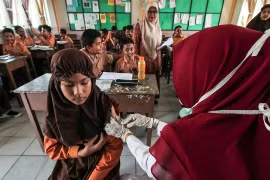
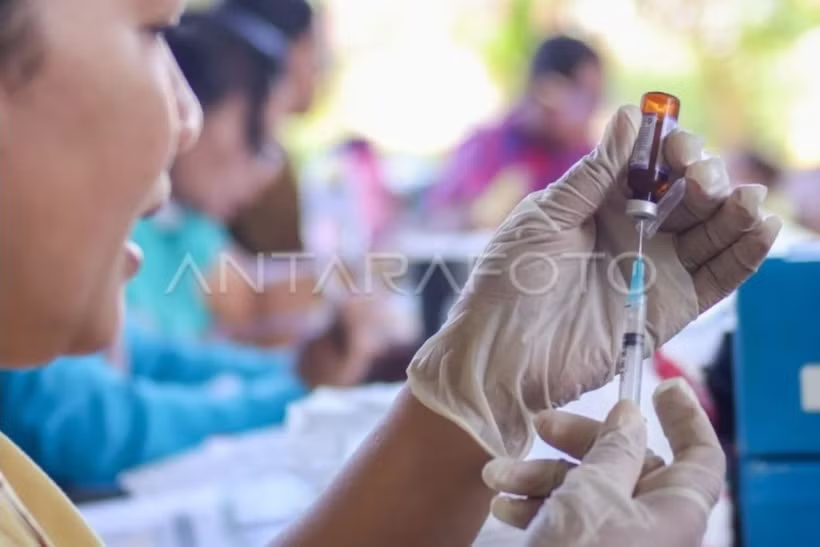
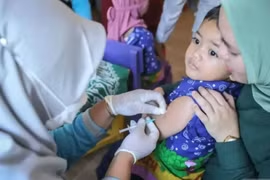
A health worker prepares a measles vaccine for a child at an integrated health post in Labuan Bajo, West Manggarai, East Nusa Tenggara, April 6, 2026. (Photo: ANTARA)

Jakarta (VNA) – Indonesia has issued a warning over the rapid spread of measles, describing it as one of the most dangerous infectious diseases globally, with transmission rates far exceeding those of COVID-19, as the country faces a major outbreak with nearly 3,000 suspected cases and 58 clusters.

Speaking at a hearing with Commission IX of the House of Representatives at the Parliament complex in Jakarta on April 20, Indonesia’s Health Minister Budi Gunadi Sadikin said one person infected with measles could transmit the virus to as many as 18 others.With COVID-19, initially one person could infect three to four people.

During Omicron, it could reach eight. With measles, one person can infect up to 18, or on average around 15 people. This makes it one of the most contagious diseases in the world, he said.

Despite its high transmissibility, Budi noted that measles is generally less deadly. Fatalities typically occur when the infection is accompanied by complications such as pneumonia, encephalitis, or other severe conditions.

He added that measles transmission tends to increase during periods of high mobility or seasonal changes, such as holidays and school breaks. In Indonesia, a surge was recorded in early 2026, with around 2,930 suspected cases and 58 outbreaks reported across 39 regencies and cities.

According to the official, the recent rise in cases is closely linked to declining immunisation coverage, partly due to disruptions during the COVID-19 pandemic, when many children missed routine vaccinations.To address the situation, the Health Ministry plans to implement Outbreak Response Immunisation (ORI) in high-risk areas.

The programme involves vaccinating all children in affected communities, regardless of their prior immunisation status.He added that the strategy has proven effective in curbing transmission. Once immunisation coverage increases, cases among children decline significantly, he said.

Budi also highlighted that the main challenge in controlling measles is not the availability of vaccines, but public hesitation toward immunisation. He noted that vaccine hesitancy remains a barrier although increased awareness following severe cases has encouraged more parents to vaccinate their children./.

VNA

See more

Malaysia considers establishing strategic petroleum reserve

Malaysia considers establishing strategic petroleum reserve

Malaysia, which was previously a net exporter, has now become a net importer due to declining domestic production and rising consumption, with demand estimated at around 800,000 barrels per day compared to production of about 400,000 barrels per day.

Indonesia to halt diesel imports from July

Indonesia to halt diesel imports from July

The move is part of the Indonesian Government’s efforts to strengthen national energy independence by utilising palm oil as an alternative fuel, said Agriculture Minister Andi Amran Sulaiman.

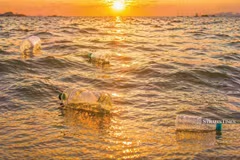
Malaysia’s growing microplastics crisis is largely self-inflicted, driven by domestic waste, weak recycling practices and everyday plastic use, said experts. (Photo: New Straits Times)

Malaysia seeks solutions to microplastic crisis

Microplastics originating from domestic waste and wastewater are increasingly entering the food chain, posing serious threats to seafood safety and the livelihoods of coastal communities.

The new mass emergency alert system SG Alert, which will be used during emergencies such as major fires, chemical or terror incidents, seen on an Apple and Android device on Apr 17, 2026. (Photo: CNA)

Singapore launches new national emergency alert system

SG Alert in Singapore uses cell broadcast technology, enabling alerts to be delivered within seconds without requiring mobile data or collecting personal information. Unlike conventional SMS, which may be delayed during network congestion or depend on internet connectivity, the system ensures fast and reliable message delivery. Alerts can be sent islandwide or targeted to specific affected areas.

Malaysia establishes ‘war room’ to ensure water security

Malaysia establishes ‘war room’ to ensure water security

The establishment of the war room reflects the Malaysian government’s commitment to shift from a reactive approach to a more proactive, data-driven one in managing national water challenges, particularly amid increasingly unpredictable weather conditions caused by global climate change

Indonesia diversifies supply sources to ensure energy security

Indonesia diversifies supply sources to ensure energy security

Indonesia is facing significant supply pressure as crude oil consumption reaches approximately 1.6 million barrels per day, much lower than the domestic production at only around 600,000 barrels per day, forcing the country to rely heavily on imports.