Singapore pioneers standardisation of generative AI testing

Singapore has proposed a new international standard to harmonise testing methods for generative artificial intelligence systems, aiming to strengthen the foundation for trustworthy AI evaluation.

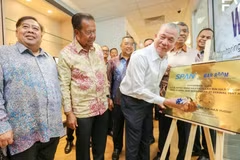
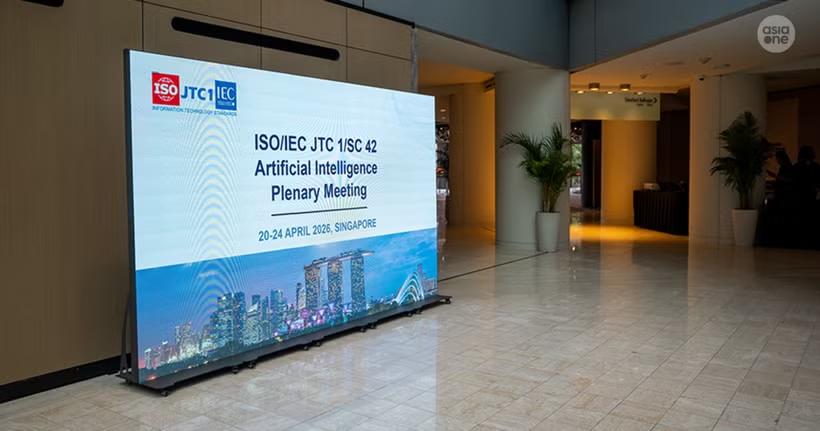
Ạt the global AI standardisation plenary meeting (Photo: AsiaOne)

Singapore (VNA) - Singapore has proposed a new international standard to harmonise testing methods for generative artificial intelligence systems, aiming to strengthen the foundation for trustworthy AI evaluation.

The proposed standard, ISO/IEC 42119-8, is the first international standard of its kind. It was announced as Singapore hosts a global AI standardisation plenary meeting this week.

The proposed standard aims to ensure trustworthy AI by standardising benchmarking and red teaming methodologies.

​The standard builds on Singapore’s earlier initiatives in AI governance and testing, including the IMDA’s AI Verify toolkit, the Starter Kit for testing large language model-based applications, and the Global AI Assurance Sandbox. It also aligns with broader national efforts such as EnterpriseSG’s ISO/IEC 42001 accreditation programme and contributions to international documentation on real-world AI use cases.

​The proposal will be discussed at the 17th ISO/IEC JTC 1/SC 42 plenary meeting held in Singapore from April 20 to 24.

​Co-organised by the IMDA (Infocomm Media Development Authority) and Enterprise Singapore (EnterpriseSG), the meeting brings together more than 35 national bodies and over 250 AI experts from markets including the US, the UK, China, Japan, Germany, France and the Republic of Korea.

​Alongside the plenary, the IMDA and EnterpriseSG are also running a series of capacity-building programmes, including workshops on AI standards capability, governance applications and AI assurance practices. These sessions bring together policymakers, standards bodies and industry stakeholders to explore how AI frameworks can be translated into real-world implementation./.
VNA

See more

Malaysia considers establishing strategic petroleum reserve

Malaysia considers establishing strategic petroleum reserve

Malaysia, which was previously a net exporter, has now become a net importer due to declining domestic production and rising consumption, with demand estimated at around 800,000 barrels per day compared to production of about 400,000 barrels per day.

Indonesia to halt diesel imports from July

Indonesia to halt diesel imports from July

The move is part of the Indonesian Government’s efforts to strengthen national energy independence by utilising palm oil as an alternative fuel, said Agriculture Minister Andi Amran Sulaiman.

Malaysia’s growing microplastics crisis is largely self-inflicted, driven by domestic waste, weak recycling practices and everyday plastic use, said experts. (Photo: New Straits Times)

Malaysia seeks solutions to microplastic crisis

Microplastics originating from domestic waste and wastewater are increasingly entering the food chain, posing serious threats to seafood safety and the livelihoods of coastal communities.

Malaysia establishes ‘war room’ to ensure water security

Malaysia establishes ‘war room’ to ensure water security

The establishment of the war room reflects the Malaysian government’s commitment to shift from a reactive approach to a more proactive, data-driven one in managing national water challenges, particularly amid increasingly unpredictable weather conditions caused by global climate change

Indonesia diversifies supply sources to ensure energy security

Indonesia diversifies supply sources to ensure energy security

Indonesia is facing significant supply pressure as crude oil consumption reaches approximately 1.6 million barrels per day, much lower than the domestic production at only around 600,000 barrels per day, forcing the country to rely heavily on imports.