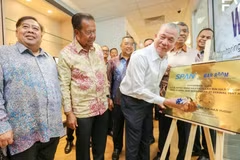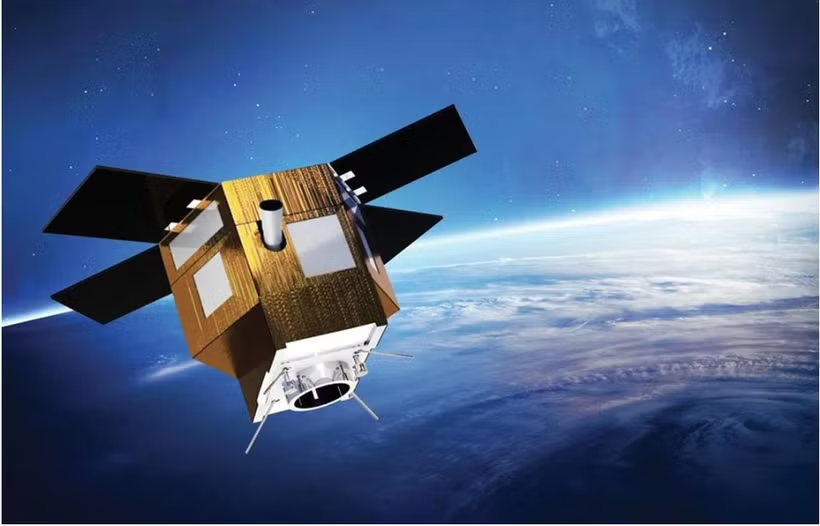
Singapore (VNA) – Singapore is accelerating its strategy to develop a space economy from the secondary school level with the opening of the Space Technology Centre at the School of Science and Technology, enabling students and alumni to conduct space observations on campus.
The move follows the official launch of the National Space Agency of Singapore (NSAS) earlier this month, aligning with the Singaporean Government’s direction of building space capabilities as an emerging technological pillar.
Speaking at the opening ceremony on April 20, Senior Minister for Education David Neo said the centre will help connect classroom knowledge with real-world applications and nurture talent, thereby strengthening Singapore's position as a research and innovation hub.
Space has become an increasingly accessible frontier for nations and businesses thanks to rapid technological advancements and declining launch costs, he said, adding that Singapore is well-positioned to capitalise on this trend due to years of investment and a strong foundation in science, technology, engineering, and mathematics (STEM).
The centre is equipped with a 17-inch PlaneWave telescope and a Takahashi refractor housed in a new observatory, enabling observations of the Sun, planets, and deep-space objects. Students can explore the universe, including lunar craters and Saturn’s rings. The telescope offers high resolution and magnification, and captures more light thanks to its large aperture. Meanwhile, in the Bell Radio Room, students can track satellites and communicate with radio users around the world. The facility functions as an amateur radio station, equipped with transceivers that allow students to send messages and receive signals from space.
Four specialised laboratories support the centre: the Alpha Lab for cybersecurity and artificial intelligence experiments; the Beta Lab, a maker space for innovation and prototyping; the Gamma Lab for applied research; and the RAE Lab for robotics and engineering.
Neo said the centre and its laboratories form a comprehensive STEM learning ecosystem./.