Indonesia views infrastructure as key to economic growth

Infrastructure development is identified as a key driver for sustainable economic growth in Indonesia as the country’s economy faces emerging challenges.

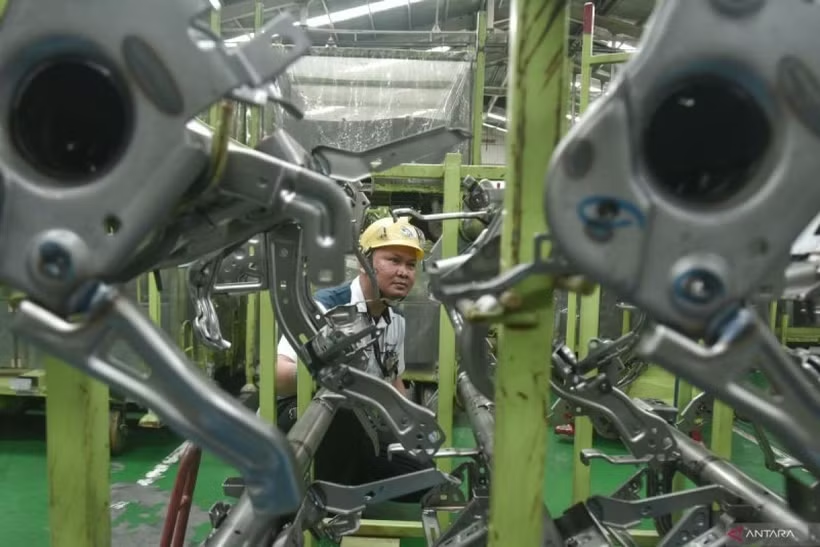
 A worker checks the quality of automotive components at a factory in Bekasi, West Java, July 3, 2025. (Photo: VNA)
A worker checks the quality of automotive components at a factory in Bekasi, West Java, July 3, 2025. (Photo: VNA)

Jakarta (VNA) – Infrastructure development is identified as a key driver for sustainable economic growth in Indonesia as the country’s economy faces emerging challenges.

​Indonesian Finance Minister Purbaya Yudhi Sadewa emphasised that amid increasing global economic uncertainties, strengthening development financing and multilateral cooperation is essential to ensuring sustainable growth. Infrastructure, he noted, not only stimulates production and business activities but also enhances the economy’s resilience to external shocks.

​The Chief Executive Officer of Sarana Multi Infrastruktur (SMI), a state-owned enterprise under Indonesia’s Ministry of Finance, said the current challenge is no longer the size of available capital but the efficiency and impact of investment. According to him, infrastructure development in the coming period requires a shift from purely financing projects to generating measurable economic, social and environmental impacts.

​In practice, infrastructure investment has played a crucial role in Indonesia’s economic expansion. Over the past two decades, SMI has committed around 275 trillion IDR (approximately 16.1 billion USD) in financing, supporting projects with a total value of 1,183 trillion IDR (about 69.3 billion USD). These projects have created jobs for more than 10 million workers and contributed roughly 0.5% to the country’s GDP.

​Experts say infrastructure is also an important tool for narrowing development gaps between regions, which remain a major bottleneck for Indonesia’s economy. Investments in transport, energy and digital infrastructure are seen as essential foundations for boosting productivity and strengthening economic connectivity across the country.

​However, to turn infrastructure into a sustainable growth engine, Indonesia needs a comprehensive set of solutions. These include innovating financing models, strengthening the role of development finance institutions such as SMI and expanding public–private partnership (PPP) schemes to mobilise greater resources from the private sector./.
VNA

See more

Malaysia targets 32% renewable energy capacity

Malaysia targets 32% renewable energy capacity

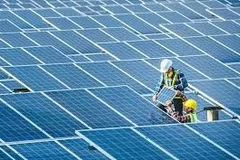
Deputy Prime Minister Datuk Seri Fadillah Yusof, who is also the Minister of Energy Transition and Water Transformation of Malaysia, said the country had achieved 31% installed RE capacity as of December 2025.

Deputy foreign ministers and senior officials of the 11 ASEAN member states and Russia pose for a group photo. (Photo: Ministry of Foreign Affairs)

ASEAN, Russia prepare for 35th anniversary summit

Deputy Minister Dang Hoang Giang reaffirmed that ASEAN views Russia as one of its key partners contributing to regional peace, stability and development. He proposed enhancing high-level strategic exchanges, strengthening cooperation in priority areas such as cybersecurity, including the effective implementation of the Hanoi Convention, and expanding collaboration within ASEAN-led mechanisms.

Thailand ready to share experience with Vietnam in green urban development: officials

Thailand ready to share experience with Vietnam in green urban development: officials

Thailand is ready to share its experience and successful models in green urban development with Vietnam, as the two countries share many similar characteristics, including rapid urbanisation, traffic congestion, flooding, canal networks and growing demand for greener public spaces, Thai officials have said in recent interviews with the Vietnam News Agency.

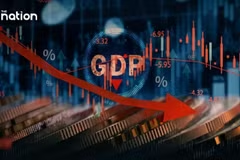
KKP cuts GDP forecast, warns Thailand faces recession risk. (Photo: The Nation)

Thailand’s economy may face recession risk

In its latest report, KKP Research noted that Thailand’s vulnerability goes beyond its reliance on imported crude oil and liquefied natural gas (LNG). Disruptions to shipping routes in the Middle East could also worsen shortages of fertilisers, affecting agricultural output, as well as petrochemical feedstocks, which would impact the plastics and textile industries.

Thai Prime Minister Anutin Charnvirakul speaks before Thai Parliament in Bangkok. (Photo: Xinhua/VNA)

Thailand plans tighter, targeted fiscal 2027 budget

Thailand's fiscal 2027 budget is projected at around 3.78 trillion THB (nearly 118 billion USD), a 2% increase from the previous year, with a focus on targeted spending and cutting unnecessary expenses, according to Prime Minister Anutin Charnvirakul.

Fitch downgrades Philippines’ outlook to ‘negative’. (Illustrative photo: Reuters)

Fitch downgrades Philippines’ outlook to ‘negative’

The Outlook revision reflects rising risks to the Philippines' strong medium-term growth prospects from recent disruptions to public investment, exacerbated in the near-term by elevated exposure to the ongoing global energy shock.

The Singapore Maritime Technology & Research Roadmap is aimed at advancing the sector’s efficiency and sustainability. (Photo: businesstimes.com.sg)

Singapore unveils new roadmap to boost innovation in maritime sector

The Singapore Maritime Technology & Research Roadmap is aimed at advancing the sector’s efficiency and sustainability. It highlights priorities – including digital technologies, decarbonisation and operational integration – to boost resilience, productivity and innovation in Singapore’s maritime ecosystem. It also addresses structural issues such as manpower, land and sea space limitations.

Malaysia considers establishing strategic petroleum reserve

Malaysia considers establishing strategic petroleum reserve

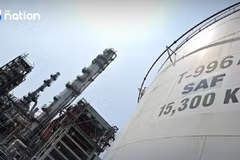
Malaysia, which was previously a net exporter, has now become a net importer due to declining domestic production and rising consumption, with demand estimated at around 800,000 barrels per day compared to production of about 400,000 barrels per day.