ASEAN, Russia prepare for 35th anniversary summit

Deputy Minister Dang Hoang Giang reaffirmed that ASEAN views Russia as one of its key partners contributing to regional peace, stability and development. He proposed enhancing high-level strategic exchanges, strengthening cooperation in priority areas such as cybersecurity, including the effective implementation of the Hanoi Convention, and expanding collaboration within ASEAN-led mechanisms.

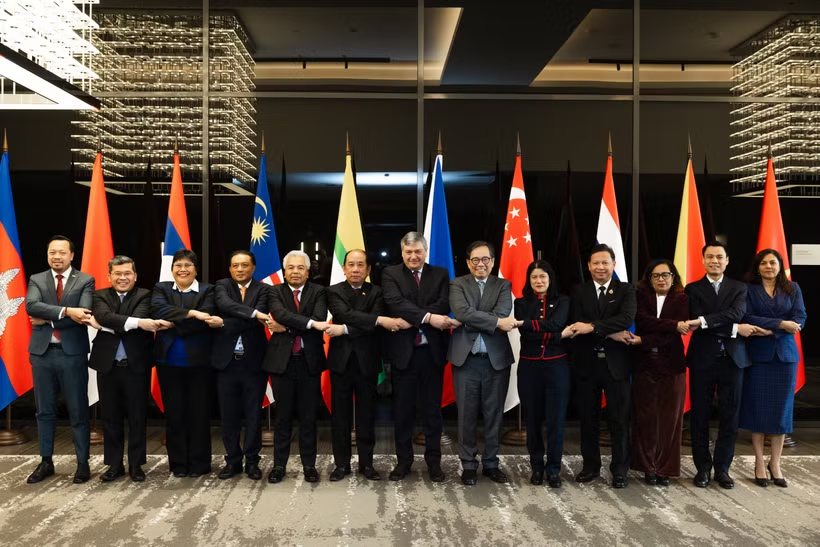
Deputy foreign ministers and senior officials of the 11 ASEAN member states and Russia pose for a group photo. (Photo: Ministry of Foreign Affairs)

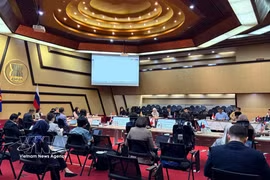
Moscow (VNA) – ASEAN and Russia are actively preparing for a commemorative summit marking the 35th anniversary of their relations, heard the 22nd ASEAN–Russia Senior Officials’ Meeting (SOM) held in Kazan, Russia, on April 20–21.

​The meeting was attended by deputy foreign ministers and senior officials from the 11 ASEAN member states and Russia. Vietnam’s delegation was headed by Deputy Foreign Minister Dang Hoang Giang, who also serves as the head of ASEAN SOM Vietnam.

​Opening the meeting, Russian Deputy Foreign Minister Andrey Rudenko, head of the ASEAN–Russia SOM, reaffirmed that Russia attaches great importance to ASEAN and the ASEAN–Russia Strategic Partnership, and supports a regional architecture with ASEAN at its centre. Noting that 2026 will mark the 35th anniversary of ASEAN–Russia relations (1991–2026), Rudenko called on both sides to build on existing achievements and advance the partnership.

​Participants reviewed cooperation and noted that ASEAN–Russia ties continue to progress across various fields. The implementation rate of the ASEAN–Russia Action Plan for 2021–2025, extended to the end of 2026, has reached 82%. Political and security ties have grown through high-level talks and Russia’s active role in ASEAN-led forums, backed by joint efforts to tackle transnational crime, boost cybersecurity, and curb drug trafficking.

​Economic cooperation has also been strengthened through trade and investment initiatives between ASEAN and Russia, as well as between ASEAN and the Eurasian Economic Union (EAEU). Russia remains an important partner of ASEAN in areas such as energy and food security. Cultural, educational, academic and people-to-people exchanges have also expanded, including youth and young diplomats’ summits.

​ASEAN countries welcomed and supported Russia’s proposal to host the Commemorative ASEAN–Russia Summit on June 17–18 in Kazan. They agreed that the event would create new momentum and set strategic directions for advancing the partnership in the coming period. Both sides pledged close coordination in preparing the agenda and documents to ensure the summit’s success.

​Amid rapidly evolving global and regional developments, the meeting agreed that ASEAN and Russia should enhance their partnership to match their potential. In addition to traditional areas of cooperation, both sides should expand collaboration into new fields such as clean energy, digital transformation, artificial intelligence and smart cities. They also consented to finalise the ASEAN–Russia Action Plan for 2026–2030 to guide future cooperation.

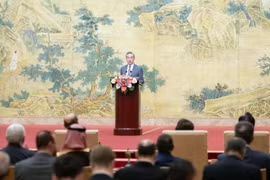
​Addressing the meeting, Deputy Minister Dang Hoang Giang reaffirmed that ASEAN views Russia as one of its key partners contributing to regional peace, stability and development. He proposed enhancing high-level strategic exchanges, strengthening cooperation in priority areas such as cybersecurity, including the effective implementation of the Hanoi Convention, and expanding collaboration within ASEAN-led mechanisms, as well as other frameworks such as ASEAN–SCO (Shanghai Cooperation Organisation) and BRICS.

​On economic cooperation, he suggested that both sides soon finalise and implement the ASEAN–Russia Strategic Programme on Economic and Investment Cooperation for 2026–2035 and facilitate transport and logistics for key export products to reduce the impact of geographical distance.

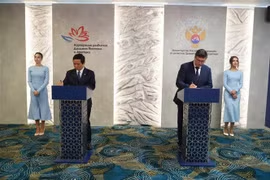
​On the sidelines of the meeting, Giang also held a bilateral meeting with Russian Deputy Foreign Minister Andrey Rudenko to discuss measures to enhance Vietnam–Russia coordination within ASEAN frameworks and preparations for upcoming high-level visits by leaders of the two countries./.
VNA

See more

Thailand ready to share experience with Vietnam in green urban development: officials

Thailand ready to share experience with Vietnam in green urban development: officials

Thailand is ready to share its experience and successful models in green urban development with Vietnam, as the two countries share many similar characteristics, including rapid urbanisation, traffic congestion, flooding, canal networks and growing demand for greener public spaces, Thai officials have said in recent interviews with the Vietnam News Agency.

KKP cuts GDP forecast, warns Thailand faces recession risk. (Photo: The Nation)

Thailand’s economy may face recession risk

In its latest report, KKP Research noted that Thailand’s vulnerability goes beyond its reliance on imported crude oil and liquefied natural gas (LNG). Disruptions to shipping routes in the Middle East could also worsen shortages of fertilisers, affecting agricultural output, as well as petrochemical feedstocks, which would impact the plastics and textile industries.

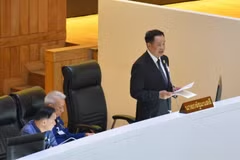
Thai Prime Minister Anutin Charnvirakul speaks before Thai Parliament in Bangkok. (Photo: Xinhua/VNA)

Thailand plans tighter, targeted fiscal 2027 budget

Thailand's fiscal 2027 budget is projected at around 3.78 trillion THB (nearly 118 billion USD), a 2% increase from the previous year, with a focus on targeted spending and cutting unnecessary expenses, according to Prime Minister Anutin Charnvirakul.

Fitch downgrades Philippines’ outlook to ‘negative’. (Illustrative photo: Reuters)

Fitch downgrades Philippines’ outlook to ‘negative’

The Outlook revision reflects rising risks to the Philippines' strong medium-term growth prospects from recent disruptions to public investment, exacerbated in the near-term by elevated exposure to the ongoing global energy shock.

The Singapore Maritime Technology & Research Roadmap is aimed at advancing the sector’s efficiency and sustainability. (Photo: businesstimes.com.sg)

Singapore unveils new roadmap to boost innovation in maritime sector

The Singapore Maritime Technology & Research Roadmap is aimed at advancing the sector’s efficiency and sustainability. It highlights priorities – including digital technologies, decarbonisation and operational integration – to boost resilience, productivity and innovation in Singapore’s maritime ecosystem. It also addresses structural issues such as manpower, land and sea space limitations.

Malaysia considers establishing strategic petroleum reserve

Malaysia considers establishing strategic petroleum reserve

Malaysia, which was previously a net exporter, has now become a net importer due to declining domestic production and rising consumption, with demand estimated at around 800,000 barrels per day compared to production of about 400,000 barrels per day.

Indonesia to halt diesel imports from July

Indonesia to halt diesel imports from July

The move is part of the Indonesian Government’s efforts to strengthen national energy independence by utilising palm oil as an alternative fuel, said Agriculture Minister Andi Amran Sulaiman.

Malaysia’s growing microplastics crisis is largely self-inflicted, driven by domestic waste, weak recycling practices and everyday plastic use, said experts. (Photo: New Straits Times)

Malaysia seeks solutions to microplastic crisis

Microplastics originating from domestic waste and wastewater are increasingly entering the food chain, posing serious threats to seafood safety and the livelihoods of coastal communities.