Nine-month tourism revenue tops annual target as Phu Quoc keeps the experience going after sunset

In the first nine months of 2026, Phu Quoc is estimated to have welcomed more than 8.57 million visitors, up 30.5% year on year. These included more than 1.92 million international visitors, an increase of 60.2%.

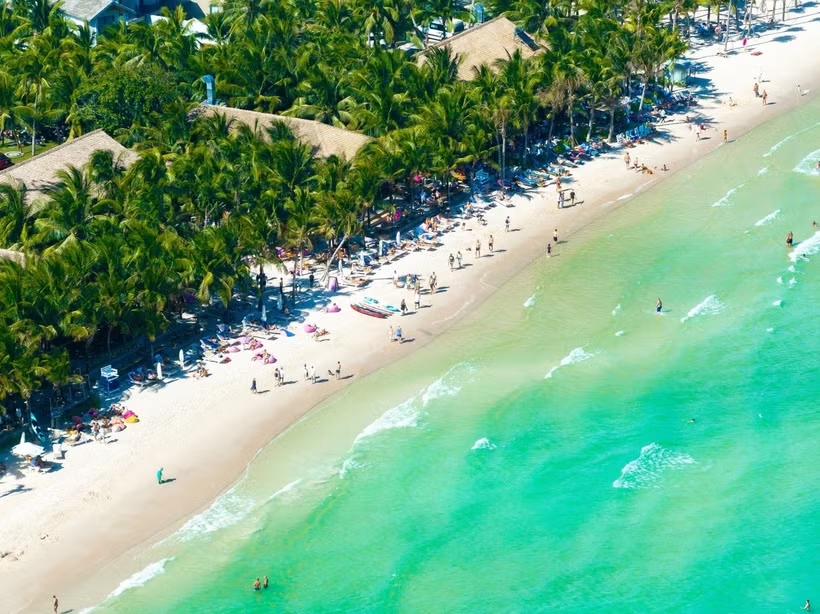
Phu Quoc’s tourism revenue has exceeded its full-year target by 1%, accounting for nearly 80% of An Giang province’s total (Photo: Sun Group)

An Giang (VNA) - With more than 8.57 million visitors and nearly 46 trillion VND in tourism revenue in nine months, Phu Quoc has surpassed its full-year revenue target. Alongside the appeal of its beaches and islands, experiences that flow from day into night are enriching visitors’ itineraries and opening up new opportunities for local tourism services.

In the first nine months of 2026, Phu Quoc is estimated to have welcomed more than 8.57 million visitors, up 30.5% year on year. These included more than 1.92 million international visitors, an increase of 60.2%. Total tourism revenue is estimated at approximately 45.976 trillion VND, up 47.7% and 1% above the full-year target. The Pearl Island continues to account for nearly 80% of An Giang province’s total tourism revenue.

The figures point to Phu Quoc’s growing appeal, particularly among international travellers. Notably, revenue is rising faster than visitor numbers, suggesting an important avenue for development: alongside attracting more visitors, the destination can generate greater value by enriching the experiences on offer during each stay.

Assoc. Prof. Dr. Pham Trung Luong, former Deputy Director of the Institute for Tourism Development Research, believes that destinations seeking to strengthen their competitiveness need to innovate, curate and connect tourism products into compelling itineraries. Beautiful beaches may draw visitors to Phu Quoc, but their holidays are also shaped by what happens beyond the shore: where to go in the afternoon, what to eat in the evening and what to look forward to after dark.
phu-quoc.jpg
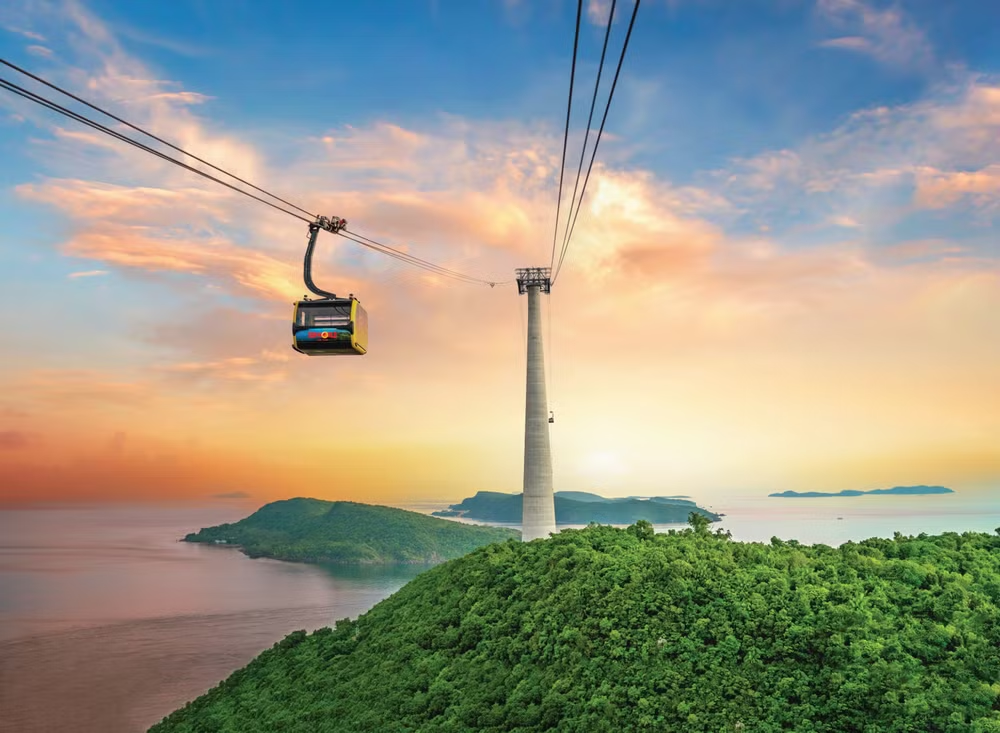
The world-record-holding cable car carries visitors to a world of entertainment on Hon Thom Island (Photo: Sun Group)

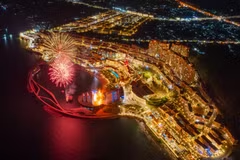
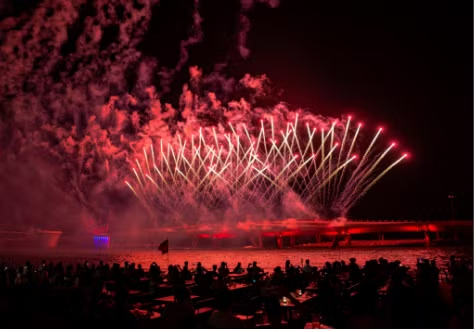
This progression is particularly evident in southern Phu Quoc. In the morning, visitors can take the cable car to Hon Thom Island to enjoy the sea and a range of leisure activities. By late afternoon, they return to watch the sunset at Kiss Bridge. After dark, performances on the water, fireworks, dining and lively streets keep the area buzzing.

The key lies not simply in the wider choice, but in how these experiences unfold at different times of day. An itinerary that might once have ended after a daytime excursion now offers more to look forward to in the afternoon and evening. Visitors enjoy a more fulfilling holiday, while restaurants, shops, transport providers and entertainment businesses gain further opportunities to serve them.
capture.png
Shows such as Symphony of the Sea bring added energy to the destination and enrich visitors’ experiences after dark (Photo: Sun Group)

According to Luong, keeping a tourism area active across different times of day also improves the use of existing infrastructure. At the same location, daytime experiences and evening activities can deliver different forms of value. This allows a destination to add depth to its offering by building on the resources it already has.

Of course, Phu Quoc’s tourism revenue growth reflects a range of factors, from visitor markets and air connectivity to accommodation and service quality across the island. Yet refreshing and connecting experiences helps explain part of the Pearl Island’s growing appeal: visitors have both more places to explore and more to do throughout their stay.

This approach is also in keeping with the spirit of the Politburo’s Resolution No. 26-NQ/TW on developing Vietnam’s tourism into a spearhead economic sector in the new era. The resolution emphasises a shift from growth driven by visitor numbers towards the quality of experiences and added value. It also sets out a direction for Phu Quoc to gradually become a new growth pole and an internationally competitive centre for high-end coastal and island resort tourism.

Nearly 46 trillion VND in tourism revenue in nine months demonstrates the scale Phu Quoc’s tourism market has reached. How the destination continues to refresh the visitor journey will help determine how much further that figure can grow./.
​

VNA

See more

Ho Chi Minh City Central Post Office remains a popular attraction for domestic and international tourists. (Photo: VNA)

Ho Chi Minh City wins three top Asian tourism awards in 2026

The 2026 honours add to the city’s impressive streak at international tourism awards. In the 2025 WTA, the southern metropolis took home four titles, including business travel and festival and event destination awards, which it had won for four years from 2022 to 2025.

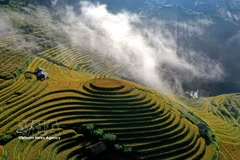
Every year, from September to October, terraced rice fields in Mu Cang Chai and Pung Luong communes, Lao Cai province, turn a golden yellow, creating a spectacular landscape across the northwestern mountains. (Photo: VNA)

Indigenous culture becomes tourism asset in northern highlands

With growing recognition of indigenous knowledge, customs and cultural values as unique assets, ethnic communities in the northern mountainous region are shifting from simply providing tourism services to becoming creators and owners of tourism products, confidently telling their own cultural stories

Tourists watch the sunset from the Kiss Bridge in Phu Quoc special zone, An Giang province. (Photo published by VNA)

An Giang's tourism sector grows, prepares for APEC 2027

Phu Quoc remains the biggest contributor to An Giang's international arrivals and tourism revenue. The special zone welcomed more than 1.92 million foreign visitors during the nine-month period, accounting for over 99% of all international arrivals in the province.

Wellness tourism is gradually becoming a high-value-added segment, extending international visitors' length of stay in Vietnam. (Photo: VNA)

Vietnam leans on wellness tourism to unlock higher-value segment by 2030

Vietnam has the abundant natural resources, including beaches, forests, mineral springs, mineral mud and a wide range of medicinal plants, backed by a long-lasting traditional medicine and the cultural identity of its ethnic communities. Together, they form the base for wellness tourism products that are both competitive and distinctly Vietnamese.

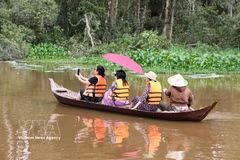
Visitors travel by boat to admire the cajuput forest landscape during the flood season at the Tram Chim tourism site in Dong Thap province. (Photo: VNA)

Dong Thap parlays flood season into tourism opportunity

At the Tram Chim tourism site, part of Tram Chim National Park in Tram Chim commune, visitors can try fishing with nets and hooks, setting traps and dismantling brush piles to catch field rats from August to November, the peak flood season.

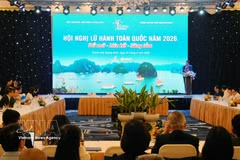
The national travel conference in Quang Ninh city on September 24, 2026. (Photo: VNA)

Vietnam’s travel sector shifts focus towards quality, value chains

The conference served as an important forum to assess changes and bottlenecks facing the tourism sector, while identifying breakthrough solutions to realise the goal of making tourism a key economic sector, as set out in Politburo Resolution No. 26-NQ/TW and Government Resolution No. 263/NQ-CP.

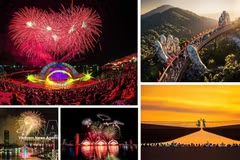
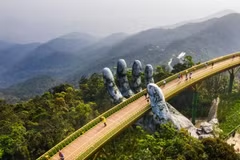
The iconic Golden Bridge at Sun World Ba Na Hills was chosen by Lonely Planet as the feature image when naming Da Nang among the top destinations for 2027.

Lonely Planet names Da Nang among the Best in Travel 2027, choosing Golden Bridge as the feature image

The city’s allure, as suggested by Lonely Planet, lies in its ability to combine diverse experiences in a single trip: relaxing by My Khe Beach, exploring nature, savouring local cuisine, and dedicating time to cultural and entertainment destinations. This versatility enables Da Nang to attract both leisure travelers seeking a relaxed getaway and those looking for an activity-packed itinerary.

Tourists visiting Hue city often choose temples, pagodas and spiritual tourism, with tranquil experiences emerging as a key tourism trend in the city (Photo: VNA)

Vietnam tourism poised for breakthrough growth

Vietnam welcomed nearly 16 million international visitors in the first eight months of 2026, up 14.4% year on year and reaching 63.6% of the full-year target. Long-haul markets also recorded strong growth, including Russia (up 165.7%), Europe (53.4%), the Americas (20.7%) and Australia (23.3%).

An overview of the talks in Lang Son province on September 19 (Photo: VNA)

Vietnam, China border tourism seeks to tap cultural potential

Lang Son and Guangxi both boast rich and diverse tourism resources spanning culture, history, ecology and leisure, an official said, expressing her hope to connect these resources into attractive cross-border tourism routes and destinations while developing caravan tours, cultural and spiritual tourism, and border shopping tourism.

A forum themed “MICE Tourism in the New Era: Sustainability – Connectivity – Opportunity” in Ho Chi Minh City on August 27, 2026. (Photo: VNA)

Vietnam prioritises MICE tourism as strategic product

For the MICE tourism sector in both Ho Chi Minh City and Vietnam, growth can no longer be driven merely by increasing the number of events; instead, the focus must shift to enhancing the value of each event and the competitiveness of each destination.

Phu Quoc is emerging as a new MICE destination with growing international ambitions. (Photos: Sun Group)

What will it take for Phu Quoc to become the world’s next MICE tourism hub?

For Phu Quoc, MICE represents more than simply another high-potential source of visitors. The segment could help the island evolve from a largely seasonal resort destination into a year-round tourism hub, while increasing spending per visitor and strengthening its ability to attract corporate groups, investors and international professionals.