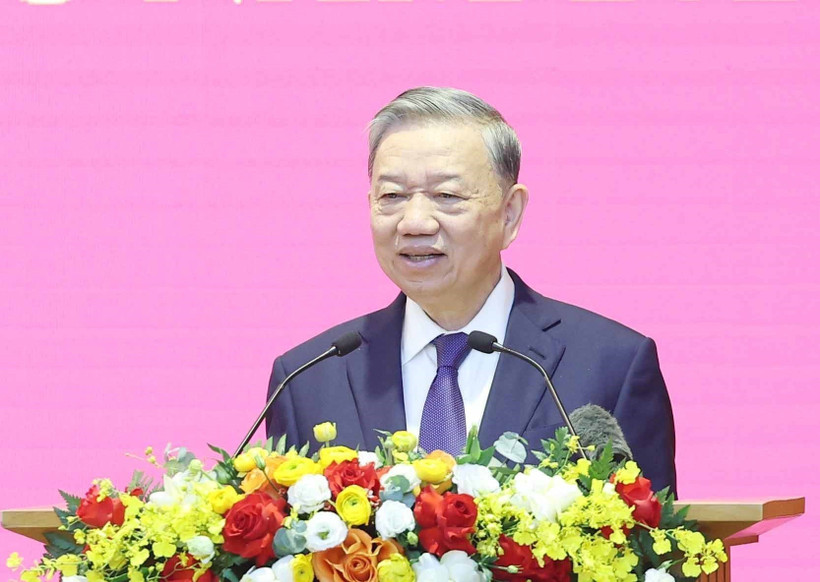
Hanoi (VNA) - The all-level Party congresses for the 2025-2030 term hold exceptional significance. They are not only major, wide-reaching political activities within the Party and the people but also serve as a vital premise for the successful organisation of the 14th National Party Congress.
The Vietnam News Agency (VNA) respectfully introduces a translation of the article, titled “Ensuring the successful organisation of all-level Party congresses for the 2025-2030 term” by Party General Secretary To Lam.
ENSURING THE SUCCESSFUL ORGANISATION OF ALL-LEVEL PARTY CONGRESSES FOR THE 2025-2030 TERM
To Lam, General Secretary of the Central Committee of the Communist Party of Vietnam
The Party congresses at all levels for the 2025-2030 term hold exceptional significance. They are not only major, wide-reaching political events within the Party and among the people, but also serve as a critical premise for the successful organisation of the 14th National Party Congress. More broadly, they represent a key step in establishing a solid political base for the country to confidently enter a new era—the era of development, wealth, and prosperity, standing shoulder to shoulder with global powers across the five continents, fulfilling the aspirations of beloved President Ho Chi Minh and the entire nation.
Vietnam's revolutionary history demonstrates that all-level Party congresses play a leading, guiding, and foundational role, exerting profound influence throughout the Party and society. This term’s congresses focus on three primary tasks: discussing and approving documents for their respective congresses, contributing feedback on draft documents for higher-level congresses, including the 14th National Party Congress; selecting personnel for Party committees at all levels; and finalising personnel in Party leadership agencies from grassroots to central levels. These tasks are critical, directly tied to the Party's leadership, ruling and combat capacity; to the development of leadership policies, guidelines, and measures; to the intrinsic strength of the Party and the political system; and to all leadership activities of all-level Party organisations in the coming tenure as well as the nation's overall strength in the future.
Our Party is the ruling party, leading the nation through its guidelines. The documents of the all-level Party congresses represent the concretisation of the Party's views and directions, transforming them into practical solutions tailored to specific sectors, localities, agencies, units, and fields. These documents provide a clear orientation for leadership, addressing existing shortcomings, maximising opportunities and advantages, removing bottlenecks and barriers, and mobilising the full participation of officials, Party members, and the public, creating great strength to achieve and surpass the set goals, contributing to the successful fulfillment of the objectives, targets, and plans set forth by the Party Central Committee or higher-level Party organisations. It is necessary to ensure the quality of feedback on the documents of their respective congresses, on the draft documents of higher levels, and on those of the 14th National Party Congress, especially proposing solutions that arise from the grassroots level and reflect the pulse of social life in each locality, even each village, commune, community, and citizen, in order to create momentum and a powerful ripple effect throughout the entire nation.
Party committee personnel are also key leaders and managers in ministries, sectors, localities, agencies, and units. They serve as a bridge between the Party, the State, and the people; and the force that leads, guides, organises the implementation of the Party's guidelines and the State's policies and laws, and decides to bring them into life. They are also responsible for assessing the situation and proposing appropriate guidelines and policies that align with the legitimate aspirations and interests of the people. Secretaries, deputy secretaries, and members of Party Committees are always key figures who determine the results of political tasks, as well as the stability, development, and strength of localities, agencies, and units both in the short and long terms.
To successfully organise Party congresses at all levels for the 2025-2030 tenure, all-level Party Committees must closely follow the Politburo's Directive No. 35-CT/TW dated June 14, 2024 on organising Party congresses at all levels towards the 14th National Party Congress, and the Politburo's Conclusion No. 118-KL/TW dated January 18, 2025 that amends and supplements the above-mentioned directive. Additionally, the Organisation Commission, the Inspection Commission, the Commission for Information and Education, the Commission for Mass Mobilisation, and the Office of the Party Central Committee have issued 21 guiding documents on organising Party congresses at all levels. These documents should be considered as textbooks for implementation.
In the context of the proactive implementation of the Politburo’s Resolution No. 18 on restructuring and streamlining the apparatus of agencies and units within the political system, Party committees at all levels must swiftly consolidate their structures, ensure smooth operations, and continue streamlining the apparatus within each agency, unit, and locality. Four newly-established Party organisations include those of central Party agencies, the Government, the National Assembly, and the Vietnam Fatherland Front; several newly-restructured commissions of the Party Central Committee; and new Party organisations and cells of certain ministries, provinces and cities, based on their functions, tasks, and organisational structure, must quickly stabilise their organisational structures and maintain their operation in accordance with the Party Charter and the new regulations set by the Party Central Committee in the operation and organisation of all-level Party congresses.
To effectively carry out Party congresses at all levels, Party committees need to focus on the following three main issues:
First, there must be a unified understanding that the achievements gained by the country after 95 years under the leadership of the Party, particularly after 40 years of renewal, are immense, highly commendable, and a source of pride. However, the country still faces many difficulties and challenges that require the entire Party, people, and military to work together with more determination to overcome. The upcoming Party congresses at all levels for the 2025-2030 term have a responsibility to play a core role in addressing these difficulties and challenges effectively. Many long-standing institutional barriers and bottlenecks remain unresolved. The risk of stagnation and backwardness, especially in terms of the economy, science and technology, and the risk of falling into the middle-income trap still exists. Recently, natural disasters, floods, and the consequences of climate change and environmental issues have caused severe damage to many localities. Corruption, wastefulness, and other negative phenomena have not been fully addressed. The situations of words not matching actions, saying one thing, doing another, working half-heartedly, without responsibility, unrealistic optimism, dishonest reporting, and incompetent officials, and the prevalence of localism and factionalism all provide ammunition for hostile and reactionary forces to exploit in their anti-government propaganda, aiming to carry out the plot of peaceful evolution and promote self-evolution and self-transformation internally to undermine public trust in the Party, the State, and our regime. These risks and challenges directly threaten the implementation of the 100-year strategic goals under the Party's leadership, which aims to transform the country into a developed nation with a high income by the mid-21st century on the occasion of the country’s 100th founding anniversary. Accurately identifying the risks and opportunities, setting clear objectives towards achieving a high level of political determination, with the right and drastic steps and actions are crucial to effectively solving difficulties, overcoming bottlenecks, unlocking resources, and fully utilising the potential and advantages of each industry, sector, and locality.
Second, on the preparation of documents and providing input on documents for higher-level Party congresses, particularly the documents for the 14th Party Congress: The political reports presented at Party congresses at all levels must closely follow the spirit of the draft documents for the 14th Party Congress. They should focus on objectively analysing and evaluating the implementation of the resolutions from the previous congress, accurately reflecting the situation and the actual development of localities, sectors, agencies, and units. They should clearly highlight notable achievements in leadership and guidance from Party organisations, while following the principle of facing the truth, evaluating the facts impartially, clearly identifying any existing shortcomings, weaknesses, and bottlenecks that have yet to be resolved and addressed. In-depth analysis of the causes of both achievements and shortcomings should be provided, particularly concerning policies, strategies, measures, and solutions at the unit or local level; along with the organisational implementation process; the decisive role of human factors and personnel work; and the level of public participation, consensus, and support. The reports should emphasise summarising successful models and best practices, drawing valuable lessons that can serve future development. Proactive efforts should be made to study, understand, and anticipate the situation, thoroughly analysing emerging issues that are directly impacting various sectors, levels, localities, agencies, and units. The reports should clearly identify the potential and advantages for development, with the principle of national vision, local action, business collaboration, and citizen responsibility, outlining the key orientations, breakthroughs, and appropriate responses to promote economic, cultural, and social development, with the ultimate goal of enhancing the material, spiritual, and overall well-being of the people.
The reports reviewing the leadership and direction of Party committees must be consistent with the political reports. There should be no mechanical reproduction of reports or superficial evaluations, nor should the process be rushed or perfunctory. The evaluation of Party committees should be based on the working regulations, action programmes, and the results of implementing resolutions of Party organisations, Party cells, as well as the guidance of higher-level Party committees and the specific conditions of localities, agencies, and units.
It must include the implementation outcomes of the resolutions and conclusions from the 4th plenary of the Party Central Committee in the 11th, 12th, and 13th tenures, linked to the study and following of the thoughts, ethics, and style of President Ho Chi Minh, the Party's regulations on what members are not allowed to do, and the regulation on setting exemplary conduct by Party members, especially those in leadership roles. The evaluation of leadership must focus on tangible results from leadership and guidance, as well as the satisfaction of the public, as the key criteria for assessment. It must honestly and objectively point out limitations and shortcomings, the extent to which previously identified weaknesses have been addressed, and the corrective measures taken. This should be done in the spirit of self-criticism and constructive criticism, without favouritism or avoidance. The reports must identify and clarify the causes, particularly internal factors, in order to draw lessons, establish plans, timelines, and effective measures to address these issues in the 2025-2030 tenure. The reports must link the collective responsibility of the Party committees with individual accountability, particularly that of the leader and those assigned to specific areas and regions, which serves as an important basis for evaluating the performance of Party committee members during the term and for proposing personnel for the new term. It is vital to recognise that the evaluation process is an opportunity to foster mutual understanding, solidarity, and unity, helping to create a more effective working environment. The evaluation should never be used for internal power struggles, to undermine, or discredit officials or Party members.
Party committees at all levels must discuss and give opnions to the draft documents of the 14th Party Congress as well as documents of their direct higher-level Party congresses in a substantive, effective and focused fashion, moving away from perfunctory feedback approaches. Based on specific conditions, they should encourage discussions on core issues, new topics, and those with multiple approaches, while selecting appropriate feedback mechanisms to gather quality input from participants. During deliberations, there is a strong emphasis on maintaining active listening and respect for differing opinions, especially when addressing novel and complex issues. They should maintain unwavering adherence to fundamental principles and remain vigilant against potential attempts to exploit the feedback process for distortion or sabotage.
Third, special attention must be paid to the preparation for the Congress’ personnel. The preparation is viewed as crucial. It is not only for a congress, further for the future development of the Party organisations, sectors, localities and agencies. More broadly, it impacts the Party’s destiny, the regime’s survival, and the nation’s development. The process has garnered significant attention from Party officials, members, and the public while also attracting attempts by hostile forces and political opportunists to spread misinformation and create internal division. Regarding committee structure, the leadership must ensure direct and comprehensive oversight of important areas and sectors, with quality taking precedence over structural considerations, and no obligation for every locality or department to have representatives at the committee. Selected committee members must serve as political leadership cores, representing Party members while winning public trust and confidence. They must be worthy of their strategic advisory roles, demonstrating unity in both will and action and maintaining steadfast loyalty. Leaders must take responsibility for proposing and nominating personnel, particularly successors, in accordance with the new regulations of the Party Central Committee. Personnel preparation requires a harmonious balance between local candidates and officials from other regions. For localities lacking qualified local personnel, the higher-level Party committees should consider transferring eligible candidates form elsewhere who meet standards and political requirements for appointment to the committee or post-congress supplementation. Efforts must be made to ensure that at least 15% of the Party committee members are women, with female representation in the standing committee. There should be a goal of having at least 10% young officials as well as representation of ethnic minorities, based on the demographic and specific needs of each locality, agency, and unit.
In addition to adhering to the Party Charter and current regulations, the personnel work of Party committees must be conducted in a systematic, scientific, and humane manner. Party committees must carefully prepare personnel for the posts of Party committee members and delegates to higher-level Party congresses. The introduction and selection of personnel must meet standards and conditions; based on planning and regulations, ensuring democracy, openness, and transparency, as well as on political qualities, ethics, lifestyle, professional competence, reputation, and specific work results and effectiveness. It is imperative not to choose those who lack public trust or to nominate those who are easy to compromise or not willing to do anything. Personnel participating in the Party committees as well as those selected to attend higher-level congresses must be the elite of the Party, who are genuinely exemplary in political quality, mattle, intellect, have strategic vision and mindset, a high sense of responsibility, innovative and creative thinking, the ability to seize opportunities, and dare to think, dare to act and dare to take responsibility for the common good, without avoiding or being passive in the face of emerging issues. They must possess practical abilities, leadership, and management skills; be bold and creative in contributing ideas to help the congress make sound decisions that meet heavier and more complex new requirements for national construction, development, and defence. The personnel work for the congress must follow a strict, scientific, and consistent process in accordance with Central Party Committee’s guidelines; avoid simplistic, arbitrary or unprincipled approaches. It must ensure that the best and most deserving individuals are selected, without overlooking those who truly possess virtue and talent and meet the necessary conditions and standards. At the same time, there must be a firm stance against opportunistic behaviours, power ambitions, group interests, and localism. Officials are the foundation of all issues, therefore in the personnel selection process, alongside accurately identifying the right candidates, efforts should be made not to overlook talents. Failing to identify and utilise the talent is a waste of human resources and potential.
The process of preparing and organising Party congresses, especially at newly established Party organisations, needs to uphold the Party’s principles of organisation and operation principles, particularly democratic centralism, solidarity and unity, and self-criticism and criticism. It is essential to thoroughly grasp the principles of consistency and innovation, inheritance, and development to prepare the congress content in a serious, meticulous, and comprehensive manner, focusing on both preparations for the congresses and leading the successful implementation of political tasks. The congresses must be organised in a practical and cost-effective way, avoiding extravagance and waste, while ensuring they are solemn and meaningful. It is necessary to renovate the way of building, issuing, and disseminating resolutions. Empowerment and delegation of authority should be strengthened, with reductions in intermediary departments and units. The proactiveness and exemplary conduct of officials and Party members should be promoted, while efforts should be made to encourage the active participation and support from the masses. It is also necessary to proactively and actively carry out ideological and information work to create unity within the entire Party organisation and consensus among the masses, while strengthening and enhancing the trust of Party members, officials, and the people in grassroots Party organisations. Good conditions and environments should be created to promote the wisdom and participation of all social classes in document drafting and personnel work, contributing positively and effectively to the success of the congresses. The resolutions of the Party congresses must be implemented as soon as possible, bringing a prosperous, free, and happy life to all citizens./.