Party chief urges completion of institutional framework for modern sports development

Party General Secretary To Lam said the Ministry of Culture, Sports and Tourism, the sports sector, ministries, agencies, the Vietnam Fatherland Front, mass organisations, local authorities, schools, businesses and society as a whole must urgently complete the institutional framework for sports development in a modern and synchronised direction to pave the way for long-term progress.

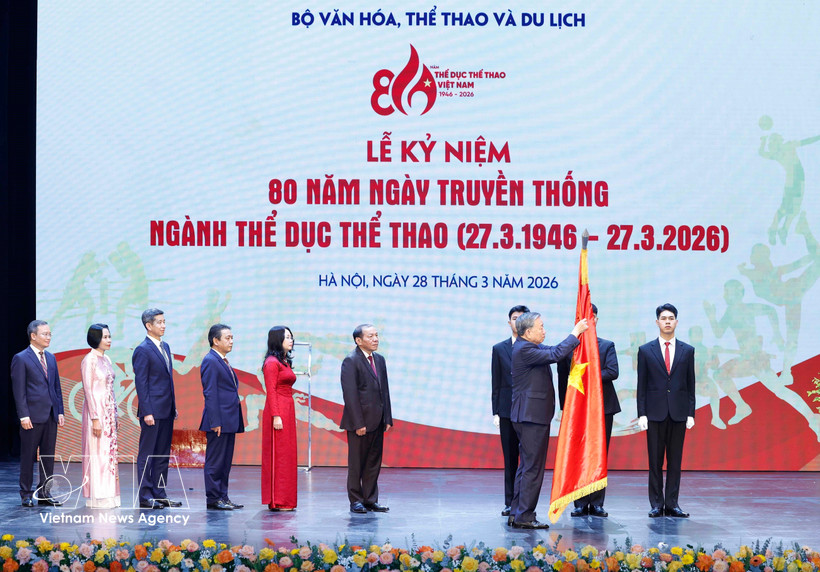
Party General Secretary To Lam presents the First-Class Labour Order to the Sports Authority of Vietnam under the Ministry of Culture, Sports and Tourism (Photo: VNA)

Hanoi (VNA) - Party General Secretary To Lam on March 28 called for the urgent completion of an institutional framework to advance Vietnam’s sports sector in a modern and synchronised direction, laying a foundation for long-term development.

He made the remarks while attending a ceremony in Hanoi marking the 80th anniversary of the traditional day of Vietnam’s sports sector (March 27, 1946 – 2026), organised by the Ministry of Culture, Sports and Tourism.

On March 27, 1946, President Ho Chi Minh issued Decree No. 38 establishing the
department of youth and physical training and called on all citizens to exercise regularly, emphasising that a strong population is the foundation of a strong nation.

The late leader recognised the importance of physical training for national development soon after the country gained independence, and laid the foundation for the country’s sports sector.

Over the past eight decades, Vietnam’s sports sector has made significant contributions to national construction and defence. In recognition of these efforts, the Party and State have awarded the sector prestigious honours, including the Ho Chi Minh Order and the Independence Order.

General Secretary Lam affirmed that under the Party’s leadership and the State’s guidance, Vietnam’s sports system has gradually taken shape from central to local levels, with growing investment in facilities, policies, training and international cooperation.

He highlighted the sector's important contributions to the country’s development, noting that these achievements reflect the dedication of generations of sports officials, the intellect of managers and scientists, the silent sacrifices of coaches, and the dedication of athletes, alongside the support of families, schools and the entire society.

He noted that the country is entering a new development stage with higher demands regarding human resources, the physical stature of the population, public health, national competitiveness and people’s quality of life. Therefore, a more comprehensive view of the role and position of sports is required.
vnanet-potal-tong-bi-thu-du-le-ky-niem-80-nam-ngay-truyen-thong-nganh-the-duc-the-thao-8668030-1.jpg
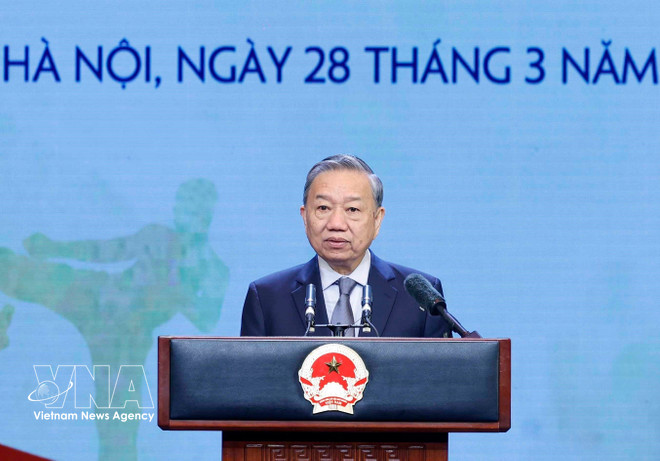
Party General Secretary To Lam addesses the event (Photo: VNA)

In the time ahead, the Ministry of Culture, Sports and Tourism, the sports sector, ministries, agencies, the Vietnam Fatherland Front, mass organisations, local authorities, schools, businesses and society as a whole must urgently complete the institutional framework for sports development in a modern and synchronised direction to pave the way for long-term progress.

A sound institutional framework, he said, should clearly define the roles of the State and society, promote socialisation, ensure transparent governance, and encourage investment, innovation and the mobilisation of resources from all sectors.

It should also establish clear standards for infrastructure, athlete and coach training, welfare and career transition for athletes, as well as promote sports science, digital technology and the development of the sports economy and industry.

The Party leader emphasised the need to strongly promote mass sports so that all citizens have opportunities and motivation to engage in regular physical exercise.

He called for sports and physical activities to become part of everyday life in families, communities, schools, workplaces and armed forces units, including remote and disadvantaged areas.

General Secretary Lam proposed promoting the campaign encouraging each citizen to choose at least one sport suitable for regular practice, which could range from simple activities such as walking, running, badminton, swimming and cycling to traditional sports and recreational games.

He stressed that the goal is not only to increase participation but also to build an active society and a culture of daily physical exercise.

The Party chief also highlighted the importance of strengthening physical education and school sports as a foundation for developing the younger generation, preserving traditional sports linked to community culture, and advancing high-performance sports in a professional, scientific and sustainable manner.

He also called for expanded international cooperation and greater proactiveness in hosting regional and international sporting events.

With its proud 80-year tradition and the support of the entire political system and society, Vietnam’s sports sector is well positioned to continue developing strongly, contributing to the comprehensive development of the Vietnamese people and national progress, he said.

On the occasion, the General Secretary presented the First-Class Labour Order to the Sports Authority of Vietnam under the Ministry of Culture, Sports and Tourism in recognition of its outstanding contributions to institutional development and professional advancement in 2024–2025.

Also at the ceremony, Deputy Prime Minister Mai Van Chinh, on behalf of the Prime Minister, awarded certificates of merit to Nguyen Danh Hoang Viet, Director of the Sports Authority of Vietnam, and Nguyen Hong Minh, its Deputy Director./.
VNA

See more

Vietnamese Deputy Minister of Finance Tran Quoc Phuong (Photo: VNA)

Vietnam takes part in ASEAN Finance Ministers' meeting

Vietnam reaffirmed its development strategy for 2021–2025 and 2026, based on three pillars - institutional reform, infrastructure development, and human resources, with infrastructure as a top priority to drive new growth.

Wei Tao, Deputy Secretary of the Party Committee and Chairman of the Guangxi Zhuang Autonomous Region, talks to Vietnam News Agency correspondent. (Photo: VNA)

Guangxi eyes boundless cooperation with Vietnam

Vietnam has remained Guangxi’s largest trading partner for 27 consecutive years. In 2025, bilateral trade exceeded 300 billion CNY (43.4 billion USD) for the first time, ranking third among China’s provincial-level localities.

Politburo member, Secretary of the Party Central Committee and Chairman of its Commission for Internal Affairs Le Minh Tri speaks at the conference. (Photo: VNA)

Party steps up anti-corruption drive in new phase

Anti-corruption efforts have achieved significant and breakthrough results, contributing to the Party and political system building, political stability, socio-economic development and stronger public trust in the Party, the State and the regime.

Chairman of the National Assembly Tran Thanh Man (Photo: VNA)

Vietnam reinforces proactive, responsible role in Inter-Parliamentary Union

Through the IPU platform, Vietnam has advanced parliamentary diplomacy to protect national interests, deepen ties with other legislatures, and elevate its global profile while contributing initiatives in areas such as sustainable development, climate change, gender equality, child protection, and digital transformation.

Politburo member, Secretary of the Party Central Committee, and Chairman of its Commission for Policies and Strategies Nguyen Thanh Nghi speaks at the national conference. (Photo: VNA)

Major socio-economic issues spotlighted at national conference

On the basis of a comprehensive assessment, the Party Central Committee has agreed on key targets aimed at achieving double-digit growth, contributing to the realisation of the country’s long-term strategic goals of becoming a developing country with modern industry, upper middle-income status and securing a position among the world’s top 30 economies by 2030.

Professor Qu Qiang of the Minzu University of China grants an interview to the Vietnam News Agency. (Photo: VNA)

Vietnam–China partnership advances towards deeper trust and connectivity: Chinese scholar

On the visit’s key agenda, Professor Qu Qiang of the Minzu University of China highlighted the need to effectively implement common perceptions and overarching directions reached by senior leaders, particularly the “six major orientations” guiding bilateral ties, including more substantive cooperation, stronger security, closer coordination, and higher political trust.

The meeting takes place in Hanoi on April 12. (Photo: VNA)

People-to-people ties between Vietnam and Slovakia strengthened

A meeting was held in Hanoi on April 12 between a delegation of the Slovak Government and representatives of Vietnamese people who have strong affection for Slovakia, on the occasion of the official visit to Vietnam by the Slovak Prime Minister and a government delegation.

Politburo member, Secretary of the Party Central Committee and Chairman of its Commission for Information, Education and Mass Mobilisation Trinh Van Quyet speaks at the national conference. (Photo: VNA)

New regulation on political, ideological work in Party highlighted at national conference

The regulation, adopted at the second plenum of the 14th Party Central Committee and issued as Regulation No. 19-QD/TW on April 8, 2026, marks the first comprehensive and systematic framework governing political and ideological work in the Party. It reflects a new step in theoretical mindset and strong political resolve to enhance Party building as well as the Party's leadership and combat capacity.

Politburo member, Secretary of the Party Central Committee, and Chairman of the Party Central Committee's Inspection Commission Tran Sy Thanh speaks at the conference. (Photo: VNA)

Party conference spotlights key reforms in inspection, disciplinary work

Resolution 05 introduces a number of breakthrough viewpoints, positioning inspection and supervision as one of the Party’s most critical leadership functions. It is defined as a mechanism for self-correction and self-improvement, a key tool to control power and uphold Party discipline and order, ensuring that the Party’s guidelines are implemented rigorously and effectively in practice.