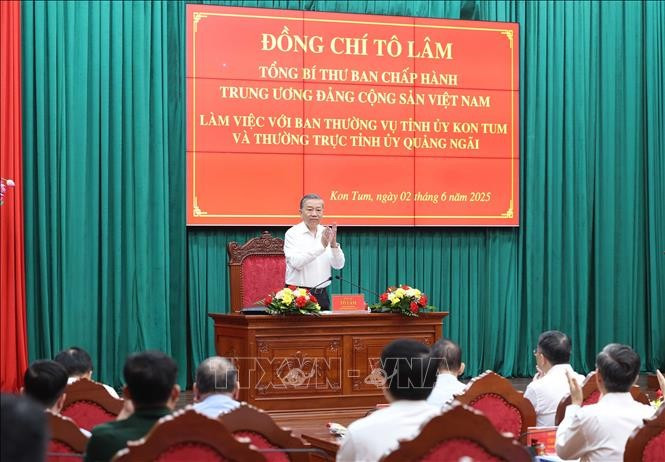
Kon Tum (VNA) – Party General Secretary To Lam has affirmed that the Party Central Committee, the National Assembly, and the Government firmly believe in and will fully support the new Quang Ngai province in making a strong breakthrough and achieving fast, sustainable, and comprehensive development.
The Party leader made the remark during a working session on June 2 with standing members of the Party Committees of the central province of Quang Ngai and the neighbouring Central Highlands province of Kon Tum.
He said that he believes after the merger of the two provinces, the new locality, to be named Quang Ngai, will become a bright spot in Vietnam’s journey to become a high-income and developed country by 2045.
General Secretary Lam emphasised that Kon Tum and Quang Ngai lie at the intersection of the Central Highlands and the south-central coastal region, a location of strategic political, economic, national defence, and security importance.
He underscored that the reorganisation of administrative units, the streamlining of political apparatus, and the formation of two-level local administation are not merely technical solutions, but institutional levers and reform catalysts to create new space and impetus for faster and more sustainable socio-economic development. This is an opportunity for comprehensive restructuring, from administrative governance to spatial planning, from resource allocation to infrastructure systems, and from a local to a regional mindset.
The objective is to enhance governance efficiency, public service quality, and local competitiveness in a rapidly changing global environment, the leader went on.
He affirmed that the planned merger of Kon Tum and Quang Ngai fits within the broader regional and national development strategies, aiming to create a larger administrative unit with breakthrough potential, poised to become a vital growth pole in the Central – Central Highlands region and generate spillovers for the surrounding areas and the nation at large. The new Quang Ngai province will boast a unique dual advantage, balancing deep geostrategic significance with ecological and economic diversity.
The new province will have the conditions to develop a multi-centre growth model, be strongly connected with regional localities, and catch up with green, digital, and circular economic trends. This will also offer an opportunity to reform the governance model and institutional frameworks, build digital government, modernise the administrative apparatus, and improve public service quality.
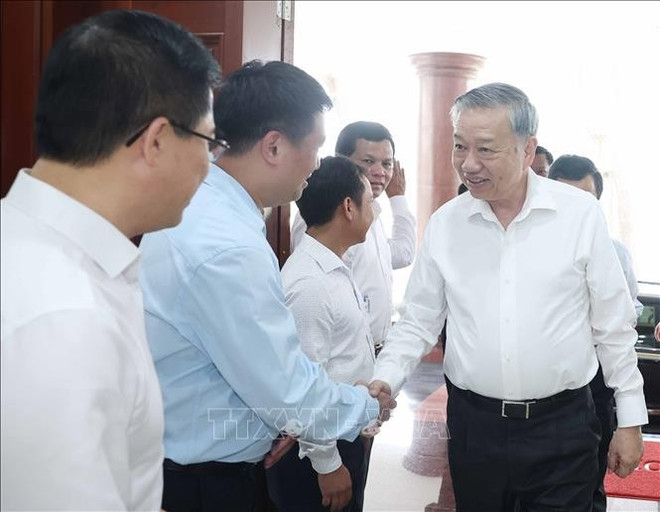
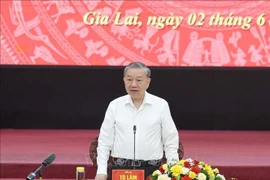
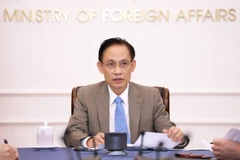
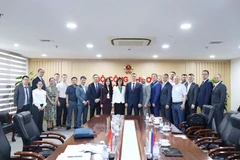
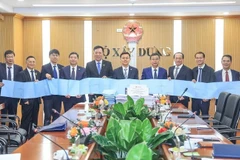
Party General Secretary To Lam and participants at the working session. (Photo: VNA)
The leader urged the Standing Boards of both provincial Party Committees to thoroughly grasp the Party Central Committee's policies, closely follow local realities, and ensure strong leadership in implementing the assigned tasks. They must comprehensively review progress against the targets set in their 2020–2025 provincial Party Congress resolutions, and proactively work on underperforming or potentially unmet targets to maximise fulfilment of the set goals.
He called for re-positioning the province within the broader development space of the East – West Economic Corridor, which connects the Central Highlands – South-Central Coast – Southern Laos – Northeastern Cambodia – Thailand. This must be closely tied to the national development strategy and the Party Central Committee's resolutions on regional development. The development vision must rest on ecological and economic diversity, targeting inclusive, green, and sustainable growth through a multi-centre model.
The Party chief also stressed the need to accelerate economic, infrastructure, and science – technology development based on innovation, regional connectivity, and sustainability. Innovation must be embedded in specific sectors such as agriculture, industry, smart city building, tourism, and services. Priority should be given to organic agriculture, forest-based economy, and medicinal plant economy, with a focus on the Ngoc Linh ginseng and endemic rare medicinal plants.
Comprehensive development of marine economy, tourism, and services should be promoted, with focal points including the Ly Son Island special zone, Mang Den eco-tourism area, and culturally and spiritually significant heritage tourism sites of ethnic minorities. Eco-smart urban centres should also be developed along the Tra Khuc and Dak Bla rivers, balancing nature conservation with modernisation and industrial diversification, he added.
He called on the new Quang Ngai to further improve the investment environment, unlock resources, resolve bottlenecks, encourage innovation and startups, support businesses, and foster a contingent of capable and visionary entrepreneurs contributing to local economic development. Social welfare must be ensured, human resource development promoted, and people’s livelihoods improved. In addition, all temporary and dilapidated housing must be eliminated by the end of 2025. Cultural heritage of ethnic minorities must be preserved and harmoniously integrated into socio-economic development. National defence and security in border areas must be upheld, with efforts to build a borderline of peace and development.
The General Secretary also emphasised the importance of building the Party and political system clean and strong; seriously implementing Directive No. 45-CT/TW on the organisation of Party congresses at all levels; pressing on with developing a comprehensively strong Party in terms of politics, ideology, and ethics; learning and following President Ho Chi Minh’s ideology, morality, and style; and ensuring strict adherence to public service ethics and the Party discipline.
According to reports presented at the meeting, each province has distinct strengths that are being increasingly harnessed for development. Kon Tum possesses vast potential in agriculture and forestry, with large specialised farming zones adopting advanced technologies and the development of a national medicinal plant value chain, notably the 4,500ha Ngoc Linh ginseng cultivation area. Quang Ngai, on the other hand, serves as a key industrial centre in central Vietnam, housing the Dung Quat Oil Refinery and deep-water seaports. Its industrial parks and Dung Quat Economic Zone are undergoing expansion
Both provinces have witnessed positive economic restructuring, marked by rising contributions from industry, construction and services, alongside reduced dependence on raw resource extraction. They are progressively shifting to a growth model based on technology and productivity. Social and cultural fields have also recorded notable progress./.