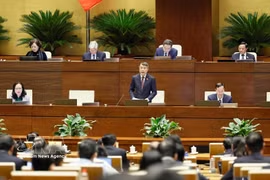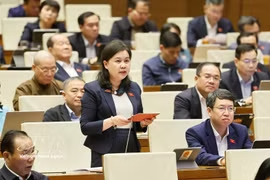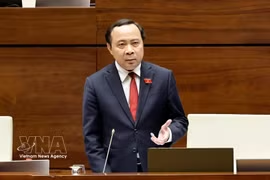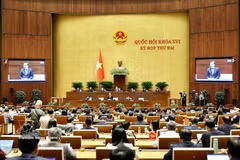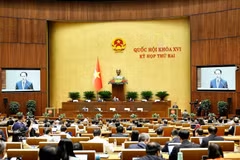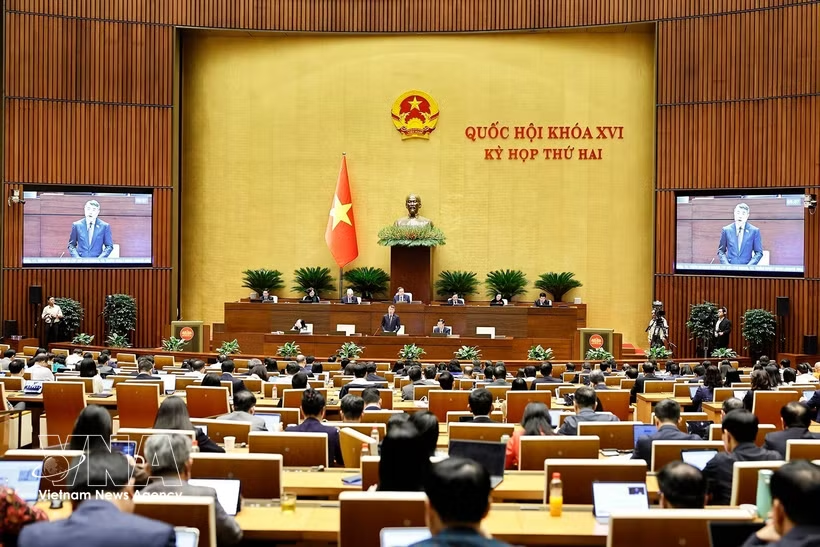
Hanoi (VNA) – Prime Minister Le Minh Hung on November 12 addressed issues raised by lawmakers concerning resource mobilisation for growth targets, macroeconomic stability, the development of medium- and long-term capital channels, the removal of obstacles to science and technology tasks, and investment orientations for the Mekong Delta.
Diversifying capital sources, tightening control over public investment
At the session, deputy Thai Quynh Mai Dung from Phu Tho province asked about specific policies to attract international investment funds and stable, long-term foreign indirect investment flows in the coming period, while deputy Nguyen Manh Hung from Can Tho city raised concerns on measures to mobilise substantial resources for public investment.
From the perspective of mobilising non-State budget capital, deputy Phan Duy Anh from Da Nang asked the Prime Minister to clarify the measures, roadmap and annual targets for developing medium- and long-term capital channels. He also asked whether the Government will report to the National Assembly annually on the results of mobilising non-State budget capital so that lawmakers could oversee progress towards the targets.
Responding to the three deputies, PM Hung said the Government has formulated a five-year socio-economic development programme in line with the Resolution of the 14th National Party Congress, together with an action programme for its implementation. On that basis, the Government draws up annual socio-economic development plans, setting growth targets and resource mobilisation goals.
Regarding measures to attract foreign direct investment, foreign indirect investment and resources from private investors, he stressed that the foremost priority is to improve institutions and establish a transparent legal framework in line with international practices and standards, thereby building confidence among individuals, businesses and foreign investors.
He said the Government will adopt specific measures for each investor group. For foreign indirect investors, particularly investment funds and providers of medium- and long-term capital, the Government has formulated plans and strategies for developing the stock market and directed the development of financial instruments to create more favourable conditions for attracting such capital flows. The establishment of two financial centres in Ho Chi Minh City and Da Nang is one of the measures, alongside efforts to encourage greater investor participation in the stock market.
The PM said FTSE Russell’s decision to upgrade Vietnam’s stock market to emerging-market status, together with some credit rating agencies assigning Vietnam investment-grade ratings, has created favourable conditions for expanding capital mobilisation. Combined with mechanisms for inspection and supervision to ensure that capital is channelled towards the right investment objectives, these factors will enable the country to attract the necessary resources.
Regarding public investment, the PM noted that in the current period, the number of projects using central budget-funded public investment capital continues to be kept under control at just over 3,000. The Government will select public investment projects with broad spillover effects and interregional connectivity, while prioritising essential infrastructure such as transport networks, seaports, key areas of science and technology, and agricultural infrastructure.
Regarding indicators for monitoring capital mobilisation, the PM said the Government reports annually to the Party Central Committee and the National Assembly on targets in the socio-economic development plan, including total social investment and the breakdown by funding source. These sources include the State budget, public investment, recurrent expenditure, capital from State-owned enterprises, private enterprises’ own funds, bank credit, foreign direct investment and additional capital raised through the stock market.
Removing bottlenecks, accelerating investment in science and technology
Questioning delays in inter-agency coordination and the implementation of science and technology tasks, deputy Nguyen Ngoc Son from Hai Phong said that although policies have been introduced and resources allocated, implementation remained slow, partly due to coordination difficulties among agencies.
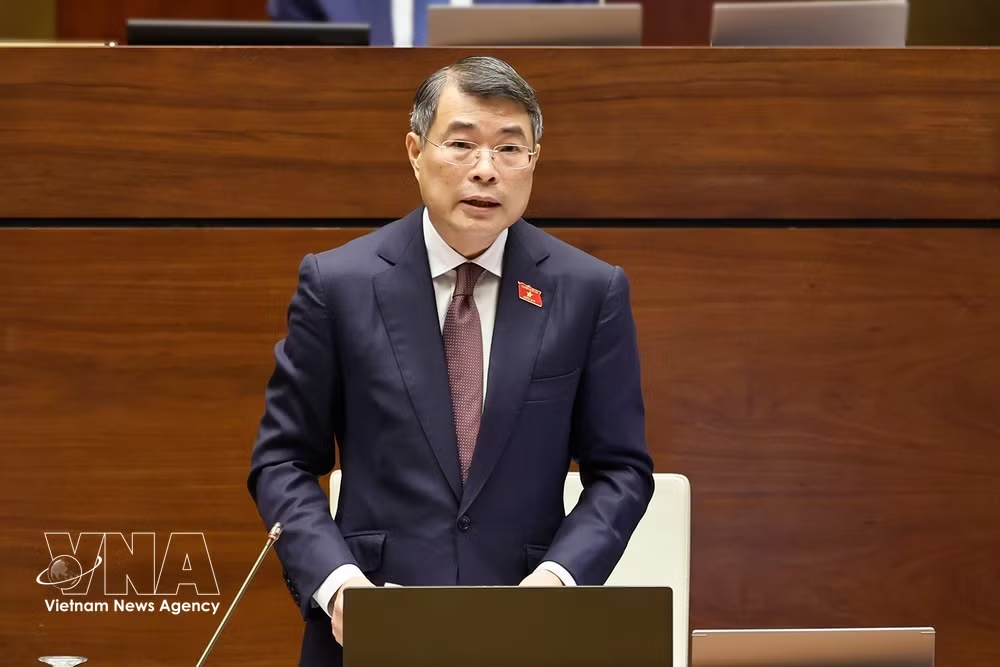
He asked the PM to clarify measures to remove bottlenecks in coordination and implementation, thereby unlocking resources and ensuring the achievement of the set growth targets.
In response, PM Hung said the implementation of Resolution No. 57-NQ/TW has only recently completed its first 18-month review. Science and technology, innovation and digital transformation are new and challenging fields, and ministries and central agencies are still encountering difficulties in implementation, while localities face even greater challenges.
The Resolution 57 Steering Committee has identified key groups of tasks for implementation, but more time is needed to carry them out. To accelerate disbursement for science and technology, innovation and digital transformation, the Steering Committee and the Government has recently directed ministries, sectors and localities to complete Version 1.0 of the National Digital Architecture Framework.
This framework provides the basic design foundation for ministries, sectors and localities to develop their own architectural frameworks and determine investment decisions accordingly. On this basis, they can proceed with investment in hardware and software and the procurement of equipment.
The Government has also issued an Overall Data Framework, requiring ministries and sectors to develop specialised data frameworks and carry out data digitisation, connectivity and interoperability.
Regarding strategic technologies and products, the PM said the Government has taken decisive action to appraise and approve investment programmes. To date, around 18 technologies and products have been prioritised for focused development, with the next step being to commission research and strengthen links between State agencies, research institutes, universities and businesses.
Ministries and sectors must proactively identify strategic technologies and products within their respective areas of responsibility and propose investment priorities.
The PM said these tasks must be implemented step by step, following specific procedures. Although most relevant legal regulations had been issued, practical implementation in new fields continued to pose numerous challenges. The Government will therefore continue to assess and identify obstacles, while improving the legal framework and accelerating implementation.
More than 320 trillion VND in public investment allocated to the Mekong Delta
Raising the issue of disparities in development conditions between regions, deputy Pham Van Hoa from Dong Thap asked whether a special mechanism should be introduced for the Mekong Delta, similar to those already applied in some provinces and cities.
Sharing the deputy’s concerns about investment in the Mekong Delta, PM Hung the Politburo has recently issued Conclusion No. 26-KL/TW on preventing and combating land subsidence, erosion, flooding, drought and saltwater intrusion in the Mekong Delta during 2026-2035, as well as an overall resolution on the development of economic regions. Based on these resolutions, the Government formulated a specific action programme.
Notably, under the 2026-2030 medium-term public investment plan, the Mekong Delta has been allocated around 320 trillion VND (12.46 billion USD), the largest amount among the country’s six economic regions. According to the Government leader, this allocation reflects the government’s strong attention to the region.
Alongside infrastructure investment, the Government will direct ministries and sectors to work with localities to attract investment in industrial fields suited to the region’s strengths, including new energy, renewable energy, seaports, trade and services.
The PM also emphasised the need to develop high-tech agriculture, strengthen links between businesses and farmers, and connect production with domestic and export markets to ensure stable outlets for agricultural products. The project to develop one million hectares of high-quality, low-emission rice is among the priority areas.
In addition, investment in healthcare and education must be increased to improve human resources quality and meet the region’s development requirements, he said./.