Hanoi (VNA) - “The more I saw of Phu Quoc, the more I realised that a few days was never going to be enough,” writes journalist Kerry Low in ANZA magazine. From secluded beaches and Bill Bensley’s “wonderfully eccentric” architecture to a world of entertainment that runs from day into late night, the Pearl Island leaves her with one lingering feeling as she departs: there is still far too much left to experience.
One of the few islands still big enough to "Feel like you have the place to yourself"
Some destinations leave travellers satisfied when it is time to go. Others leave them with a sense of regret because the journey seems to have ended far too soon. For Kerry Low, a journalist with ANZA – a magazine serving Singapore’s international expatriate community – Phu Quoc belongs firmly in the latter category.
In her article, “Where Discovery Begins,” published in ANZA’s September/October 2026 issue, Low admits that her short trip was enough only to make her realise just how much she had underestimated the scale of experiences the island has to offer.
“On my quick trip, the more I saw of Phu Quoc, the more I realised that a few days was never going to be enough. There were beaches I never reached, experiences I didn’t have time to try, and corners of the island I left wishing I’d had more time to explore. I left with a growing list of things for next time – which, fortunately, gives me the perfect excuse to come back,” she writes.
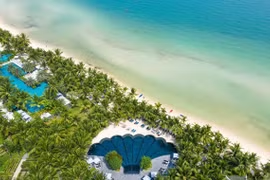
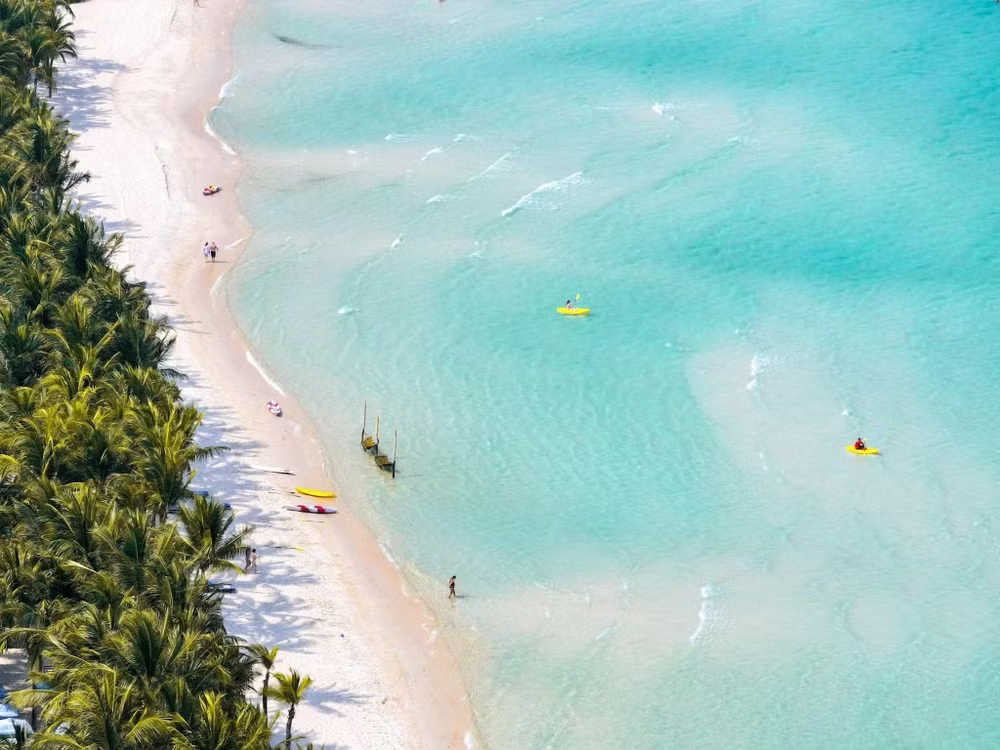
What first impressed the journalist was not a luxury resort or a spectacular entertainment complex, but a sense of space that is becoming increasingly difficult to find at Southeast Asia’s best-known coastal destinations. According to ANZA, visitors can still find a quiet stretch of sand in Phu Quoc, away from the crowds, and “feel like you have the place to yourself”.
Beyond the soft white sands of Sao Beach and Kem Beach lie stretches of tropical rainforest reaching down towards secluded shores, interspersed with trails where waterfalls emerge from the jungle and wildlife thrives largely untouched. With a national park covering much of the island, Phu Quoc offers enough space for visitors to temporarily escape from the city.

Yet in ANZA’s eyes, Phu Quoc is far more than an island for lazy days by the beach. Just beyond its pristine natural landscapes lies a vast playground for those who enjoy sport and adventure. Visitors can kayak through sheltered bays, dive among coral reefs, play pickleball at Sun Tropical Village or take on the Eschuri Vung Bau golf course.
It is this constant shift between tranquillity and energy that makes it difficult to fit Phu Quoc into the mould of an ordinary beach holiday.
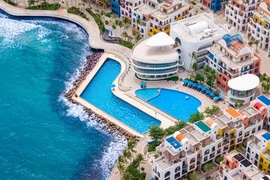
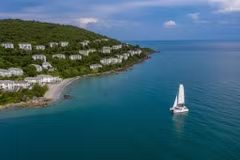
If the island’s natural beauty makes Kerry Low want to venture further, its resorts make her want to stay longer. For multigenerational families, ANZA recommends New World Phu Quoc Resort, with its spacious villas, private pools and on-site waterpark. At Premier Village Phu Quoc Resort on Ong Doi Cape, meanwhile, guests enjoy a rare geographical privilege: the chance to watch both sunrise and sunset from opposite sides of the sea on the same day. Low describes the experience as her “dream getaway!”.
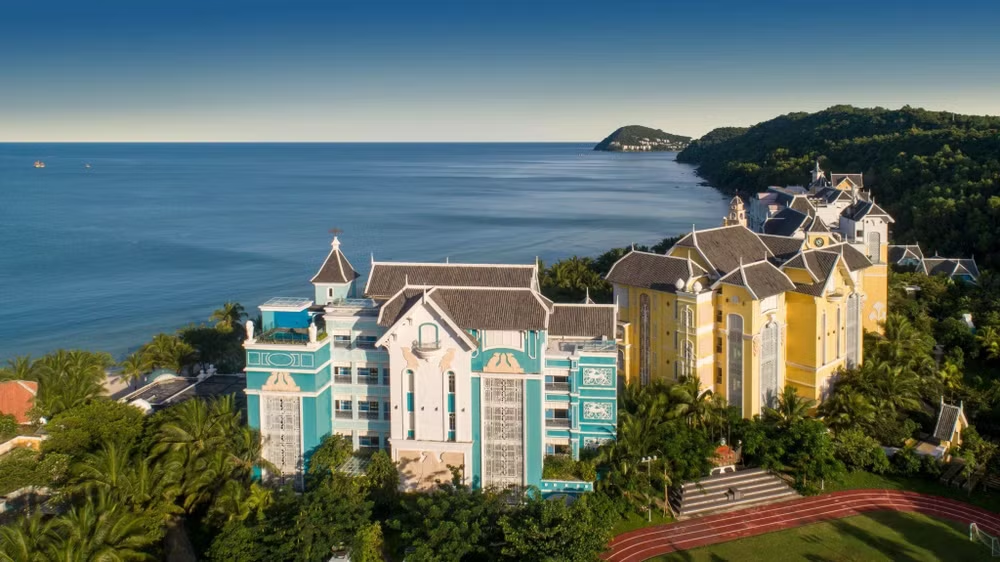
But the place that astonishes the author most is JW Marriott Phu Quoc Emerald Bay Resort, a resort created by architect Bill Bensley around the fictional story of Lamarck University.
Rather than simply designing a beautiful hotel, the “wonderfully eccentric” architect has conjured an entire world, complete with eccentric academic departments, vintage trunks, laboratories, hidden wine cellars and countless quirky details, all deliberately arranged to bring the story to life.
Each space feels like a scene from a film, with guests cast as characters following clues to a long-lost university. ANZA describes the resort’s architectural storytelling simply: “It's quirky. It's theatrical. And it's brilliant”.
It is no longer simply a place to stay, but an experience that encourages guests to slow down, examine every door, corridor and decorative object – and ultimately realise that even one night seems far too short.
When sunset is not the end of a day’s fun
ANZA also recommends setting aside an entire day for Hon Thom Island, beginning with a ride on the world’s longest three-wire cable car across the sea to the island.
From the cabin, tiny islands, fishing villages and expanses of blue water unfold below, creating the sensation of leaving the main island behind and entering an entirely different world.

That transformation becomes even more apparent upon arrival at Hon Thom Island. The morning can be spent racing down the high-speed slides at Aquatopia Water Park, while the afternoon slows to a more leisurely pace by the beach at Santo Beach Club.
On one side are cheers, thrills and high-energy attractions; on the other, music, the sea and hours in which doing almost nothing is perfectly acceptable. The two contrasting moods coexist on the same island, allowing every member of the family to shape their holiday in their own way.
On many islands, sunset signals that a day of activities is drawing to a close. In southern Phu Quoc, however, it is when the experience moves into its next chapter.
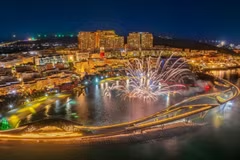
ANZA likens Sunset Town to a vast immersive theatre, where visitors can wander along seaside streets, stumble upon unexpected street performances and end the afternoon at Kiss Bridge – a structure stretching out over the sea with a deliberately narrow gap between its two arms.

As the sun sinks precisely into that gap, the entire structure becomes a stage set against the natural landscape. But the fading light is not the final act.
Shows, music and fireworks continue to carry the rhythm of southern Phu Quoc well into the night.
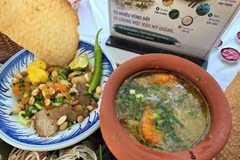
An evening here, according to the Singapore magazine, does not have to be elaborate. It could be as simple as a quiet table by the sea, a bowl of Bun Quay Kien Xay and a chilled, locally brewed Sun KraftBeer.
It is precisely this interplay between local flavours and an international atmosphere and experience that gives Phu Quoc a character that feels both fresh and distinctly its own.
The island’s appeal becomes even more pronounced for the Singapore market as the distance is shortened by direct flights operated by Sun PhuQuoc Airways. With a flight time of around 1 hour and 45 minutes, Phu Quoc becomes an attractive option even for a long weekend getaway, rather than a destination requiring days of travel planning.
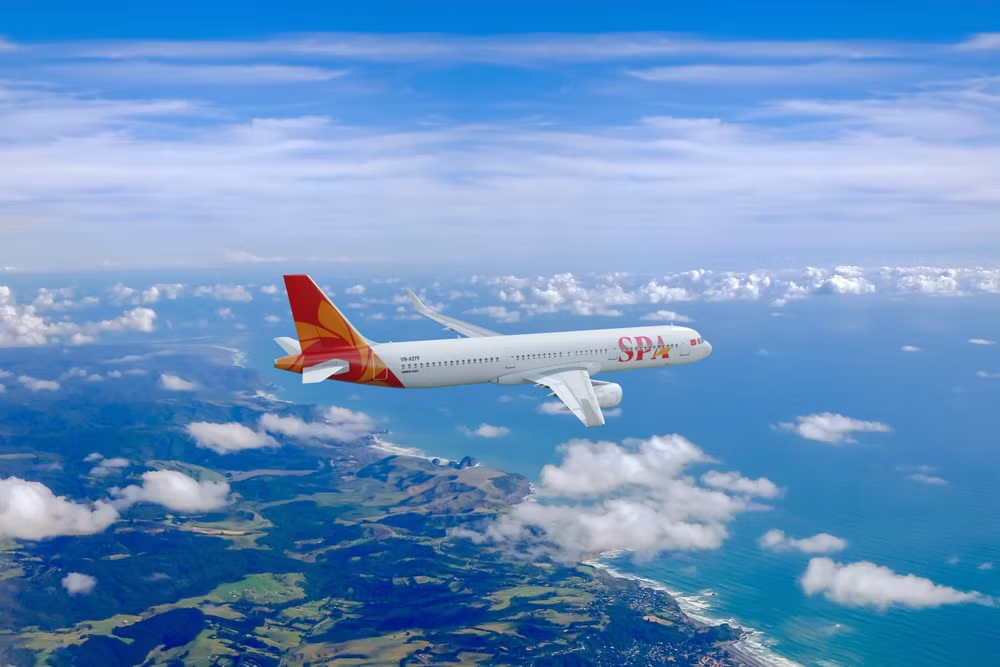
For Singapore travellers, the morning may begin amid the urban rhythm of the Lion City, yet just a few hours later they can be standing by the sea in Phu Quoc, watching the sunset at Kiss Bridge or stepping into Bill Bensley’s fantastical world.
The arrival of the airline bearing the island’s name further completes a seamless travel experience spanning flights, accommodation, entertainment, recreation and dining.
ANZA’s article therefore does more than offer readers a list of places to visit. Through Kerry Low’s experience, Phu Quoc emerges as an island that constantly makes an initial itinerary feel too short: wild and unspoilt enough to offer moments of solitude, yet rich in experiences that make it difficult to imagine visiting only once.
And perhaps the most convincing praise a destination can receive is not measured by how many places a traveller manages to see, but by whether, when they leave, they are still longing to come back./.