Vietnam moves to make tourism a true new growth driver

Resolution No. 26-NQ/TW, issued on August 22, sets out a new vision, with a focus on fundamentally renewing the mindset, methods and approaches to tourism development and governance, shifting from quantity to quality and increasing the sector’s contribution to the national economy.

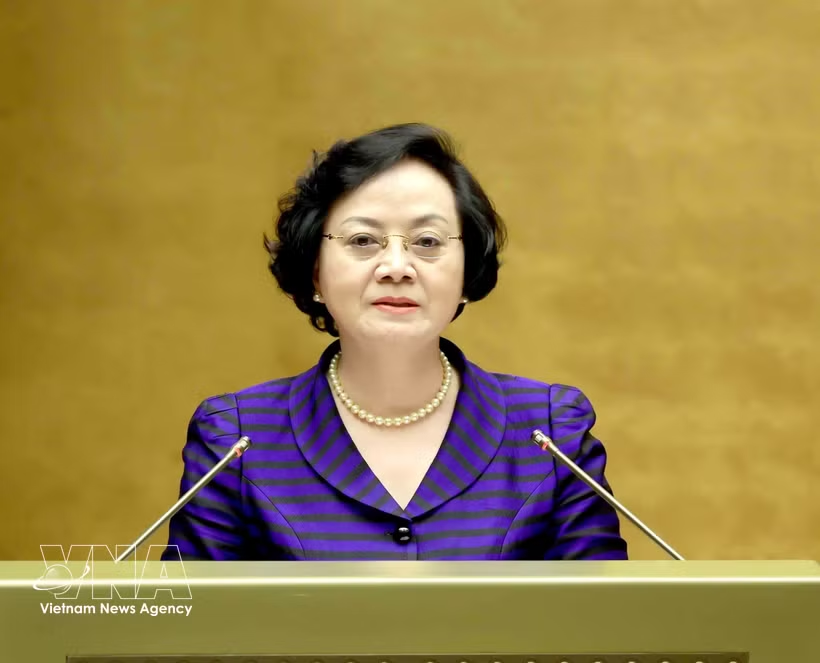
Secretary of the Party Central Committee and Deputy Prime Minister Pham Thi Thanh Tra speaks at the conference. (Photo: VNA)

Hanoi (VNA) – Vietnam is moving to turn tourism into a spearhead economic sector and a new growth driver for double-digit economic growth, with a shift from volume-based expansion to a quality- and value-driven model, Secretary of the Party Central Committee and Deputy Prime Minister Pham Thi Thanh Tra has said.

Speaking at a nationwide conference held on September 3 to study, disseminate and implement several resolutions and directives of the Political Bureau, Tra presented the key contents of Resolution No. 26-NQ/TW on developing Vietnam’s tourism into a spearhead economic sector in the new era.

Nearly a decade of implementing Resolution No. 08-NQ/TW, Vietnam’s tourism sector has made significant progress, with improved policies and mechanisms, expanding markets, stronger infrastructure and human resources, and advances in promotion, marketing and digital transformation. It has increasingly affirmed its role and capacity to generate high added value in socio-economic development, create jobs, support economic restructuring, preserve and promote cultural values and showcase the image of Vietnam and its people to the world.

In 2025, Vietnam welcomed nearly 21.2 million international visitors, up 20.4% year-on-year, and served 137 million domestic tourists. International arrivals reached 15.9 million in the first eight months of 2026, putting the sector on track to meet its annual target of 25 million foreign visitors.

However, tourism remains below its potential and is not yet fully sustainable, with challenges including inadequate investment, weak inter-sectoral and inter-regional coordination, limited product diversity, low value addition and implementation bottlenecks.

Against this backdrop, Resolution No. 26-NQ/TW, issued on August 22, sets out a new vision, with a focus on fundamentally renewing the mindset, methods and approaches to tourism development and governance, shifting from quantity to quality and increasing the sector’s contribution to the national economy, Tra said.

The resolution positions tourism as a key component of the new growth model and a new growth driver contributing to the realisation of the double-digit economic growth target. Culture is identified as the foundation while cultural identity and experience quality are seen as competitive advantages, supported by science – technology, innovation and digital transformation.

It also calls for an integrated tourism ecosystem that promotes economic, cultural, social and environmental sustainability while enhancing national defence, security, social order and safety, cultural diplomacy and international integration. Besides, it points out the need to develop smart, green and creative tourism, strengthen the competitiveness of tourism products and services, improve the quality of human resources, and properly handle employment and social security issues.

It is also necessary to modernise data-driven governance and reinforce links among sectors and regions, she went on, adding that developing tourism is viewed as a task of the entire political system under the Party's leadership, with businesses identified as the pioneering force, people as participants and beneficiaries, and domestic and international resources utilised for tourism development.

Tra noted that the resolution aims to build a high-quality, smart, green and innovative tourism sector with strong cultural identity, high added value and greater regional and international competitiveness. Tourism development will be linked with cultural industries to help promote Vietnam’s image and enhance its national soft power.

By 2030, tourism is expected to contribute 10–12% directly to GDP, attract 45–50 million international visitors, serve 160 million domestic tourists, and gain 80–90 billion USD in tourism revenue. Hanoi, Ho Chi Minh City and Da Nang will become three tourism growth poles, alongside 10 key tourism centres and 20 national tourism areas. The sector is set to create about 2.3 million direct and 3.5 million indirect jobs.

By 2045, tourism is targeted to contribute 14–15% directly to GDP, attract 70 million international visitors and place Vietnam among the world’s 30 most competitive tourism destinations.

To achieve these goals, the official said, the Political Bureau has outlined focal solutions covering institutional perfection; infrastructure; markets and products; promotion; human resources; businesses and tourism communities; science – technology, innovation, and digital transformation; and tourism governance reform.

Tra stressed that the effective implementation of Resolution No. 26-NQ/TW will be decisive in turning tourism into a spearhead economic sector in the new era. The Government has completed an action plan for implementing the resolution that comprises 30 tasks assigned to seven ministries and agencies, along with provincial-level administrations.

Vietnam has sufficient natural resources and cultural heritage to build a tourism sector of regional and global stature. What remains is our determination and action, she stressed./.

VNA
See more

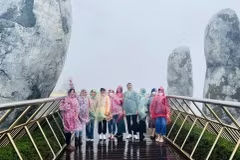
Tourists visit Golden Bridge in Da Nang city in the rainy season. (Photo: hanoimoi.vn)

Turning rainy season into tourism opportunity

Seasonality has long been a challenge for Vietnam’s tourism industry. In many localities, tourism peaks in summer but visitor numbers fall during the rainy months. Destinations are now seeking to restructure their tourism ecosystems and develop products that can operate year-round.

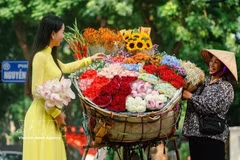
Flower vendors form a distinctive feature of Hanoi’s autumn. (Photo: VNA)

Hanoi builds four-season tourism appeal

Hanoi’s tourism events are increasingly designed to inspire exploration beyond individual festivals. At the Hanoi Tourism Gift Festival, for instance, visitors can make handicrafts with artisans, explore destinations through virtual reality and discover new tours and tourism stimulus programmes.

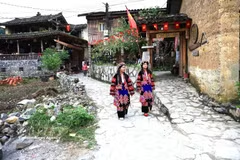
A view of the Lo Lo Chai community tourism village in Tuyen Quang province (Photo: VNA)

Vietnam taps community tourism potential for sustainable development

The tourism market is shifting from sightseeing towards living and connecting with destinations. Visitors increasingly seek authentic and locally rooted experiences, interaction with local people, culture and nature, as well as small-group and personalised trips with limited environmental impact and clear benefits for communities.

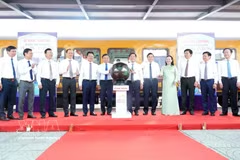
Delegates press the button to launch the “Phong Nha – Hue Ancient Capital: World Heritage Journey” tourist train. (Photo: VNA)

Tourist train linking Phong Nha and Hue heritage sites launched

The 190-km route runs between Hue, Dong Ha, My Trach, Dong Hoi and Tho Loc stations, giving travellers access to destinations including the Complex of Hue Monuments, Quang Tri Ancient Citadel, Vinh Moc Tunnels, Hien Luong–Ben Hai historical site and Phong Nha-Ke Bang National Park.

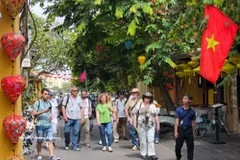
International tourists visit Hoi An Ancient Town in Da Nang city. (Photo: VNA)

Tourism ready for National Day holiday, eyes year-end acceleration

A range of cultural and artistic activities will be held during the holiday. In Da Nang, the “Hoi An Memories” show will present its “Flag Hat” version from August 26 to September 2. Phu Quoc will host the “The Memory of Flowers” exhibition, while Thanh Hoa will organise the Sam Son Kite Festival 2026 from August 30 to September 1.

Businesses introduce their tourism products at the 20th International Travel Expo Ho Chi Minh City. (Photo: VNA)

Vietnam ready to create new momentum for regional, global MICE tourism

Vietnam has consistently identified tourism as a spearhead economic sector, Deputy PM Pham Thi Thanh Tra stressed, adding that in the new development era, with the need for rapid and sustainable growth and a stronger national position, MICE should be positioned as a strategic tourism product, targeting high-quality visitors while generating additional momentum for trade and investment and enhancing national competitiveness.

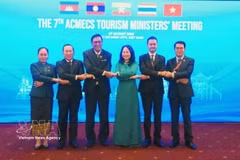
Officials at the 7th ACMECS Tourism Ministers’ Meeting in Ho Chi Minh City on August 27 (Photo: VNA)

ACMECS strengthens tourism ties, promotes “Five Countries, One Destination”

The newly adopted joint action plan on ACMECS tourism cooperation for 2026–2028 focuses on five key pillars: improving connectivity and facilitating travel; promoting digital transformation and smart tourism; developing ecotourism, community-based and cultural tourism; enhancing tourism security and safety; and developing human resources.

A stall at the 20th International Travel Expo Ho Chi Minh City (Photo: VNA)

International Travel Expo 2026 opens in Ho Chi Minh City

ITE HCMC 2026 features one of its largest and most diverse tourism networks to date, with tourism promotion agencies and businesses from the Republic of Korea, Japan, Malaysia, Thailand, Laos, Cambodia, Bhutan, Russia’s St. Petersburg and Nicaragua.

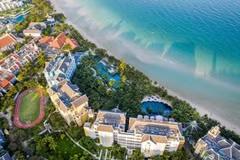
The Shell Pool by the shores of Kem Beach is one of the signature features of JW Marriott Phu Quoc Emerald Bay Resort. (Photo: Sun Group)

Sun Group’s Phu Quoc resort named among the world’s most whimsical stays

Among the hotels featured, JW Marriott Phu Quoc Emerald Bay Resort, developed by Sun Group on Kem Beach in southern Phu Quoc, stands out as the only representative from Vietnam. Travel + Leisure also selected an image of the resort’s iconic Shell Pool, set among coconut palms and white sands, as the lead image for the article.

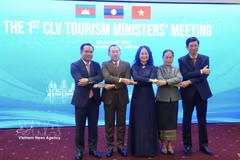
Delegates at the meeting (Photo: VNA)

Vietnam, Laos, Cambodia boost tourism collaboration

The conference adopted a joint action plan for 2026-2028 aimed at realising the “One Journey, Three Destinations” initiative, sharpening competitiveness and developing cross-border tourism products.

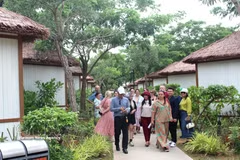
The famtrip delegation surveys and experiences accommodation and dining services in Tien Thanh ward, Lam Dong province. (Photo:VNA)

Lam Dong steps up global tourism push

Lam Dong welcomed around 900,000 international visitors in the first seven months of 2026, up 15% year-on-year, while international tourist-days increased 18% to nearly 2.9 million.