CLMV countries target double-digit growth in international arrivals

The implementation of joint action programmes has delivered positive results. In 2025, the four CLMV countries welcomed 32.3 million international visitors, up 9.6% from 2024, generating approximately 45.8 billion USD in tourism revenue.

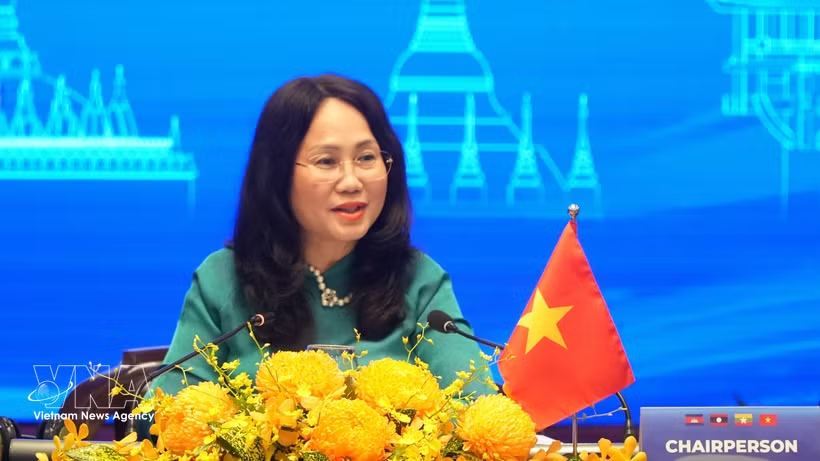
Vietnamese Minister of Culture, Sports and Tourism Lam Thi Phuong Thanh delivers the opening remarks at the 8th CLMV Tourism Ministers’ Meeting in Ho Chi Minh City on August 27. (Photo: VNA)

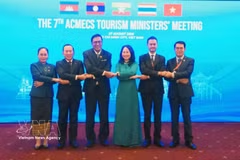
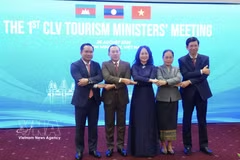
Ho Chi Minh City (VNA) – The 8th CLMV (Cambodia, Laos, Myanmar and Vietnam) Tourism Ministers’ Meeting was held in Ho Chi Minh City on August 27.

The meeting was chaired by Vietnamese Minister of Culture, Sports and Tourism Lam Thi Phuong Thanh and attended by Cambodian Minister of Tourism Thong Khon, Myanmar Union Minister for Hotels and Tourism Maung Myint, and Lao Deputy Minister of Culture and Tourism Darany Phommavongsa.

In her opening remarks, Thanh highlighted the steady consolidation and deepening of CLMV tourism cooperation since the four countries adopted their first joint declaration in 2010 on the occasion of the International Travel Expo Ho Chi Minh City (ITE-HCMC).

The mechanism has become one of the Mekong subregion’s longest-standing and most effective frameworks for tourism cooperation, she said.

The minister said this meeting confirmed the mechanism’s long-term value, showing the commitment to continue dialogue, boost connections, and turn promises into real action, thereby giving new energy to tourism growth in each country.

Delegates reviewed progress in cooperation since the 11th CLMV Summit, held under the theme “Friendship and Solidarity for a Resilient and Prosperous Community,” and the 7th CLMV Tourism Ministers’ Meeting held in Yangon, Myanmar, in November 2024.

The implementation of joint action programmes has delivered positive results. In 2025, the four CLMV countries welcomed 32.3 million international visitors, up 9.6% from 2024, generating approximately 45.8 billion USD in tourism revenue.

Intra-CLMV travellers reached 3.3 million, accounting for about 9.6% of total international arrivals. In the first six months of 2026, the four countries welcomed around 17.1 million international visitors, including 1.7 million intra-regional travellers.

The four countries have stepped up joint promotion and marketing activities and tourism workforce training through cooperation with ASEAN and the Greater Mekong Subregion.

However, progress towards building the “Four Countries, One Destination” brand has yet to match the region’s potential. Gaps remain in linking tourism products, developing tourism corridors, facilitating travel and conducting joint promotion.

The tourism industry is also facing a rapidly changing global environment shaped by geopolitical tensions, climate change, extreme weather and rising travel and accommodation costs.

At the same time, travellers are increasingly choosing multi-destination itineraries to optimise costs and experiences, while relying more heavily on digital platforms and artificial intelligence to search, compare and book tourism services.

These trends present both an opportunity for the “Four Countries, One Destination” model and a call to strengthen the adaptability and digital skills of tourism workers, particularly those in remote and disadvantaged areas.

Against this backdrop, the meeting reviewed the implementation of the CLMV Tourism Cooperation Programme for 2025–2026 and adopted a Joint Action Plan on CLMV Tourism Cooperation for 2026–2028.

The plan focuses on five main priorities: making travel easier and boosting regional connections; enhancing joint promotion of the “Four Countries, One Destination” brand through digital tools and smart tourism; building skills and improving tourism management; encouraging sustainable, responsible, and community-based tourism along with cultural and heritage promotion; and increasing collaboration with development partners.

Thanh called on the four countries to develop specific targets and indicators for 2026–2028, covering international visitor growth, intra-regional travel, joint tourism products and new direct air routes.

Such targets would provide a clearer basis for assessing the effectiveness of the cooperation mechanism at the next meeting, she said.

The 9th CLMV Tourism Ministers’ Meeting is expected to be held in Cambodia in 2028./.

VNA

See more

Resorts set along some of the world’s most beautiful beaches make a vacation in Phu Quoc even more rewarding. Photo: Premier Village Phu Quoc.

Thailand's newspaper spotlights Phu Quoc as luxurious vacation island for 2026

In an article highlighting islands suited to luxury vacations, Thairath placed particular emphasis on Phu Quoc’s appeal to Thai travellers. The newspaper described Vietnam’s largest island as an ideal choice for those seeking the privacy and comfort of a five-star retreat without spending hours in transit.

Karst limestone mountains in the Phong Nha - Ke Bang National Park, with large cave entrances opening amid the primeval forest, reflect a geological formation process spanning millions of years. (Photo: VNA)

Phong Nha - Ke Bang named among Vietnam’s 11 most beautiful destinations

According to the magazine, boat trips into Phong Nha Cave and strolls through Paradise Cave (both family-friendly) offer a tantalising glimpse of their astonishing scale, but the real adventure lies deeper within the park, where cavers wade through underground rivers and weave among stalagmites.

The Trang An Festival 2026 opens at Trang An Ecotourism Site in Ninh Binh province on May 3 (Photo: VNA)

Tourism seeks new growth momentum under Resolution 26

Tourism effectiveness should be measured not only by visitor numbers and revenue, but also by spending, length of stay, repeat visits, job quality, visitor satisfaction and environmental carrying capacity, said experts.

Vietnam welcomes nearly 2 million international visitors in August, up 19.7% from July and 18.4% year-on-year. (Illustrative photo: VNA)

Vietnam tourism maintains strong growth, expands international markets

The National Statistics Office under the Ministry of Finance reported that Vietnam welcomed nearly 2 million international visitors in August, up 19.7% from July and 18.4% year-on-year. The figure represented 63.6% of the tourism sector’s full-year target of 25 million arrivals.

News website news.ru reports that the number of Russian visitors to Vietnam could reach a historic record of 1.5 million in 2026. (Photo: VNA)

Russian arrivals to Vietnam forecast to reach record high

Russian arrivals to Vietnam surpassed 1 million in the first eight months of 2026, representing a remarkable 165.7% increase year-on-year. This was the highest growth rate among Vietnam’s major international tourist markets.

Secretary of the Party Central Committee and Deputy Prime Minister Pham Thi Thanh Tra speaks at the conference. (Photo: VNA)

Vietnam moves to make tourism a true new growth driver

Resolution No. 26-NQ/TW, issued on August 22, sets out a new vision, with a focus on fundamentally renewing the mindset, methods and approaches to tourism development and governance, shifting from quantity to quality and increasing the sector’s contribution to the national economy.

Tourists visit Golden Bridge in Da Nang city in the rainy season. (Photo: hanoimoi.vn)

Turning rainy season into tourism opportunity

Seasonality has long been a challenge for Vietnam’s tourism industry. In many localities, tourism peaks in summer but visitor numbers fall during the rainy months. Destinations are now seeking to restructure their tourism ecosystems and develop products that can operate year-round.

A pot of Mi Quang (Quang noodles). (Photo: VNA)

Da Nang promotes distinctive cuisine as key tourism attraction

As travellers increasingly seek authentic local experiences, the central coastal city of Da Nang is stepping up efforts to integrate cuisine into tourism itineraries, linking culinary promotion with destination branding and cultural preservation.

Flower vendors form a distinctive feature of Hanoi’s autumn. (Photo: VNA)

Hanoi builds four-season tourism appeal

Hanoi’s tourism events are increasingly designed to inspire exploration beyond individual festivals. At the Hanoi Tourism Gift Festival, for instance, visitors can make handicrafts with artisans, explore destinations through virtual reality and discover new tours and tourism stimulus programmes.

A view of the Lo Lo Chai community tourism village in Tuyen Quang province (Photo: VNA)

Vietnam taps community tourism potential for sustainable development

The tourism market is shifting from sightseeing towards living and connecting with destinations. Visitors increasingly seek authentic and locally rooted experiences, interaction with local people, culture and nature, as well as small-group and personalised trips with limited environmental impact and clear benefits for communities.