University accreditation needs mandatory criteria

While welcoming Vietnam's new regulations on university accreditation, Associate Professor Dr. Do Van Dung says the Ministry of Education and Training should introduce mandatory core criteria to ensure accredited universities meet essential quality standards.

sinh-vien-shb.jpg
Students attend a lecture at the Hanoi School of Business and Management under Vietnam National University, Hanoi. (Photo: Vietnam+)

Hanoi (VNA) - The Ministry of Education and Training's Circular No. 20/2026/TT-BGDDT on higher education institution accreditation took effect on May 15. While the circular brings Vietnam's accreditation system closer to international standards, experts warn that without mandatory core criteria, universities could still be accredited without meeting essential quality requirements.

VietnamPlus spoke with Associate Professor Dr. Do Van Dung, former Rector of Ho Chi Minh City University of Technology, about the issue.

- In your view, what does Circular 20 mean for the development of Vietnam's higher education, particularly in achieving the Politburo's goal under Resolution No. 71-NQ/TW of raising the international standing of the country's universities?

Associate Professor Dr. Do Van Dung: Circular No. 20 is a timely and strategic step in advancing Vietnam's higher education, particularly as the country implements Politburo Resolution No. 71-NQ/TW.

The circular marks a fundamental shift from accreditation to continuous improvement. It introduces "conditional accreditation," allowing institutions that fail no more than four standards to receive a two-year conditional accreditation certificate while implementing improvements and submitting regular progress reports. It also places greater emphasis on meaningful internal quality assurance (IQA), self-assessment and periodic post-accreditation reviews.

The circular improves transparency by requiring universities to publish self-assessment reports, accreditation results and improvement plans on their websites within a specified timeframe. Accreditation agencies and the ministry must also disclose relevant information on their online portals.

anh-man-hinh-2026-05-15-luc-095409.jpg
Associate Professor Dr. Do Van Dung. (Photo: Courtesy of the interviewee)

It also promotes international integration by allowing foreign accreditation agencies recognised by the ministry to operate in Vietnam.

These reforms make the accreditation system more flexible and outcome-oriented, encouraging universities to focus on genuine quality improvement rather than simply meeting formal requirements.

Overall, Circular 20 provides a key legal framework for implementing the goals of Resolution 71.
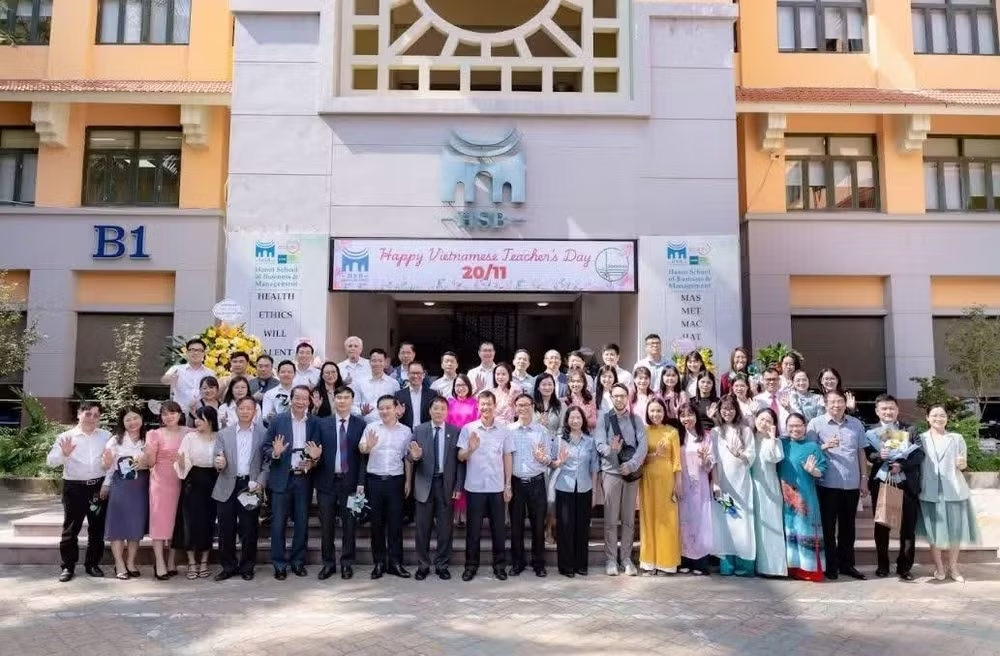
truong-dai-hoc-hsb.jpg
The Hanoi School of Business and Management under Vietnam National University, Hanoi becomes Vietnam's first public university to earn the QS 5-Star rating. (Photo: Vietnam+)

- The Ministry says Circular 20 is designed to align Vietnam's accreditation system with international standards. How do you assess its standards, criteria and accreditation process?

Associate Professor Dr. Do Van Dung: The circular's international orientation is reflected in a framework built around three pillars: strategy, systems and outcomes.

The strategic pillar covers vision, mission, culture, governance, leadership and strategic management, with an emphasis on long-term development and leadership responsibility.

The systems pillar covers human resources, finance, infrastructure, education, research, and international cooperation, focusing on institutional capacity and internal quality assurance.

The outcomes pillar focuses on education, research and community service, measuring their impact on learners, society and the economy.

The framework closely follows the AUN-QA (ASEAN University Network - Quality Assurance) model, which Vietnam has increasingly adopted as a regional benchmark. Many criteria emphasise continuous improvement, stakeholder engagement and internationalisation through external partnerships.

Its closer alignment with international standards also makes it easier to benchmark against regional and global frameworks such as AUN-QA, ABET, QS and THE, helping universities gain international accreditation and improve their global rankings.

nganh-stem-2.jpg
A student conducts experiments at the University of Science under Vietnam National University, Hanoi. (Photo: Pham Mai/Vietnam+)

However, the circular still has shortcomings. Some criteria remain highly qualitative and require more detailed guidance to ensure consistent and objective assessments.

It also does not fully align with specialised international accreditation systems such as ABET or AACSB, as it focuses on institutional rather than programme accreditation.

Overall, the new framework is a clear improvement over the previous one and provides a solid foundation for universities seeking international accreditation.

- What further measures would you recommend to ensure Circular 20 achieves its intended goals after taking effect?

Associate Professor Dr. Do Van Dung: Detailed implementation guidelines should be issued as soon as possible, including self-assessment templates, scoring scales and clear evaluation criteria. Large-scale training should also be provided for accreditors and university staff on the new accreditation process.

The Ministry of Education and Training should add a set of mandatory core criteria - covering strategic governance, internal quality assurance (IQA), learning outcomes and financial sustainability - to strike a balance between flexibility and quality.

It should also establish a transparent online portal publishing each university's accreditation results and improvement plans, strengthen post-accreditation monitoring through regular reporting, and provide technical support for institutions granted conditional accreditation.

Cooperation with international accreditation bodies such as AUN-QA and ABET should be further encouraged to raise quality standards.

These measures would help shift the accreditation system from compliance-based assessment to continuous quality improvement, while supporting the goals of Resolution 71 to raise Vietnam's higher education to international standards.

- Thank you very much.

anh-cuoi.jpg
BUV is the first higher education institution in Vietnam to receive the QS 5-Star rating. (Photo: Vietnam+)

See more

VNUA President Prof. Dr. Nguyen Thi Lan introduces the university to President of the National Assembly of Côte d'Ivoire Patrick Achi and his delegation. (Photo: VNA)

NA President of Côte d'Ivoire visits agriculture university

President of the National Assembly of Côte d'Ivoire Patrick Achi praised Vietnam's major achievements in agriculture, particularly improvements in productivity, livestock and fisheries, as well as policies promoting agro-processing and higher added value, while visiting the Vietnam National University of Agriculture (VNUA) in Hanoi on August 24.

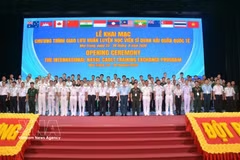
Military officials at the INCATEP 2026 opening ceremony in Khanh Hoa province on August 24 (Photo: VNA)

Vietnamese navy opens 2026 int’l training programme

Nearly 50 naval officers, instructors and cadets from 12 countries, including Australia, Cambodia, Canada, China, India, Indonesia, Laos, Malaysia, Myanmar, New Zealand, Singapore and Thailand, are joining the event. It is designed to foster solidarity, mutual respect and friendship among participating countries.

At Carnaval Ha Long 2026. (Photo: VNA)

NA approves establishment of Quang Ninh and Bac Ninh cities

The establishment of Quang Ninh and Bac Ninh is not merely an administrative restructuring, he said, but also aims to reorganise development space, improve local governance models and create a new growth driver for the two localities, the Red River Delta, the northern region and the country as a whole.

The Vietnam Coast Guard Region 3 Command presents national flags to fishermen in Tien Thanh ward, Lam Dong province (Photo: VNA)

Coast Guard force joins fishermen in fight against IUU fishing

The outreach focused on maritime and island laws, particularly regulations on combating IUU fishing. Through dialogues, leaflets, consultations and question-and-answer sessions, coast guard officers helped fishermen better understand fishing-zone boundaries, requirements for installing vessel monitoring systems, and necessary legal procedures for offshore fishing.

Intricate ceramic shaping techniques at Bat Trang craft village in Hanoi. (Photo: VNA)

Hanoi promotes craft village tourism as a driver of growth

Hanoi’s experience shows that linking craft villages with tourism and digital transformation is no longer simply a local initiative. By preserving heritage, promoting products through digital platforms and using tourism as a channel to showcase traditional crafts, the capital’s craft villages can integrate more deeply into the creative economy and create momentum for sustainable growth in rural areas.

Illustrative photo (Source: Internet)

Vietnam issues rules on handling cyberspace activities threatening national security

The decree, which took effect on August 19, provides detailed regulations for Article 14 of the Law on Cybersecurity, covering preventive and handling measures, the authority of specialised cybersecurity forces and competent agencies, and the responsibilities of domestic and foreign businesses providing telecommunications, Internet and other online services.

Deputy Director Vu Thi Tu Anh of the Department of Vocational and Continuing Education under the Ministry of Education and Training speaks during the workshop’s discussion session. (Photo: IOM Vietnam)

Vietnam advances qualifications referencing to support labour mobility in ASEAN

On August 21, the International Organization for Migration (IOM), in cooperation with the Department of Vocational and Continuing Education under the Ministry of Education and Training, held a national workshop in Hanoi to discuss the implementation of the AQRF and introduce Vietnam's AQRF Referencing Report and post-referencing action plan.

A part of Kinh Bac ward, Bac Ninh province (Photo: VNA)

Bac Ninh poised for historic milestone as centrally-run city

Bac Ninh is approaching a historic milestone as the Government has approved a proposal to establish the province as a centrally-run city and submitted it to the National Assembly for consideration, with localities across the province accelerating urban development and infrastructure preparations.

Passengers advised on refunds for cancelled Bamboo Airways flights

Passengers advised on refunds for cancelled Bamboo Airways flights

To protect consumers’ legitimate rights and interests, the commission advised passengers whose flights were cancelled and who wish to seek refunds to visit Bamboo Airways’ ticket refund information portal and complete the online form with the required information.