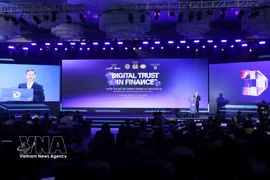
Hanoi (VNA) - The National Electronic Authentication Centre under the Ministry of Science and Technology opened an international conference in Hanoi on July 21, themed shifting cryptographic standards for trust services to the post-quantum era.
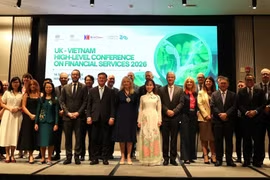
The event brought together technology experts, regulators, and domestic and foreign firms to examine trust-service trends, share public key infrastructure modernisation experience and set roadmaps for next-generation cryptographic standards.
Digital trust as economic foundation
NEAC Director To Thi Thu Huong said Vietnam is entering a rapid build-out phase for its digital economy, society and government, making PKI, digital signatures and trust services foundational to authenticating electronic identities, ensuring data integrity and securing digital transactions.
Proactively updating advanced international standards and preparing conditions for future transitions will maintain digital trust, protect electronic transactions and enable greater interoperability, mutual recognition of trust services and cross-border electronic transactions, Huong said.
As of late June, Vietnam issued nearly 32 million digital signature certificates, pushing penetration among adults to almost half the population and supporting billions of electronic transactions annually. Rapid advances in quantum computing, however, mean many existing cryptographic algorithms could be broken unless preparations start early.
Experts said the push aligns with the Politburo’s Resolution 57-NQ/TW, which calls for modern digital infrastructure, cybersecurity, data security and gradual mastery of strategic technologies, including artificial intelligence, semiconductors and quantum technology.
Speakers identified three major challenges for digital trust infrastructure over the next decade. First, quantum computing will force countries to adopt new cryptographic standards to protect data and transactions.
The rapid expansion of cloud computing, AI, the Internet of Things and large-scale digital systems is sharply increasing the number of certificates and devices requiring authentication, creating pressure to modernise PKI.
Another trend is shorter digital certificate validity periods to strengthen security, adding operational strain. Experts said the shift is not only technological challenge but also involves governance, standardisation and organisation.
Crypto agility - the ability to flexibly switch between cryptographic algorithms – also drew considerable attention. Experts stressed that adopting hybrid cryptography is now the most strategic and practical step for public certification authorities in Vietnam to transition securely without disrupting existing systems.
Preparing for a secure digital future
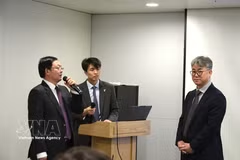
The event provided updates on global trends in electronic identification, signatures and trust services. A DigiCert representative shared experience in adopting international legal frameworks and standards such as eIDAS 2.0, ETSI and PSD3, along with approaches to PKI modernisation, automation of certificate lifecycle management and crypto agility to meet post-quantum security requirements.
Hoang Nguyen Van, Deputy Director of the Vietnam Digital Transformation Innovation Institute, proposed a 2026-2030 transition roadmap covering cryptographic asset inventories and risk assessments, testing post-quantum algorithms and building capacity to master the new cryptographic ecosystem.
The transition to post-quantum cryptographic standards will be a long process requiring coordinated preparation across institutional frameworks, technical standards, technology infrastructure and workforce, experts said. Vietnam needs to track international technology trends, assess current cryptographic infrastructure at agencies and firms, modernise certificate management systems, increase automation and train qualified specialists.
The orientation is consistent with Resolution 57 on developing modern digital infrastructure, mastering strategic technologies, fostering international cooperation and ensuring data security throughout the development of science, technology, innovation and national digital transformation.
Participants agreed that building digital trust in the post-quantum era cannot fall to regulators or technology companies alone but requires close coordination among the State, trusted service providers, the financial system, and experts./.