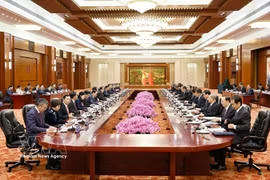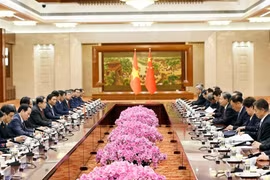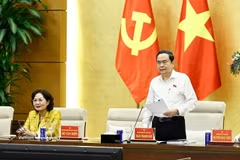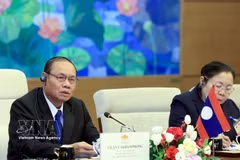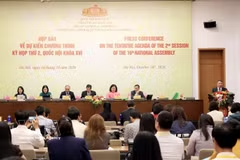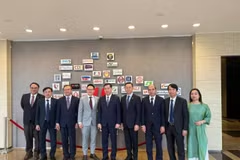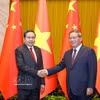
Beijing (VNA) – National Assembly President Tran Thanh Man’s official visit to China from October 11 to 15 would help strengthen cooperation between the Vietnamese NA and the National People’s Congress of China (NPC), particularly in legislation, creating a favourable legal framework for economic and trade ties, infrastructure connectivity and people-to-people exchanges, according to a Chinese expert.
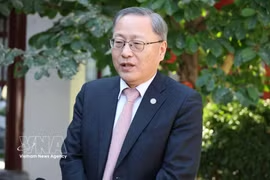
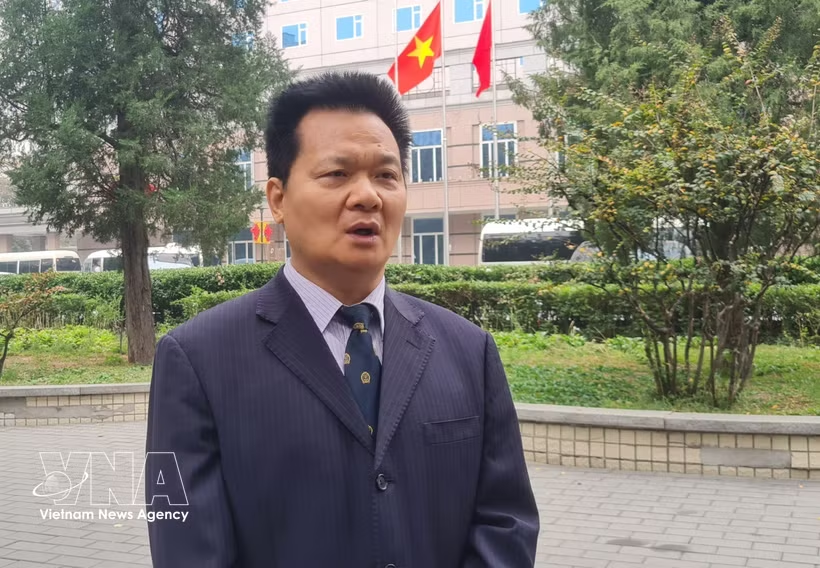
In an interview with Vietnam News Agency correspondents in Beijing, Wang Hanling, a research fellow at the Institute of International Law under the Chinese Academy of Social Sciences, said the visit, which took place less than six months after General Secretary of the Communist Party of Vietnam (CPV) Central Committee and President To Lam’s visit to China in April 2026, reflected sustained high-level exchanges between the two Parties and countries.
Such exchanges help enhance political trust, broaden comprehensive cooperation and translate leaders’ common perceptions into concrete action. Cooperation also encompasses legislative bodies, whose exchanges are important for consolidating the legal framework and ensuring the effective implementation of bilateral agreements, he said.
Wang noted that the two legislative bodies had established a cooperation committee mechanism to maintain regular exchanges and promote substantive collaboration. The 2025 visit to Vietnam by a leader of the NPC Standing Committee and NA President Man’s visit to China help sustain this mechanism, allowing the two sides to share legislative experience and discuss issues of mutual concern.
Regular exchanges allow the two sides to share legislative experience, identify issues requiring coordination in handling, and develop solutions to support bilateral ties, Wang stressed, expressing the hope that such exchanges would continue regularly to ensure consistent and effective cooperation.
Growing economic, trade and people-to-people ties have increased the need for legislative coordination, particularly in border trade, supply chains, investment, transport connectivity and crime prevention. Better-aligned regulations would facilitate business, protect citizens’ legitimate rights and interests, and improve cross-border management, he said.
On railway connectivity, the expert highlighted the necessity to coordinate technical standards and legal frameworks to support transport links between the two countries. He said legislative bodies should exchange experience during infrastructure development to facilitate regional connectivity and economic ties.
He also underscored the importance of cooperation between local elected bodies, particularly in border areas, noting that cooperation between China’s Guangxi Zhuang Autonomous Region and Vietnamese localities, including mechanisms linking Baise city with Tuyen Quang province, offers scope for stronger legislative exchanges, border trade, cross-border travel and crime prevention.
Legal education initiatives between Dongxing city in Guangxi and Vietnamese localities also help residents understand each other’s regulations, comply with local laws and reduce problems related to trade and cross-border movement, he went on.
Looking ahead, Wang said the legislative bodies could expand discussions on facilitating border trade, protecting investment and intellectual property rights, and promoting industrial cooperation. Clear and stable legal frameworks consistent with each country’s commitments are essential to supporting businesses and cross-border supply chains. Greater facilitation of travel is also needed as more tourists, businesspeople and students move between the two countries.
The expert expressed his hope that NA President Man’s visit will strengthen legislative cooperation, contributing to concretising the common perceptions of the two countries’ leaders, and promoting practical cooperation across sectors. He said effective interparliamentary cooperation mechanisms will provide an important channel for the two sides to exchange experience, address emerging legal issues and advance the stable development of Vietnam-China relations in line with the interests of their people./.