Vietnam, Indonesia seek to tap multi-sector economic cooperation potential

As members of the ASEAN Trade in Goods Agreement (ATIGA), various ASEAN free trade agreements with partners, and the Regional Comprehensive Economic Partnership (RCEP), Vietnam and Indonesia share a strong legal framework to expand trade and investment ties.

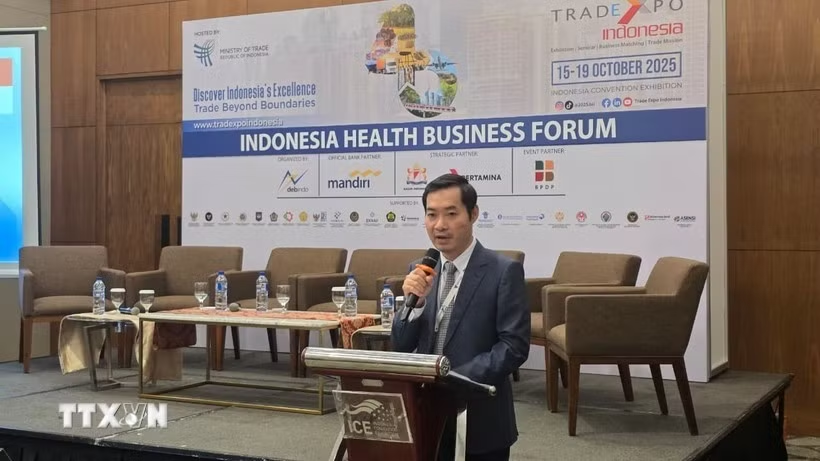
Dr. Nguyen Phuc Nam, Deputy Director of the MoIT’s Department of International Market Development speaks at the forum. (Photo: VNA)

Jakarta (VNA) – Vietnam and Indonesia are stepping up efforts to strengthen their economic partnership across multiple sectors, aiming to unlock new opportunities in trade, investment, and innovation.

Vietnam’s Ministry of Industry and Trade (MoIT) on October 16 held a Vietnam–Indonesia Business Forum in Banten within the framework of Trade Expo Indonesia 2025, providing an open platform for government agencies, business associations, and enterprises from both countries to exchange views, share market information, and explore potential partnerships in fields, particularly pharmaceuticals and medical equipment.

Addressing the forum, Dr. Nguyen Phuc Nam, Deputy Director of the MoIT’s Department of International Market Development, highlighted the diversity and dynamism of Vietnam–Indonesia economic relations. He proposed four key directions to deepen bilateral cooperation.

First, he suggested enhancing policy dialogue and harmonising trade and investment regulations between the two governments, while promoting digitalisation of import–export procedures toward building an ASEAN Smart Customs System.

Second, he encouraged enterprises to form production partnerships in high value-added industries such as pharmaceuticals, medical devices, agro-processing, electronics, green energy, and logistics.

Third, he called for greater business-to-business (B2B) connection through trade fairs, digital platforms, and innovation programmes to help small and medium-sized enterprises (SMEs) seize cooperation opportunities.

Fourth, he emphasised the importance of human resource development, expert exchanges, and technology transfer, particularly in smart manufacturing, logistics, and supply chain management.

Nam noted that both governments are pursuing goals related to green growth, circular economy, and digital transformation, creating fertile ground for businesses to strengthen collaboration. As members of the ASEAN Trade in Goods Agreement (ATIGA), various ASEAN free trade agreements with partners, and the Regional Comprehensive Economic Partnership (RCEP), Vietnam and Indonesia share a strong legal framework to expand trade and investment ties.

A special discussion session at the forum focused on cooperation in pharmaceuticals and medical devices.
viet-nam-indonesia-khai-thac-tiem-nang-hop-tac-kinh-te-da-linh-vuc-8343833-2.jpg
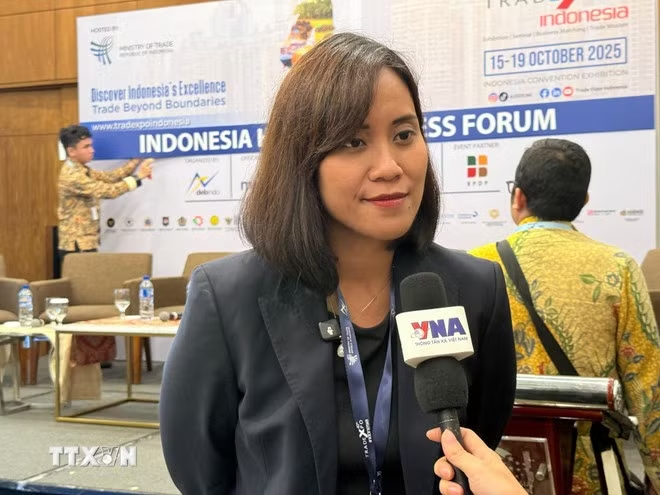
Febie Yoenza, Vice President of the Indonesian Association of Medical Device Manufacturers (ASPAK). (Photo: VNA)

Febie Yoenza, Vice President of the Indonesian Association of Medical Device Manufacturers (ASPAK), said that the two countries hold great potential for collaboration. Indonesia could increase its exports to Vietnam, while Vietnam has developed innovative medical technology industries, including cardiac stent manufacturing and advanced medical software.

She noted that Vietnam has strong capabilities to transfer technology to Indonesia’s medical equipment industry. In addition, the two sides could cooperate in research and development between businesses, universities, and research institutes./.
VNA

See more

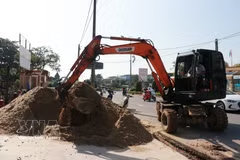
The sidewalks on Hung Vuong street in Quang Tri province are under renovation. (Photo: VNA)

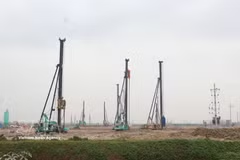
Quang Tri approves 103 priority projects for investment during 2026–2030

The 103 projects are categorised into seven fields, comprising energy; logistics; tourism, services, and trade; green and high-tech agriculture; industry, industrial zones, and production infrastructure; urban development and commercial housing; and healthcare, wellness, and resort services.

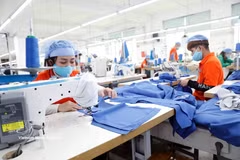
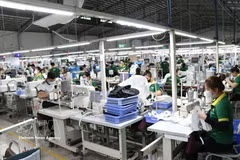
Workers make clothes for export to the Japanese market at Hung Viet Garment Company in Hung Yen province (Photo: VNA)

Vietnam’s textile-garment firms striving to achieve export targets, sustain employment

To achieve the annual target, textile and garment businesses are jointly implementing several core tasks, including diversifying export markets and partners, developing the supporting industries for raw materials and accessories to establish integrated supply chains, investing in technological innovation linked to AI, stepping up high-quality workforce training, promoting green transformation based on circular economy models, and building brands in both domestic and international markets.

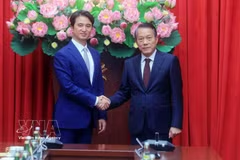
Minister of Public Security General Luong Tam Quang (R) receives Choo Hyeong Wook, President and CEO of the Republic of Korea’s SK Innovation in Hanoi on November 16. (Photo: VNA)

Vietnam promotes international cooperation in energy, high technology

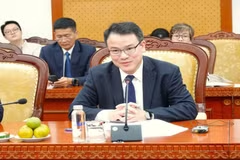
Minister of Public Security General Luong Tam Quang called on the RoK's SK Innovation to share experience and work with Vietnamese partners in developing clean and renewable energy, hydrogen, liquefied natural gas, energy storage technologies and carbon emission reduction solutions.

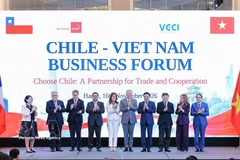
Delegates pose for a photo at the Chile-Vietnam Business Forum in Hanoi on November 16 (Photo: VNA)

Vietnam, Chile seek to expand trade ties

Chilean President José Antonio Kast pointed to potential for cooperation in agriculture and food, and called for stronger technical cooperation, better market access and closer links in innovation, technology, services and sustainable development.

Production of footwear for export at Lefaso Tra Vinh Industrial Investment and Production Joint Stock Company, Tra Cu commune, Vinh Long province (Illustrative image. Source: VNA)

VEFTA implementation requires exporters to restructure supply chains: Experts

Under VEFTA, tariff reductions to zero will be meaningless for Vietnam’s key export sectors, including textiles and garments, footwear, and agricultural and aquatic products, if goods are found to contain banned chemicals, violate rules of origin or lack transparency regarding their carbon footprints.

Deputy Prime Minister Nguyen Van Thang meets with Martin Sommer, head of the IMF’s Article IV consultation mission team to Vietnam, in Hanoi on November 13, 2026. (Photo: VNA)

IMF sees positive growth prospects for Vietnam, urges cautious monetary policy

Martin Sommer, head of the IMF’s Article IV consultation mission team to Vietnam, noted that inflation risks in Vietnam remain under control, but several factors could add to price pressures. He therefore called for cautious monetary policy management and readiness to respond promptly if inflationary pressures increased.

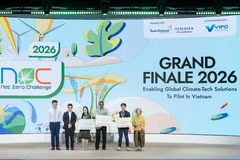
Representatives of the three first-prize-winning startups receive their awards at the event. (Photo: SGGP)

Seven green-tech startups secure 770,000 USD at Net Zero Challenge 2026

In its fourth year, the competition attracted more than 1,100 applications from 80 countries and territories, making it the most competitive edition since its launch in 2023. Nine finalists presented solutions in three categories, namely renewable energy and carbon removal; food systems and sustainable agriculture; and circular economy and waste management.