"Vietnam is part of my life": The story of a 60-year Chile–Vietnam friendship

"Vietnam is part of my life," affirmed Patricia Abarzua Munoz, emphasising that the friendship between the Chilean and Vietnamese peoples is built on shared values and mutual respect.

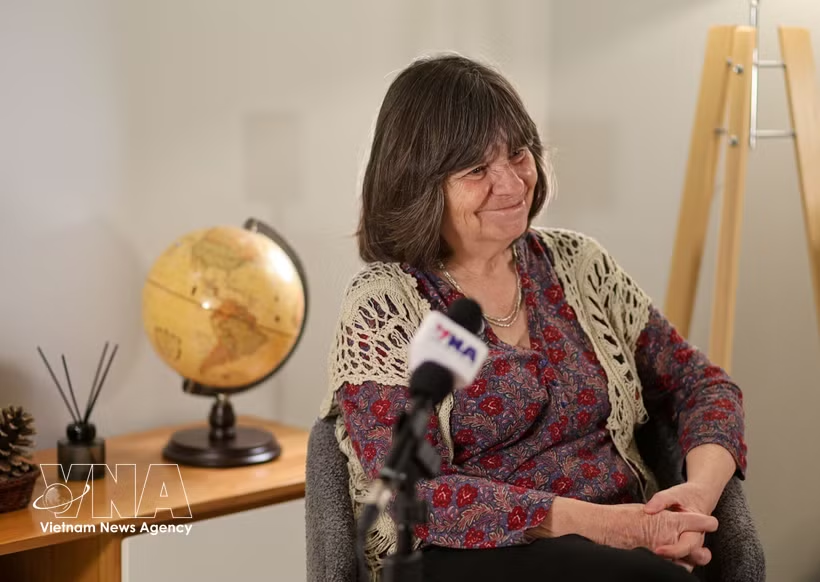
Patricia Abarzua Munoz, President of the Chile–Vietnam Cultural Friendship Institute (Photo: VNA)

Buenos Aires (VNA) – Patricia Abarzua Munoz, President of the Chile–Vietnam Cultural Friendship Institute, highlighted the close friendship between the peoples of Chile and Vietnam, rooted in historical ties, solidarity, and mutual respect, while praising the evolution of bilateral relations.

Speaking to the Vietnam News Agency (VNA) correspondent in Buenos Aires on the occasion of the 216th anniversary of Chile's Independence, Abarzua recounted her over six decades of ties with Vietnam and the institute's efforts to strengthen the friendship between the two peoples.

Abarzua recalled that she first learned about the reality of Vietnam in 1962 when a Vietnamese delegation visited Chile to attend a conference of the Unified Workers' Central (CUT).

Meetings with the Vietnamese representatives inspired journalist Fernando Murillo Viana, later awarded Chile's National Journalism Prize, to establish one of the country's first solidarity groups with Vietnam.

The movement later grew with the participation of prominent Chilean political and social figures, including then-Senator Salvador Allende, who would eventually become President of Chile, and Clodomiro Almeyda, who served as Foreign Minister during Allende's government.

During her university years, Abarzua actively joined the student movement and activities showing solidarity with Vietnam. She worked for the Chile–Vietnam friendship organisation and later became the Secretary General of the Chile–Vietnam Cultural Institute, a position she held until 1973.

The September 1973 coup d'état radically changed her life and put an end to the institute's activities. Its headquarters were raided and destroyed by the military, along with photographs, films, documents, and other materials.

Abarzua was forced into exile for four years, first in Italy and later in Spain, before returning to Chile.

Upon her return, she reconnected with her Vietnamese friends, including journalist Nguyen Khac Thin, then the VNA correspondent in Santiago. These contacts helped rebuild the bonds of friendship and eventually revive the Chile–Vietnam Cultural Friendship Institute, which continues its activities to this day.

Abarzua also recalled the numerous expressions of solidarity with Vietnam from the Chilean people during the war. She highlighted a march held from July 8 to 13, 1967, when some 2,000 youths and students walked nearly 200 kilometres from Valparaiso to Santiago to express their solidarity with the Vietnamese people. Salvador Allende participated in that march.

She also reminisced about Allende's visit to Hanoi in May 1969, when, as President of the Chilean Senate, he led a delegation to express the solidarity of the Chilean people. During that visit, Allende was received by President Ho Chi Minh.

Over the decades, Abarzua has visited Vietnam six times. Her most recent trip was as an international guest for the 50th anniversary of the liberation of the South and national reunification.

She noted that the transformations Vietnam has undergone left a profound impression on her.

"It is extraordinary to see the development of the cities and the country. Today, you have to go to museums to imagine what the war in Vietnam was like," she said, highlighting not only the infrastructure improvements but also the vitality, creativity, and strong work ethic of the new Vietnamese generations.

Regarding the institute's work, she described its activities as a vital bridge between the peoples of both nations. The organisation has promoted seminars, meetings, and cultural events about Vietnam and published President Ho Chi Minh's “Prison Diary” in Santiago.

She also recalled that to mark the 40th anniversary of Vietnam's reunification, 40 Chilean artists donated 40 artworks that were sent to Vietnam for a special exhibition.

"Vietnam is part of my life," affirmed Abarzua, emphasising that the friendship between the Chilean and Vietnamese peoples is built on shared values and mutual respect. In her view, Chileans particularly value the simplicity, kindness, and gratitude of the Vietnamese people.

She further highlighted the significance of Ho Chi Minh Park in Chile, whose creation was closely linked to the solidarity movement with Vietnam. She noted that even during the dictatorship, the space retained the Vietnamese leader's name. Later, alongside the first Vietnamese Ambassador to Chile, Nguyen Van Dao, she promoted the idea of erecting a statue of President Ho Chi Minh there, a project that eventually became a reality.

Looking to the future, Abarzua expressed her desire to continue promoting the image of a peaceful, dynamic, and developing Vietnam among Chileans, especially the youth.

She considers it crucial for new generations to learn not only the history of the struggle for independence but also the remarkable achievements Vietnam has made in its nation-building and development process.

For Abarzua, after more than six decades, the bond with Vietnam transcends mere social activity or a chapter in her life: it has become an inseparable part of her identity and a constant motivation to continue strengthening the friendship between the peoples of Chile and Vietnam./.

VNA

See more

Vietnamese representative Le Nguyen Bao Ngoc and other Miss World 2026 contestants at the opening performance at the "Dances of the World" grand finale in Nha Trang ward, Khanh Hoa province, on September 5. (Photo: VNA)

"Beauty ambassadors" promote image of Vietnam to the world

The greatest value lies in the contestants themselves, who can become “beauty ambassadors” and authentic storytellers. Through their first-hand experiences and perspectives, they can naturally share Vietnam’s landscapes, culture and people with audiences around the world, said an organiser.

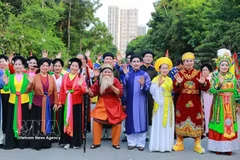
The programme opens with an artistic parade, with artisans and artists dressed in traditional costumes characteristic of Cheo, Tuung and Ca tru, creating an impressive festival scene. (Photo: VNA)

Traditional arts bring closer to public through “Music and Heritage” programme

The key message the organisers want to convey to the public and international friends is that heritage is not a collection of artefacts or values frozen in the past, but a living flow that continues to evolve, adapt and be enriched by each generation, Le Thi Anh Mai, Deputy Director of the Hanoi Department of Culture, Sports and Tourism, said.

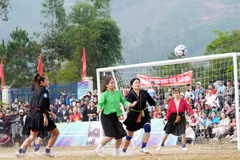
An action during the final between Lam Thuong (Lao Cai province) and Mong Duong (Quang Ninh) on December 7, 2025, as part of the 2025 Quang Ninh Open Ethnic Minority Women’s Football Tournament – VTV5 Cup. (Photo published by VNA)

Potential of ethnic minority women’s football

Women’s football movements in local communities have been quietly growing, but they’ve now built up enough momentum to inspire organisers to launch the first Vietnam Ethnic Minority Women’s Football – VTV Cup in 2026.

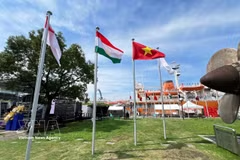
The national flag of Vietnam flies alongside the flags of other countries at the 2026 Asian Games. (Photo: VNA)

Vietnamese national flag flies at 2026 Asian Games

As the Vietnamese national anthem played, the red flag with a yellow star was raised at Nagoya Port, marking the official presence of the Vietnamese delegation at ASIAD 2026 and boosting the athletes’ morale ahead of the competitions.

The Song Hong Jazz Band perform at the opening ceremony of the Hanoi International Jazz Festival 2026 on September 17. (Photo: VNA)

Hanoi International Jazz Festival 2026 kicks off

With open and free-of-charge activities held at both professional performance venues and public spaces, Hanoi Jazztival 2026 seeks to expand access to jazz and make the genre more visible in the capital’s urban cultural life.

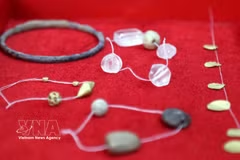
Glass beads, gold-coloured metal beads and leaf-shaped objects uncovered in the tombs. (Photo: VNA)

Archaeologists uncover artefacts in two 1,500-year-old tombs

Based on their structure, construction techniques and unearthed artefacts, the two tombs are identified as brick-built burial chambers. Such tombs, commonly known as brick tombs or Han tombs, were relatively widespread in areas along major rivers and waterways, including the Luc Dau, Bach Dang, Y Bich and Lam river systems, which served as important links between settlements and the sea.

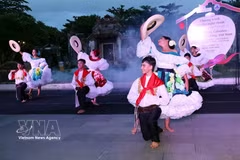
A performance staged by Colombian dancers at the artistic exchange in Hoi An town, Da Nang city, on September 16, 2026. (Photo: VNA)

Artistic exchange helps foster Vietnam-Colombia friendship

Co-organised by the Embassy of Colombia, the Da Nang Department of Foreign Affairs, the municipal Department of Culture, Sports and Tourism, and the Hoi An World Cultural Heritage Conservation Centre, the programme contributed to strengthening cultural exchanges, connecting young people and promoting friendship between the two countries.

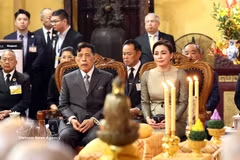
Thai King Maha Vajiralongkorn and Queen Suthida Bajrasudhabimalalakshana at the prayer ceremony (Photo: VNA)

Thai King, Queen visit Quan Su pagoda for prayer ceremony

The King and Queen offered candles and flowers, after which monks and Buddhists chanted prayers for their peace and well-being, and deeper progress in the Vietnam-Thailand Comprehensive Strategic Partnership as well, timed to the 50th anniversary of diplomatic ties.

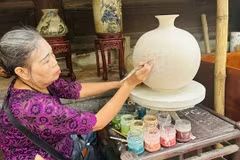
An artisan from Bat Trang Village demonstrates part of the ceramic making process. (Photo: baovanhoa.vn)

Hanoi's old streets and crafts available at Temple of Literature

Inspired by the streetscapes and their architecture, traditional craft streets and daily life of ancient Thang Long, the programme presents images and historical artefacts of Hanoi’s historic '36 Streets' while offering hands-on workshops with traditional craftspeople. It unfolds the story of a Hanoi rich in history and culture, yet dynamic and constantly evolving amid modern life.

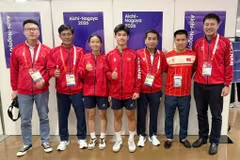
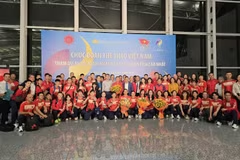
Vietnam sports delegation embarks on ASIAD 20 (Photo: baochinhphu)

Vietnamese sports delegation departs for ASIAD 20

Vietnamese teams are travelling to Japan in separate groups according to their competition schedules. Shooting, karate and sepak takraw are among the teams carrying high expectations after winning gold medals at ASIAD 19. The Vietnamese delegation is targeting at least four gold medals at ASIAD 20.