Vietnam posts second straight monthly trade surplus in October

The office's socio-economic report released on November 3 showed that total import-export turnover in October reached an estimated 122.03 billion USD, up 3.7% from the previous month and 47.4% year on year.

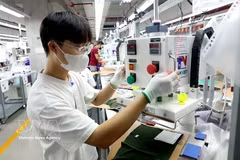
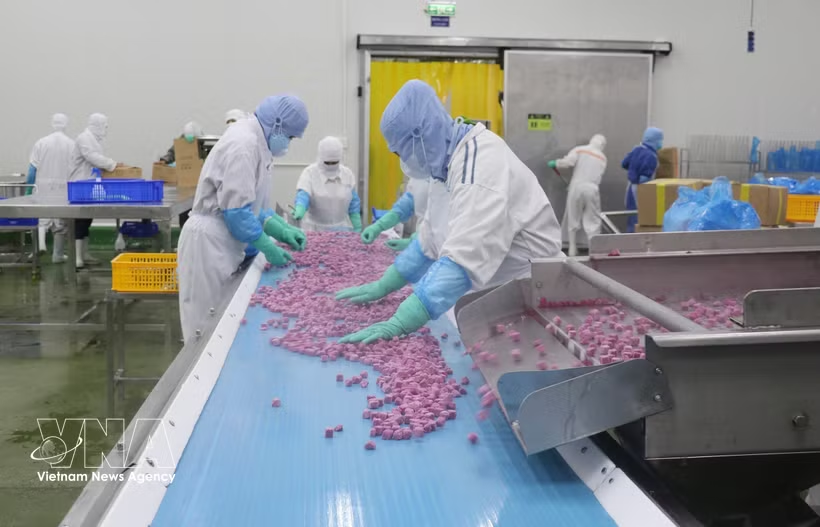
A dried dragon fruit production line at Thabico Tien Giang Food Industry JSC in Binh Ninh commune, Dong Thap province. (Photo: VNA)

Hanoi (VNA) – Vietnam recorded a trade surplus of 7.31 billion USD in October 2026, following a surplus of 1.3 billion USD in September, marking the second consecutive monthly surplus this year, according to the National Statistics Office (NSO) under the Ministry of Finance.

The office's socio-economic report released on November 3 showed that total import-export turnover in October reached an estimated 122.03 billion USD, up 3.7% from the previous month and 47.4% year on year.

In the last 10 months, total trade turnover reached 1.01 trillion USD, up 32.3% year on year, exceeding the 1-trillion-USD mark for the first time and reaching a record high. Exports rose 27.5%, while imports increased 37.4%, resulting in a trade deficit of 12.07 billion USD.

Export earnings in October amounted to 64.67 billion USD, up 8.7% month on month and 51.4% year on year. Domestic businesses contributed 9.94 billion USD, while the foreign-invested sector, including crude oil, accounted for 54.73 billion USD, up 4.2% and 9.5%, respectively.

Cumulative exports in the January-October period surged 27.5% year on year to 499.24 billion USD, with domestic businesses contributing 93.93 billion USD, up 8.2%, and foreign-invested enterprises 405.31 billion USD, up 33%. The respective shares were 18.8% and 81.2%.

During the period, 37 export products generated over 1 billion USD each, accounting for 94.9% of total export value, including eight products exceeding 10 billion USD, which made up 73.4%.

Processing products dominated exports at 452.74 billion USD, or 90.7%, followed by agricultural and forestry products at 33.48 billion USD (6.7%), seafood at 10.36 billion USD (2.1%), and fuels and minerals at 2.66 billion USD (0.5%).

Meanwhile, imports in October totalled 57.36 billion USD, down 1.4% month on month but up 43.1% year on year.

For the first 10 months, imports rose 37.4% year on year to 511.31 billion USD. Production materials accounted for 481.03 billion USD, or 94.1%, while consumer goods made up the remaining 5.9%.

Vietnam posted trade surpluses of 40.84 billion USD with the EU and 3.42 billion USD with Japan, up 26.8% and 110.4%, respectively. Meanwhile, it recorded deficits of 134.94 billion USD with China, 48.63 billion USD with the Republic of Korea and 16.93 billion USD with ASEAN.

The Ministry of Industry and Trade plans to accelerate exports, diversify markets and improve compliance capacity, focusing on making better use of signed free trade agreements, expanding into new markets, and strengthening early warnings of trade defence cases, tariff barriers, green standards, traceability and rules of origin.

It will also support businesses in improving product quality, developing brands and ensuring supply chain transparency, while promoting official export channels, expanding agricultural quarantine agreements, investing in cold-chain logistics infrastructure, and standardising growing areas and packing facilities to meet partner markets' requirements./.

VNA
See more

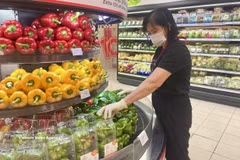
Consumers shop at CO.OPmart Rach Gia supermarket in Rach Gia ward, An Giang province. (Photo: VNA)

CPI up 4.57% in first 10 months of 2026

Compared with September, prices increased in seven of the 11 main groups of consumer goods and services, while four recorded declines. CPI rose 0.16% in urban areas and 0.25% in rural areas.

In the third quarter of 2026, Vietjet operates 39,000 flights and carries 7.3 million passengers. (Photo: Vietjet)

Vietjet posts 41% revenue growth in first nine months of 2026

In the third quarter of 2026, Vietjet operated 39,000 flights and carried 7.3 million passengers. Consolidated revenue reached 22.849 trillion VND (approx. 886 million USD), up 35% year-on-year, while net profit after tax reached 348 billion VND (approx. 13.5 million USD).

Private sector: From a key driver to a leading force for growth

Private sector: From a key driver to a leading force for growth

An open institutional framework and a transparent, stable business environment are essential for encouraging enterprises to make long-term investments. In recent years, the Party, National Assembly and Government have continued to promote administrative reform, address obstacles to investment and business activities, and support new growth drivers.

Trung Nguyen Instant Coffee Joint Stock Company in Bac Ninh city exports its products to numerous countries. (Illustrative photo: VNA)

Vietnam–EU forum to explore green economy, new value chains

By linking policy dialogue with businesses' practical needs, the forum is expected to help translate Vietnam–EU cooperation potential into concrete trade and investment opportunities. It will also provide an opportunity for both sides to make more effective use of the EVFTA, expand markets for Vietnamese goods and businesses, and tap into Europe's capital, technology and management expertise.

MICE guests experience services at Song Be Golf Resort, Ho Chi Minh City. (Photo: VNA)

Vietnam needs breakthrough policies to boost MICE tourism

Pham Van Bay, Deputy Director of Vietravel Hanoi Branch, said the recovery of international tourism, together with improvements in event organisation and accommodation infrastructure, is creating favourable conditions for the development of Vietnam's MICE sector.

A forum titled businesses amid exchange rate, interest rate and energy price volatility is held in Hanoi on October 30. (Photo: VNA)

Businesses urged to diversify funding to build resilience

Exchange rate, interest rate and energy price volatility is putting mounting pressure on businesses' production costs, cash flows and competitiveness, highlighting the need to diversify funding sources, and strengthen financial management to maintain operations and build resilience.