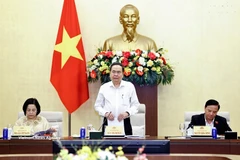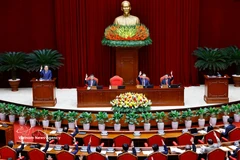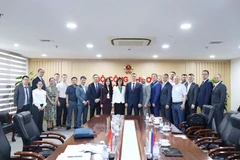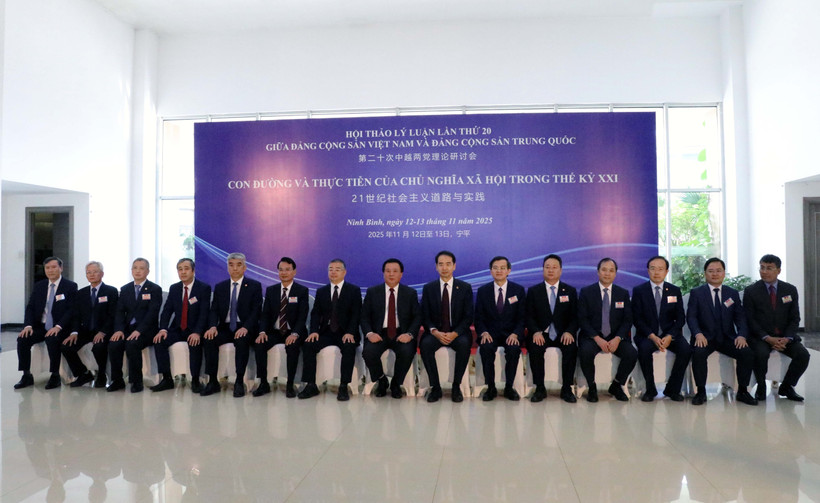
Hanoi (VNA) - The 20th theory seminar between the Communist Party of Vietnam (CPV) and the Communist Party of China (CPC) was held in the northern province of Ninh Binh on November 12 under the theme “The path and practice of socialism in the 21st century.”
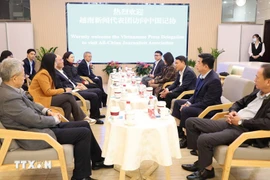
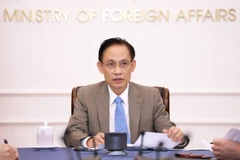
The CPV delegation was led by Nguyen Xuan Thang, Politburo member, Chairman of the Central Theory Council, and President of the Ho Chi Minh National Academy of Politics, while the CPC delegation was headed by Li Shulei, Politburo member, Secretary of the CPC Central Committee’s Secretariat, and head of the Publicity Department of the CPC Central Committee. Attending the seminar were representatives of ministries, central agencies, and localities, along with scientists, experts, and scholars from both countries, as well as the Chinese Ambassador to Vietnam.
General Secretary of the CPV Central Committee To Lam and General Secretary of the CPV Central Committee and President of China Xi Jinping sent congratulatory letters to the regular seminar.
In the letters, the two leaders affirmed the important role of this highest-level theory exchange mechanism between the two Parties, reflecting their strategic vision, close bond, and shared responsibility in safeguarding, applying, and creatively developing Marxism–Leninism in accordance with each country’s realities, as well as demonstrating the high level of political trust between the two Parties and nations.
General Secretary Lam highly appreciated the special significance of this year’s seminar, describing it as an important opportunity for the two Parties to engage in profound and comprehensive exchanges to clarify theoretical and practical issues related to the path towards socialism in the new era of development. He emphasised that the CPV has always been steadfast and creative in applying and developing Marxism–Leninism and Ho Chi Minh Thought, valuing the summarisation of practical experience, theory study, and the linkage between renewal of theoretical thinking and renewal of the growth model.
The Party aims to build an independent and self-reliant economy closely associated with deep international integration, for the goal of a prosperous people and a strong, democratic, equitable, and civilised country, he underlined.
The General Secretary affirmed that the CPV stands ready to work with the CPC to further deepen theory cooperation and share experiences in Party building, national development, and social governance, thereby promoting the development of socialist theory in the context of globalisation and the Fourth Industrial Revolution, for the benefit of the peoples of both countries and for a brighter future for socialism worldwide.
Meanwhile, General Secretary and President Xi stressed that China and Vietnam are “good neighbours, good friends, good comrades, and good partners”, forming a community with a shared strategic future that carries strategic signifiance. He affirmed that the in-depth theory exchange between the two Parties contributes to exploring socialist modernisation paths suited to each country, advancing the development of socialism globally, and continuously writing new chapters in the friendship between the two Parties and countries.
Addressing the event, Thang stressed that Vietnam’s Doi Moi (Renewal) process and China’s reform and opening-up have achieved remarkable successes, affirming the soundness of the socialist model in the 21st century.
He introduced Vietnam’s socialist model under the leadership of the CPV, which is built on three pillars - a socialist-oriented market economy, a socialist rule-of-law state, and socialist democracy.
He highlighted the “three concentric circles” of development structure on the path to socialism in the new phase — identifying a new economic growth model driven by science, technology, innovation, and digital transformation; shaping and perfecting Vietnam’s new development model; and completing the Vietnamese socialist model in the 21st century on the basis of summarising the practice of Doi Moi.
Meanwhile, Li shared core issues in theory and practice drawn from building socialism with Chinese characteristics in the new era.
The two officials affirmed the importance of strengthening theoretical and practical exchanges in building socialism in the 21st century. They emphasised that, amid the rapidly changing and complex global situation and the explosion of science and technology, both sides need to jointly discuss and seek breakthroughs in the Party’s leadership methods; enhance cooperation in science and technology, innovation, and digital transformation; and promote the combination of each country’s cultural values with Eastern values and the universal values of humanity.
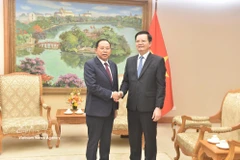
The same day, Thang and Li held a cordial meeting, during which the host congratulated China on its recent achievements, including the successful convening of the fourth plenary session of the 20th CPC Central Committee and the adoption of the orientation for formulating the 15th Five-Year Plan. He reaffirmed that Vietnam always attaches great importance and gives top priority to relations with China.
Li affirmed that the CPC firmly believes in and supports the CPV in successfully organising the 14th National Congress, opening a new era of development for Vietnam. He affirmed that China always prioritises the development of relations with Vietnam in its neighbourhood diplomacy.
Both sides highly valued the positive momentum of Vietnam–China relations in recent times and engaged in in-depth discussions on major orientations and measures to further strengthen exchanges and cooperation between the two Parties and their theory research agencies, thereby contributing to the stable, healthy, and sustainable development of bilateral relations.
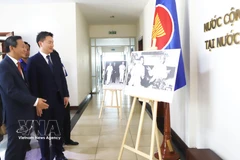
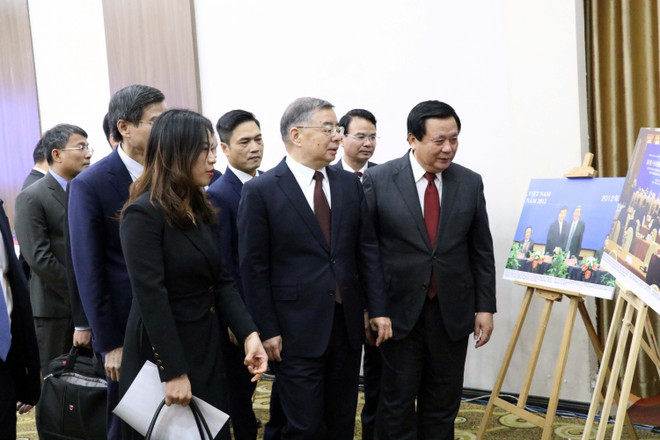
Following the meeting, officials visited a book and photo display commemorating the 20th anniversary of the theory seminar mechanism between the two Parties./.