Vietnamese rice attracts Japanese consumers

Takashi Takanashi, head of the Spice House Co., a company based in Sagamihara, Kanagawa Prefecture, specialising in wholesale imported food for restaurants and retailers, said his company is receiving increasing requests for Vietnamese rice, he said.

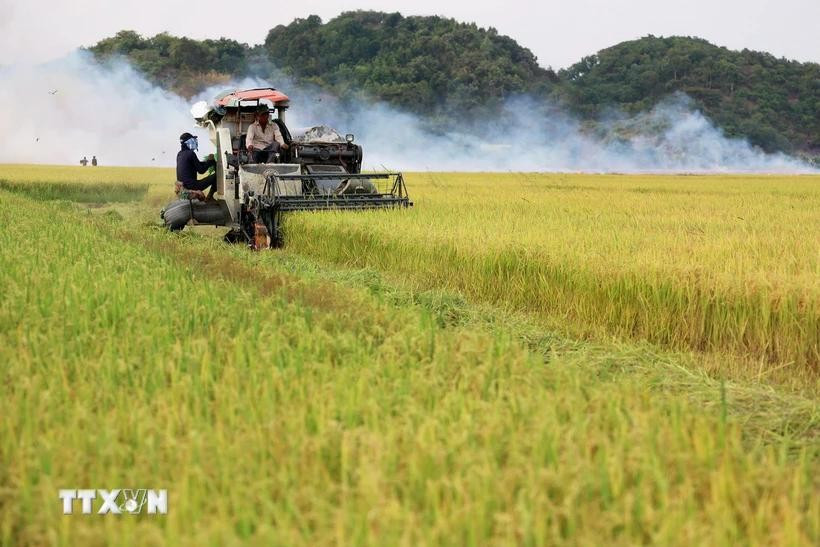
Farmers harvest rice in Lam Dong province. (Photo: VNA)

Tokyo (VNA) – Among imported rice in Japan, Vietnamese rice has been gaining attention from consumers due to its similarities to Japanese rice.

Takashi Takanashi, head of the Spice House Co., a company based in Sagamihara, Kanagawa Prefecture, specialising in wholesale imported food for restaurants and retailers, said his company is receiving increasing requests for Vietnamese rice, he said.

At a store affiliated with the company, five kilograms of Japonica rice produced in Vietnam is priced at 3,240 JPY (21.8 USD), including tax. In contrast, the same quantity of domestically produced rice is sold at around 4,000 JPY (27 USD). Japonica rice, characterised by its small, short grains, is the dominant variety in Japan.

Takanashi stated that Vietnamese rice closely resembles Japanese varieties in both appearance and taste.

The Spice House Co. began selling Vietnamese rice in 2024. In October, the company introduced an initial volume of 200 tonnes, targeting both regular customers and food service businesses seeking bulk purchases. The strong demand has nearly depleted the company’s stock, leading to temporary purchase limits of one bag per customer.

The surge in rice prices has seen five-kilogram packs frequently surpassing 4,000 JPY. This marks a significant increase compared to last year when consumers could buy the same amount for approximately 1,500 JPY. Amid the surge, demand for more affordable imported rice is on the rise.

Vietnamese rice has gained traction amid this price crisis. Despite a private import tariff of 341 JPY per kilogram, it remains more affordable than domestically grown Koshihikari and other Japanese rice varieties, which are sold at around 800 JPY (5.4 USD) per kilogram./.
VNA

See more

Experts said that Vietnam’s economic outlook continues to be underpinned by stable foreign direct investment inflows and public investment, which is playing an important role in driving growth. (Photo: thoibaotaichinh.vn)

Foreign investors maintain strong confidence in Vietnam’s market

Looking ahead to 2026, prospects remain bright as manufacturing, economic growth and foreign investment in Vietnam are expected to stay robust, with the country forecast to post the highest growth rate in the region this year, according to Adam Sitkoff, Executive Director of the American Chamber of Commerce (AmCham) in Vietnam.

Toy production at a Hong Kong-invested factory (Photo: VNA)

Vietnam targets deeper market penetration in Hong Kong in 2026

Vietnam-Hong Kong trade hit 62.3 billion USD in the first 11 months of 2025, soaring 73.1% annually. Vietnamese exports to Hong Kong amounted to 36.8 billion USD, a 90.6% hike, ranking fourth among Hong Kong’s import sources, while imports from Hong Kong stood at 25.5 billion USD, up 52.9% and ranking third.

Vietnam’s start-up market enters restructuring phase

Vietnam’s start-up market enters restructuring phase

In 2026, venture capital inflows into Vietnam’s start-up ecosystem are expected to recover gradually, though in a more selective manner. VinVentures forecasts that capital will focus on start-ups that have survived the rigorous screening of 2024–2025, possess clear business models, strong commercialisation capacity, and the ability to generate real cash flows.

Workers process tra (pangasius) for export (Photo: VNA)

Vietnam–Singapore trade continues to thrive

For the year as a whole, Vietnam retained its position as Singapore’s 10th largest trading partner. Bilateral trade reached a record high of nearly 40 billion SGD, up 26.2% from the previous peak of 31.67 billion SGD recorded in 2024.

Eric Van Vaerenbergh, an energy expert and lecturer at the Brussels Engineering School (ECAM) (Photo: VNA)

Belgian expert optimistic about Vietnam’s economic outlook

Vietnam should move from a growth model based mainly on expanding capital and labour to one driven by productivity improvements. He said that this requires enhancing the quality of the workforce, particularly engineers, technicians, and managers in industrial sectors.

Workers at the VSIP Hai Phong industrial and urban complex, which specialises in producing electronic components for office equipment. (Photo: VNA)

Roadmap aims to improve business climate and boost competitiveness

By the end of 2026, Vietnam aims to rank among the world’s top 50 performers in the United Nations Sustainable Development Goals, advance at least three places in the International Property Rights Index, and climb at least one position in the Global Innovation Index.