Hanoi (VNA) - Deputy Prime Minister and Minister of Foreign Affairs Bui Thanh Son has penned an article titled “A 30-year journey: From shared aspirations to a trusted and responsible member” on the occasion of the 30th anniversary of Vietnam’s accession to the Association of Southeast Asian Nations (ASEAN) (July 28, 1995 – 2025) and bloc's 58th founding anniversary, underscoring Vietnam’s active and responsible engagement as well as its growing role within the group.
Thirty years ago, on July 28, 1995, Vietnam’s accession to ASEAN marked a historic strategic decision, opening a new chapter in the country’s integration process and beginning its strong rise. Over the past three decades, Vietnam’s journey has been a vivid testament to the vision and political resolve of the Party and State in fostering and consolidating a peaceful and cooperative environment for development. Vietnam joined ASEAN in a spirit of friendship and with a strong sense of responsibility. Today, in a world undergoing profound transformations, and with a fresh mindset, Vietnam will continue working with fellow member states to shape new success stories for ASEAN in this new era of development.
A historic decision, a strategic vision
In the early 1990s, Vietnam stood at a historic turning point in its Doi moi (renewal) process, striving to overcome a severe socio-economic crisis while gradually breaking the long-standing isolation and embargo. In that context, diplomacy was identified as a strategic breakthrough to create a peaceful, stable, and cooperative environment, first in the region, to help the country emerge from crisis and open new development opportunities.
Diplomatic principles deeply rooted in Ho Chi Minh’s identity, such as “more friends, fewer enemies,” “being friends with all countries,” and “being steadfast in principles while being flexible in tactics,” were applied with flexibility and creativity to new realities, guiding Vietnam’s renewed mindset of foreign policy. On that foundation, the foreign policy of independence, self-reliance, multilateralisation and diversification of relations was gradually shaped and firmly implemented.
At that time, the world was entering the Post-Cold War era, in which ideological confrontation gradually gave way to trends of cooperation, integration, and globalisation. Amid this powerful wave of change, Southeast Asian nations soon realised that only by strengthening unity and collective strength could they stand firm and advance in development.
Historical “knots” in relations among regional countries were gradually untied, serving as a catalyst for reconciliation, cohesion, and cooperation. Barriers of the past gave way to trust and goodwill, bringing countries closer together in a joint effort to promote peace, stability, and development.
The convergence of Vietnam’s aspiration for “Doi moi” with ASEAN’s desire to expand cooperation—aligned with the global trend toward peace and development, created a moment of “right time, right place, and right conditions.” Joining ASEAN was therefore not merely a diplomatic step, but a proactive and strategic choice by the Party and State, marked by comprehensive renewal in both mindset and action - taking integration as a motivation, taking the region as a foundation, and taking cooperation as the path to stable and long-term development.
Vietnam’s history has witnessed, and will continue to witness many turning points. Among them, Vietnam’s accession to ASEAN will forever be remembered as a decision carrying a strategic vision, historical significance, and intellectual depth, signifying the country’s transformation into a proactive, active, and responsible member of the region and the world.
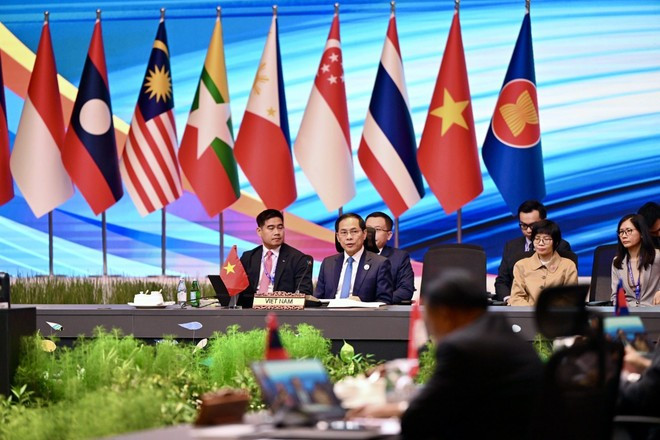
Deputy Prime Minister and Foreign Minister Bui Thanh Son leads a Vietnamese delegation to the ASEAN–UK Ministerial Meeting held in Malaysia on July 11, 2025. (Photo: VNA)
30-year steadfast efforts affirm Vietnam’s mettle and mark
ASEAN has not only opened the door for integration but also created a belt of peace, security, and development in a region of strategic importance to Vietnam. With that deep awareness, Vietnam entered the ASEAN family with a proactive and responsible mindset, determined to make meaningful and effective contributions. Over the past three decades, Vietnam has remained an essential link of ASEAN, sharing its goals and strategic vision while fostering consensus and unity in action.
Vietnam’s foremost and consistent contribution has been its effort to strengthen solidarity and consensus — core values that define ASEAN’s success and identity. In a region which is diverse in interests, political systems, and development levels, consensus is not born from uniformity but built through consultation, trust, and shared responsibility. With a balanced and goodwill approach, Vietnam has helped harmonise differences, expand common ground, and maintain ASEAN’s united voice on the region’s strategic issues, grounded in the principles of international law, the UN Charter, and the ASEAN Charter.
If consensus is the outcome of a shared vision, then action is the measure of its effectiveness. In this regard, Vietnam has excelled as a bridge between policy and practice, bringing tangible benefits to people, businesses, and localities. From the 2001 Hanoi Declaration on narrowing development gap for close ASEAN, to COVID-19 response initiatives, and the 2021 ASEAN High-Level Forum on Sub-Regional Cooperation, Vietnam has consistently taken the lead in promoting balanced and inclusive development. Notably, Vietnam’s approach of placing people at the centre, and as the goal and driving force of the ASEAN Community building process, has been adopted as a guiding principle in the ASEAN Community Vision 2045.
Vietnam has also been an active driver in expanding ASEAN’s partnership network and enhancing its influence. Vietnam has contributed to deepening ties between ASEAN and its partners, strengthening the bloc’s central role in the regional architecture, and promoting ASEAN’s engagement in global agendas -from emerging growth areas such as digital transformation, renewable energy, and science-technology to transnational challenges like climate change, pandemics, maritime security, and food security. By linking regional priorities with global concerns, Vietnam has taken the lead in launching many numerous initiatives, most notably the ASEAN Future Forum’s success over the past two years, which opened opportunities for inclusive policy dialogue on emerging trends, helping to shape long-term mindset and cooperative solutions.
New mindset and determination: Ready for ASEAN’s next journey
Thirty years ago, Vietnam joined ASEAN through a historic strategic decision. Today, in a rapidly changing world, the country once again finds itself at a moment of “right time, right place, and right conditions” - ready to make greater contributions to ASEAN in the new era. Vietnam’s position and strength, built over nearly four decades of “Doi moi”, are reinforced by a national aspiration to make breakthroughs in the new era of its rise. Added to this is the international community’s trust in Vietnam’s role, credibility, and leadership capacity in cooperative processes. ASEAN, for its part, is also entering a new stage with the ASEAN Vision 2045, reaffirming itself as a successful model of peace, stability, and cooperation. On this foundation, Vietnam has identified five major orientations to continue shaping ASEAN’s success.
First, safeguard the strategic space for peace and stability. Vietnam will continue working with other member states to strengthen consensus, build strategic trust, uphold ASEAN’s centrality, promote established principles and codes of conduct, and champion the rule of law.
Second, expand the economic space by advancing initiatives to tap into intra-bloc markets, effectively leveraging free trade agreements with partners, and diversifying linkages with dynamic and high-potential partners.
Third, develop an innovation space where ASEAN becomes a destination for breakthrough ideas and solutions, driven by digital transformation, science and technology, and innovation.
Fourth, shape an inclusive development space where people, businesses, and localities can equitably enjoy benefits, and are empowered to participate more deeply in the Community building process.
Finally, connect the socio-cultural space to further enrich the Community’s identity, strengthen friendship and mutual understanding among the people of the ASEAN countries. This will serve as an intrinsic force binding the Community together, providing a solid foundation for a united, sharing, and cohesive ASEAN.
Looking back over the past 30 years, every commitment, action, and initiative has showcased Vietnam as a proactive and responsible member that is fully dedicated to ASEAN. This has been not only a journey of integration, but also one of affirming national resolve, sharing values, and building a common future with the region. As it embarks on a new journey with a renewed mindset and determination, Vietnam will continue to stand alongside other ASEAN member states in building a resilient, inclusive, and sustainable ASEAN Community./.