Vietnam’s EV market attractive to both domestic, foreign manufacturers

The roadmap to restrict the use of petrol-powered vehicles and encourage green ones in such major cities as Hanoi and Ho Chi Minh City is creating a strong boost to the EV market.

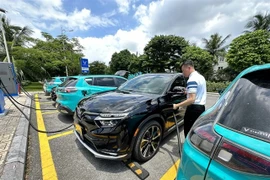
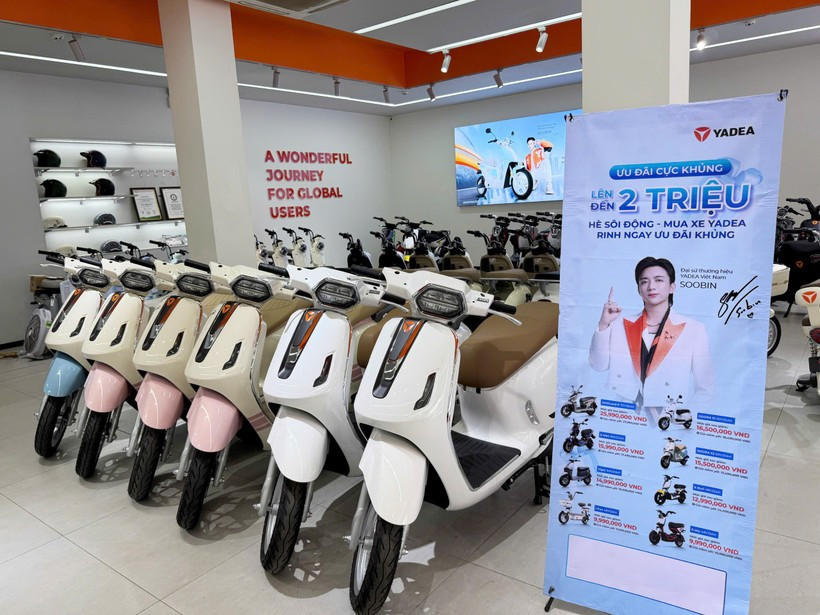
Domestic manufacturers like VinFast, Yadea, Selex, Dat Bike, and Pega now have a combined production capacity of 1.8 million units per year. (Photo: VNA)

Hanoi (VNA) – As Vietnam’s electric vehicle (EV) market is booming and not a “playground” of a single business, both domestic and foreign enterprises are accelerating to occupy this promising market.

The market is seeing a strong investment inflow, from both domestic firms and international corporations. Recently, LG Energy Solution, a leading global battery manufacturer from the Republic of Korea (RoK), announced its plan to invest in an electric motorbike factory and charging station in the northern province of Phu Tho.

The group’s intention to invest in Vietnam through official development assistance (ODA) is considered as a positive sign for the domestic energy industry and green transport development.

Facing the rising competition, domestic companies are promoting production and expanding their market shares. VinFast, an EV manufacturer of Vietnam, has set a target of raising its capacity of producing electric motorbikes to 1 million units a year, and venturing into new segments, including mini electric cars and electric trucks.

Dat Bike – a prominent startup in this field – is planning to triple the scale of its factory in Ho Chi Minh City, and expanding its coverage in the southwestern region. Notably, it is developing mobile maintenance and warranty services, a model welcomed by local consumers.

Domestic manufacturers like VinFast, Yadea, Selex, Dat Bike, and Pega now have a combined production capacity of 1.8 million units per year, close to the level that meets the new consumption trend. Meanwhile, foreign-invested Honda and Yamaha are also launching some EV models, expected to trigger a domino effect on other foreign brands such as Piaggio, Suzuki, and SYM.

Going beyond selling EVs, many foreign companies are eyeing to boost the rates of locally made components and long-term investment in Vietnam. BYD, the largest EV manufacturer in China, is reportedly making a survey to open a plant in Vietnam, while the RoK’s Hyundai is intensifying its supply chain in the country.

Mercedes-Benz, BMW, Audi, and Porsche are also introducing their high-class EVs, targeting local high-income earners.

According to experts, the Vietnamese EV market is entering an important transition stage, and this race sees the involvement of technology, services, infrastructure and policies.

The roadmap to restrict the use of petrol-powered vehicles and encourage green ones in such major cities as Hanoi and Ho Chi Minh City is creating a strong boost to the EV market. Thorough preparations, not only in product but also in services, maintenance and charging stations, are believed to be key to the success of enterprises in this field.

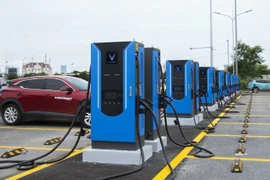
Currently, several localities like Hanoi, Da Nang city, and Ho Chi Minh City are taking measures to support investors in developing charging stations like land lease fee exemption and location planning.

However, experts stressed the need for the early issuance of common technical standards for batteries and charging stations, as well as green credit policies and incentives in terms of electricity prices.

RMIT forecast the Vietnamese EV market may reach 6.7 billion USD by 2030, with an average growth rate of 18% annually./.

VNA
See more

Vietnam is strengthening its position in the technology value chain, becoming a major manufacturing hub for complete consumer electronics products. (Photo: VNA)

ESG standards offer opportunities to reposition Vietnam’s electronics firms

The 2025-2027 period will be a critical turning point, as exporters to the European market will be required to strictly comply with ESG standards, including net-zero emissions roadmaps, labour standards, corporate governance and transparency requirements. As a key export sector, the electronics industry is being directly and strongly affected by this shift.

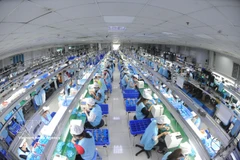
A production line for camera modules and electronic components at the factory of MCNEX VINA Co. Ltd, a Republic of Korean-invested company in Phuc Son Industrial Park, Ninh Binh province. (Photo: VNA)

Science, technology, innovation as engines of economic growth

To ensure that science and technology truly act as a powerful growth engine, experts emphasised the need for the Government to put in place supportive mechanisms and policies that encourage enterprises to invest in research and development, while strengthening cooperation among the State, research institutions and the business sector.

The headquarters of the Ministry of Industry and Trade in Hanoi (Photo: VNA)

PM updates lead roles to drive UKVFTA forward

The Ministry of Industry and Trade (MoIT) is named the lead agency, with overall responsibility for the agreement’s general goals and definitions, trade remedies, non-tariff barriers to trade and investment in renewable energy, competition policies, State-owned enterprises, enterprises with special or exclusive rights and those with designated monopolies, as well as institutional, general and final terms.

Vietravel Airlines is taking measures to enhance service quality and optimise operations amid high travel demand during Tet. (Photo: VNA)

Vietravel Airlines to add new route serving Lunar New Year travel peak

During the peak period of the Lunar New Year (Tet) festival in 2026, Vietravel Airlines plans to operate six – eight flights daily on the Ho Chi Minh City – Hanoi route, three flights daily on the Ho Chi Minh City – Da Nang and Ho Chi Minh City – Vinh routes; and two flights daily on the Ho Chi Minh City – Quy Nhon route.

The completion of Can Tho - Ca Mau expressway has helped shorten travel time from Can Tho to Ca Mau to just one hour and a half (Photo: VNA)

Can Tho–Ca Mau expressway fully opens from January 19

The new section, together with the Can Tho–Hau Giang segment that has been operating smoothly since late December last year, has completed the entire 110.85-km route. With total investment exceeding 27.52 trillion VND (1.04 billion USD), the four-lane expressway is built to modern standards and serves as a key transport artery linking major economic and political centres, industrial zones and seaports in the southwestern region.