VinFast adds 500 million USD to expand plant in India

As the second phase of its existing 2 billion USD commitment, VinFast will invest 500 million USD in Thoothukudi to develop new dedicated workshops and production lines for electric buses and e-scooters, covering manufacturing, assembly, testing and other related operations.

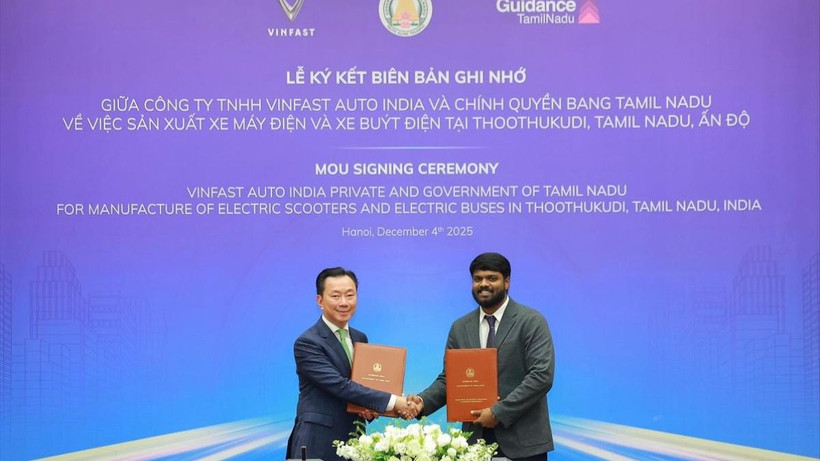
Pham Sanh Chau (left), Vingroup Asia CEO and VinFast Asia CEO, and Prabakaran Andi Saravanan, Associate Vice President at Guidance Tamil Nadu, at the MoU signing ceremony. (Photo: vingroup.net)

Hanoi (VNA) – VinFast and the government of India's Tamil Nadu state signed a memorandum of understanding (MoU) to allocate approximately 200 hectares of land in the SIPCOT Industrial Park in Thoothukudi city to support the development of the company’s existing facility.

This milestone provides an opportunity for VinFast to broaden its product portfolio from electric cars to electric buses, e-scooters and charging infrastructure, while reaffirming the company’s long-term commitment to the world’s third largest automotive market.

Under the MoU, the government of Tamil Nadu will allocate approximately 200 hectares of land adjacent to VinFast’s existing facility in Thoothukudi. The state will also provide support in securing required permits and in establishing essential infrastructure connections such as electricity, water, internal road access, drainage, and waste management.

As the second phase of its existing 2 billion USD commitment, VinFast will invest 500 million USD in Thoothukudi to develop new dedicated workshops and production lines for electric buses and e-scooters, covering manufacturing, assembly, testing and other related operations.

For VinFast’s proposed 500 million USD investment, the government of Tamil Nadu will apply all applicable incentives, financial support measures, and statutory exemptions in accordance with the state’s prevailing regulations and relevant policies.

With the signing of this MoU, VinFast takes another step forward in strengthening its manufacturing readiness in the Indian market. The initiative is also expected to increase supply chain localisation, create additional employment opportunities, and support workforce skill development in the region.

The existing Thoothukudi facility covers 160 hectares and is equipped with internationally standardised production lines. It has an initial annual capacity of 50,000 electric vehicles and is being expanded to 150,000 units.

Pham Sanh Chau, Vingroup Asia CEO and VinFast Asia CEO, stated that the proposed expansion of the Tamil Nadu plant will enable VinFast to broaden its product lineup in India, from electric cars to electric buses and e-scooters, allowing it to meet a wider range of customer needs.

He noted the company also expects this initiative to create new job opportunities, advance localisation and strengthen the skills of the local workforce. It believes that Tamil Nadu will continue to serve as a strategic hub in its global expansion journey and will play an important role in supporting India’s green mobility goals in the years ahead.

Dr. T.R.B. Rajaa, Minister of Industries of the government of Tamil Nadu, said they welcome VinFast’s next phase of planned development of electric cars in Tamil Nadu, and that the new introduction of electric bus and e-scooters production will generate additional momentum for the green transportation strategy of both Tamil Nadu and India.

The state government is committed to working closely with VinFast and ensuring favourable conditions throughout the implementation process to deliver lasting benefits for the community and the regional economy, he added.

Since entering the Indian market, VinFast has continuously expanded its comprehensive electric vehicle ecosystem that spans manufacturing, distribution, charging infrastructure, aftersales services and battery recycling. At the same time, the company’s distribution network is rapidly growing, with 24 dealers already operating in major cities and a target of reaching 35 by the end of the year./.


VNA

See more

Tran Ngoc Quan, Trade Counsellor and head of the Vietnam Trade Office in Belgium and the EU (Photo: VNA)

Belgian firms suggested to expand presence in Vietnamese market

Entering 2026 – the first year of implementing the Vietnam – EU Comprehensive Strategic Partnership, the Vietnam Trade Office in Belgium and the EU views this as a pivotal time to inject new momentum into trade ties, said Trade Counsellor Tran Ngoc Quan.

Saigon Marina IFC, an emerging landmark, reflects Ho Chi Minh City’s pioneering spirit.

Saigon Marina IFC – The light of Ho Chi Minh City’s new icon

Saigon Marina IFC, an emerging landmark, reflects Ho Chi Minh City’s pioneering spirit. Designed to become an International Financial Centre, this new architectural icon along the Saigon River is envisioned not only as a premium commercial complex, but as a central platform supporting financial institutions, international investors and cross-border capital flows in the years ahead.

Shoppers at a supermarket in Hung Yen (Photo: VNA)

Retailers see tax compliance, AI as key to survival in 2026 survey

The annual survey, conducted at the end of 2025 among retail and food and beverage (F&B) sellers nationwide, found that businesses are shifting their focus from rapid growth to operational efficiency, cost control and legal compliance amid increasingly stringent regulatory standards.

Visitors shop at Glorious Spring Fair 2026 (Photo: VNA)

Spring Fair 2026 opens broader prospects for Vietnam–UAE trade cooperation

For Vietnam, the UAE serves not only as a consumer market but also as a gateway to the Middle East and North Africa. Vietnamese agricultural products such as cashew nuts, pepper, cinnamon and rice have steadily gained market share, while aquatic products, including tra fish and tuna, are increasingly present in the UAE’s hospitality sector.

Bao Viet Bank's employee counts Vietnamese banknotes at a transaction counter in Hanoi. (Photo: VNA)

Credit quota reform, tighter capital rules may widen gap among banks

Yuanta Vietnam Securities estimates that to achieve GDP growth above 10%, credit growth would need to exceed 16%. This suggests bank credit is no longer expected to be the main growth driver, with greater reliance on fiscal policy, public investment and capital markets.

Commercial Counsellor Do Viet Phuong, Head of the Vietnam Trade Office in Cambodia. (Photo: VNA)

Spring Fair 2026 offers ample room to deepen Vietnam–Cambodia trade ties

Cambodia holds substantial potential for cooperation in agro-processing and exports, especially in key products such as rice, cashew nuts and rubber. In recent years, the country’s cultivation area and agricultural output have grown steadily, providing a stable raw material base for processing industries.

Vietnam is projected to have approximately 2.4 million SMEs, accounting for over 98% of the country’s total enterprises. (Photo: cafef.vn)

Banks offer diverse solutions to support SMEs

With an increasingly significant role in the economy, the small and medium-sized enterprise (SME) sector is becoming a key segment in the credit growth strategies of many banks and the banks have been taking diverse solutions to support the enterprises.