Work plan promotes national digital transformation for socio-economic development

Prime Minister Pham Minh Chinh, Chairman of the National Committee for Digital Transformation, has signed a decision to issue the committee’s work plan in 2024, aiming to speed up national digital transformation in an effective and practical manner, creating breakthroughs in the country's socio-economic development and contributing to completing all socio-economic targets for 2024 and the 2021-2025 period.
Work plan promotes national digital transformation for socio-economic development ảnh 1Officials and employees of agencies in northern Dien Bien province install the "Dien Bien Smart" application and use online public services. (Photo: VNA)
Hanoi (VNA) – Prime Minister Pham Minh Chinh,Chairman of the National Committee for Digital Transformation, has signed a decision to issue the committee’s work plan in 2024, aiming to speedup national digital transformation in an effective and practical manner, creatingbreakthroughs in the country's socio-economic development and contributing tocompleting all socio-economic targets for 2024 and the 2021-2025 period.

The work plan’s objectives include strengthening theresponsibility of organisations and individuals, especially leaders of stateagencies at all levels in digital transformation, while synchronously andeffectively implementing goals and tasks in the National Digital TransformationProgramme to 2025 with a vision to 2030, e-government development strategiestowards digital government, and the strategy for developing digital economy anddigital society.

Specific targets of the work plan include developing 48,000digital technology enterprises operating in localities, and 60% of businessesin industrial parks and export processing zones applying digital platforms inmanagement and production, thus changing production and business processes,increasing productivity, operational efficiency, and reducing emissions.

Meanwhile, 40% of adults are expected to use online publicservices. This year, the Government will complete the supply of 53 onlinepublic services.

At the same time, 100% of the information system serving theprocessing of administrative procedures of ministries, sectors and localitieswill be connected to the system monitoring and measuring the level of serviceprovision (EMC system).

Under the work plan, 100% of the reporting informationsystems of ministries, sectors and localities are expected to be connected tothe government reporting information system, the centre for information and directionof the Government and the Prime Minister, while 100% of villages and hamlets accessingthe national power grid are hoped to have mobile broadband coverage.

Besides, 100% of ministries, ministerial-level agencies, governmental agencies and People's Committees of provinces and centrally-runcities are scheduled to use the management support platform to ensureinformation security by level.

To achieve these targets, the National Committee for Digital Transformation gave a number ofsolutions, including strengthening inspections of the implementation of digital transformationtasks in ministries, sectors and localities, building a semiconductor IC industrydevelopment strategy to 2030 with a vision to 2035, promoting, connecting andproviding favourable conditions for digital technology firms to engage in the digitaltransformation process in industrial parks and export processing zones, prioritisingthe use of digital technology solutions developed by Vietnamese businesses, speedingup the development of local digital technology businesses, and deployingelectronic invoice solutions initiated from cash registers to prevent tax andbudget losses./.
VNA

See more

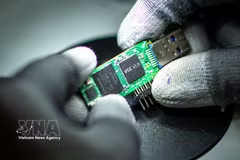
The VGC v1.0 security chip, designed and developed by Vietnam (Photo: VNA)

Vietnam builds initial semiconductor foundation

Experts said the first step is not another broad strategy but a hard-headed audit of what Vietnam can actually do and a clear-eyed map of its advantages, technology gaps and opportunities in the global value chain.

The inauguration ceremony of the ASEAN-China Health Exchange and Cooperation Centre in Chongqing. (Photo: VNA)

Vietnam proposes stronger ASEAN-China cooperation in AI

For Vietnam, AI-driven transformation is both a strategic opportunity and an inevitable requirement for development. Science, technology and innovation are becoming key drivers of growth, productivity and competitiveness, said Deputy Minister of Foreign Affairs Nguyen Manh Cuong.

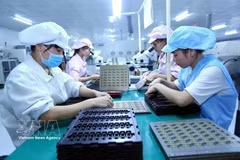
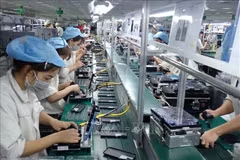
Assembling electronic components on the production line of Bao Sen Co., Ltd in Bac Ninh City. (Photo: VNA)

Vietnam builds technological capacity in digital era

As science, technology and digital transformation become increasingly integrated into production, governance and daily life, they can help create new drivers of growth and advance the development goals set out in the resolution.

The beauty of Dong Van Karst Plateau (Photo: VNA)

Vietnam tourism’s competitive future runs on digitalisation

The Vietnam National Authority of Tourism (VNAT) reported that Vietnam drew about 19.5 million foreign arrivals in the first 10 months of 2026, up 13.8% from a year earlier. That growth, along with changing consumer behavior, is forcing travel companies to rethink sales, service quality and how they mine customer data.

Visitors at the exhibtion held within the framework of the 16th Business of IP Asia Forum. (Photo: VNA)

Vietnam promotes innovation links at Hong Kong Entrepreneur Day 2026

Van expressed her hope that the NIC would serve as a bridge to encourage businesses and major corporations from the GBA to invest in Vietnam and transfer innovative technologies, particularly in artificial intelligence (AI), green transition and financial technology (FinTech).

Karnataka Chief Minister D.K. Shivakumar speaks positively about cooperation prospects and expresses hope that more Vietnamese businesses will invest in the Indian state. (Photo: VNA)

Vietnam, India's Karnataka boost science, technology cooperation

The ambassador highlighted the complementary strengths of Vietnam and the Indian state, home to the country's Silicon Valley, and significant potential for cooperation in artificial intelligence (AI), semiconductors, digital technology, and research and development.

Delegates pose for a group photo at the Bengaluru Tech Summit 2026 in Karnataka, India (Photo: VNA)

Vietnam attends annual int’l tech summit in India

Vietnam's growing focus on science and technology, digital transformation and innovation as new drivers of development made India a natural partner in achieving its development and digital transformation goals. Cooperation potential between the two countries remains substantial, spanning both hardware and software.

Vietnamese Deputy Minister of Science and Technology Tran Trung Tinh speaks at the event. (Photo: Published by VNA)

Vietnam, RoK seek to expand cooperation in AI and semiconductor sectors

Vietnamese Deputy Minister of Science and Technology Tran Trung Tinh stressed that the Politburo's Resolution No. 57-NQ/TW identifies science and technology, innovation and digital transformation as leading breakthroughs and key drivers of rapid and sustainable development. Semiconductors and artificial intelligence (AI) are among the strategic technologies prioritised for development.

Representatives of Cambodia’s Ministry of Education, Youth and Sport (MoEYS), the Agence Universitaire de la Francophonie (AUF) and Viettel Cambodia (Metfone) sign a tripartite agreement to strengthen cooperation and accelerate digital transformation in Cambodia’s higher education sector. (Photo: khmertimeskh.com)

Vietnamese company joins Cambodia’s digital transformation efforts

The agreement establishes a cooperation framework to modernise higher education through digital governance, digital learning, artificial intelligence (AI) applications, and capacity building through training and knowledge sharing. It also aims to expand internship, employment and scholarship opportunities for students.

USTH students access modern equipment (Photo: VNA)

Vietnam’s AI ambition runs into talent wall

AI is becoming a foundational technology, cutting across industrial production, healthcare, education, finance, governance and public service delivery. But turning technological potential into practical value requires a workforce able to study, master and apply AI to Vietnam’s real-world problems.

Trainees practise programming and operating robots at the Ho Chi Minh City High-Tech Park Training Centre. (Photo: VNA)

Vietnam, Malaysia hold potential for cooperation in robotics industry

Businesses from both countries should lead joint research and field-testing projects in areas such as electronic component inspection, warehouse transport, agricultural monitoring and medical logistics, said Samirul Ariff Othman, a policy, economic and business analyst at Global Asia Consulting and visiting lecturer at Universiti Teknologi PETRONAS.

Illustrative image (Photo: SGGP)

Ericsson establishes R&D capability in Vietnam

This initiative builds on Ericsson’s growing software engineering and testing capabilities in the country, and will further strengthen Vietnam’s contribution to Ericsson’s global technology development.