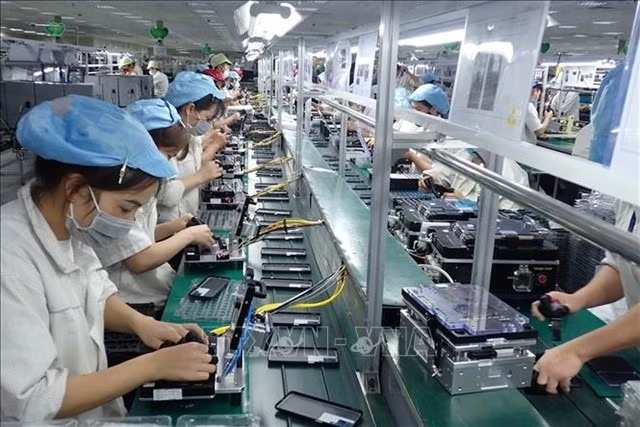
Hanoi (VNS/VNA) – Vietnam's digital technology industry generated an estimated 254.6 billion USD in revenue in the first 10 months of 2026, up 53% from a year earlier, while exports rose 46.2% to 212 billion USD, the Ministry of Science and Technology said in its latest report.
According to the report, hardware and electronics exports reached an estimated 30.681 billion USD in October, up 108% from the same month last year. Businesses in the sector contributed an estimated 12.45 trillion VND in taxes to the state budget, an increase of 102%.
The industry recorded total revenue of 215 billion USD in 2025, up 36% from the previous year, with exports reaching 172 billion USD, an increase of 30%.
The growth comes as Vietnam steps up efforts to implement Politburo Resolution No. 57-NQ/TW on breakthroughs in science and technology, innovation and national digital transformation.
After nearly two years of implementation, the country has gradually strengthened its legal framework, mobilised investment resources and expanded digital infrastructure, the ministry said.
The ministry has led the drafting, submission or issuance of 195 legal documents and advised on a 100-day campaign to address bottlenecks in digital transformation.
Digital platforms and online public services have also expanded across government agencies.
As of September 30, 37 of the country's 79 national shared digital platforms were operational, while another 12 were undergoing testing. A national digital master architecture framework has also been issued to guide ministries, agencies and local authorities in developing interconnected information systems and facilitating data sharing and reuse.
The National Public Service Portal currently offers 3,745 online administrative procedures, including 2,361 fully online services.
By October, Vietnam had issued approximately 36.16 million digital signature certificates, up 36.71% from the end of 2025.
Artificial intelligence is also being introduced into public administration. Two platforms developed by Vietnamese companies using Vietnamese-language large language models are being piloted free of charge at 24 ministries and central agencies and 34 localities.
The platforms assist officials in searching legal documents, drafting and summarising content, comparing regulations and reviewing documents. As of November 2, they had attracted around 761,000 registered accounts, the ministry said.
Meanwhile, the Government is seeking to align scientific research and innovation more closely with practical needs.
The Prime Minister has identified 20 major challenges and assigned 10 ministries, sectors and agencies to lead efforts to address them. He has also approved a plan to restructure national science, technology and innovation programmes for 2026-35.
As of November 3, authorities had approved 18 strategic technology tasks, marking a shift towards an output-oriented approach that links research activities more closely with real-world applications./.
See more
Vietnam ranks among world's top 50 economies in digital and AI competitiveness
Vietnam ranked 13th in AI application, 15th in digital and AI governance, and 21st in efficiency, highlighting its strengths in digital technology and AI application, and in digital governance.
Strategic technologies key to improving Vietnam’s Global Innovation Index
The 2025 and 2026 GII reports show that Vietnam continued to rank first globally in the share of high-tech exports and creative goods in total trade.
Vietnam’s AI ambition runs into talent wall
AI is becoming a foundational technology, cutting across industrial production, healthcare, education, finance, governance and public service delivery. But turning technological potential into practical value requires a workforce able to study, master and apply AI to Vietnam’s real-world problems.
Vietnam, Malaysia hold potential for cooperation in robotics industry
Businesses from both countries should lead joint research and field-testing projects in areas such as electronic component inspection, warehouse transport, agricultural monitoring and medical logistics, said Samirul Ariff Othman, a policy, economic and business analyst at Global Asia Consulting and visiting lecturer at Universiti Teknologi PETRONAS.
Ericsson establishes R&D capability in Vietnam
This initiative builds on Ericsson’s growing software engineering and testing capabilities in the country, and will further strengthen Vietnam’s contribution to Ericsson’s global technology development.
RoK’s AI robotics drive opens cooperation opportunities with Vietnam
Dao Tuan Hung, President of the Business Association of Vietnamese in Korea (BAVIK), said Vietnam should adopt a practical approach by prioritising specialised robots, including autonomous mobile robots (AMR/AGV), collaborative robots and machine vision systems, in sectors such as agro-fishery processing, textiles and garments, electronics and logistics.
Russian survey vessel docks in Hai Phong
This is the third joint marine scientific survey in Vietnamese waters, running from November 4 - December 12, and one of the opening field activities under the Vietnam–Russia roadmap for marine scientific research cooperation for 2026-2035.
Vietnam-Japan semiconductor cooperation paves the way for high-tech investment
The two countries are implementing five semiconductor research projects involving leading universities, with funding agreements signed in July. The projects cover three-dimensional integrated circuits, advanced semiconductor materials, secure artificial intelligence (AI) chips and power electronic components.
Vietnam to open registration for two-character “.vn” domain names for first time
Short, memorable and limited in number, these domains offer businesses, organisations and individuals an opportunity to establish distinctive online identities and strengthen their brands in the digital environment.
Mobilising international resources to drive Vietnam’s technology development
Vietnam previously focused mainly on attracting overseas experts and intellectuals to work in the country over the long term, but this approach encountered certain difficulties. Cooperation methods are now shifting towards greater flexibility, allowing experts to take part in conferences and scientific seminars, contribute to addressing major national challenges, or participate in short-term training and research programmes.
Vietnam needs to master robot integration technologies to develop robotics industry
Associate Professor Dr. Duong Minh Hai of the National University of Singapore said Vietnam has several advantages, including its industrial manufacturing base, network of industrial parks, foreign investment inflows and technical workforce.
Core technologies key to sustainable robotics development in Vietnam: expert
Vietnam should select suitable robotic platforms and gradually build capacity in core technologies, including sensing, environmental perception, positioning, state estimation, AI, control and system integration. This will help develop technologies applicable across multiple sectors while avoiding fragmented investment and dependence on a single product category.
AI robots help streamline administrative procedures
Operating around the clock, AI robots provide information on administrative procedures, required documents, processing times, fees and relevant regulations, complementing assistance from civil servants.
From QR codes to digital communities
Residents could send their QR codes to visitors and service providers, enabling them to find homes without asking for directions.
High prospects for Vietnam-Italy cooperation in robotics industry
Vietnam and Italy have highly complementary strengths in this robotics field. Italy has experience in machinery manufacturing, industrial robotics applications and an established business network, while Vietnam has a dynamic market, strong demand for production modernisation and a promising young engineering workforce.
Top leader receives new foreign ambassadors
Vietnam wishes to step up cooperation with the countries in such areas as economy, trade and investment; cutting-edge science and technology applications, semiconductors, artificial intelligence, new materials, digital transformation, sustainable agriculture, the environment, energy and renewable energy, the marine economy and maritime transport.
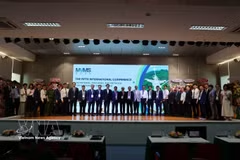
Over 400 scientists attend international material conference
Discussions focus on six key areas, including advanced materials and their applications for sustainable development; environmentally friendly material processing technologies; product lifecycle engineering; sustainable machine design; low-carbon industries and the circular economy; and artificial intelligence and digital transformation in material and mechanical engineering.
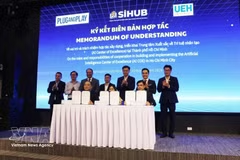
Applied AI Centre of Excellence to be built in Ho Chi Minh City
The initiative follows a memorandum of understanding signed in Ho Chi Minh City on September 30 by the three parties, aimed at establishing a regular channel linking the city’s innovation and startup ecosystem with Silicon Valley.
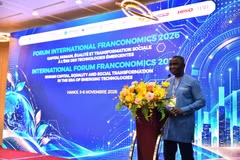
Franconomics 2026 explores human-centred technological transformation
Addressing the opening ceremony, Nguyen Anh Tuan, Rector of VNU-IS, said Franconomics was launched in 2019 as a multidisciplinary platform connecting scientists, policymakers, businesses and international organisations to discuss socio-economic issues relevant to Vietnam and the Francophone community.
Vietnam promotes int'l cooperation in science, technology and innovation
Science is opening up new opportunities in artificial intelligence, healthcare, semiconductors and clean energy, while challenges such as climate change, energy security and epidemics require international cooperation. Science, technology, innovation and digital transformation are central to Vietnam’s new growth model.