Vietnam, Malaysia hold potential for cooperation in robotics industry

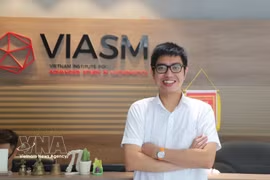
Businesses from both countries should lead joint research and field-testing projects in areas such as electronic component inspection, warehouse transport, agricultural monitoring and medical logistics, said Samirul Ariff Othman, a policy, economic and business analyst at Global Asia Consulting and visiting lecturer at Universiti Teknologi PETRONAS.

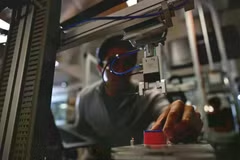
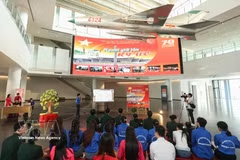
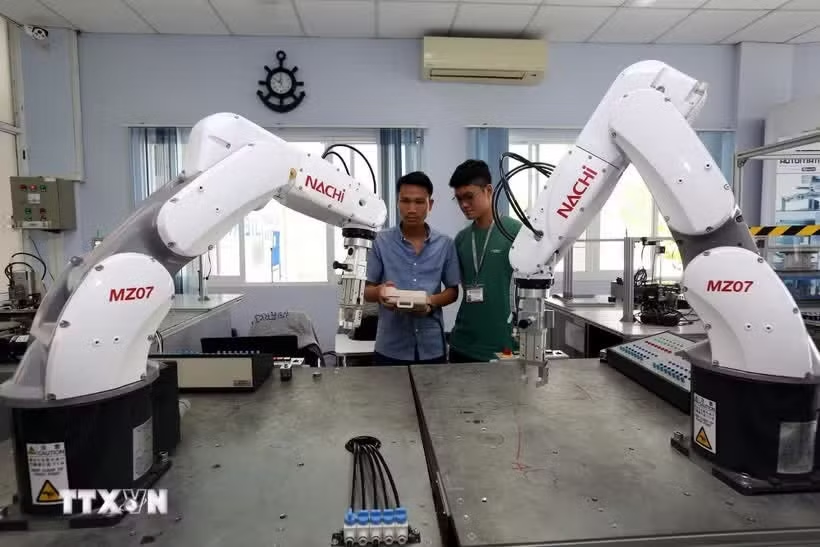
Trainees practise programming and operating robots at the Ho Chi Minh City High-Tech Park Training Centre. (Photo: VNA)

Kuala Lumpur (VNA) – Vietnam and Malaysia have strong potential to expand cooperation in the robotics industry, combining their complementary manufacturing capabilities to develop higher-value products and strengthen their positions in global value chains, according to a Malaysian expert.

Samirul Ariff Othman, a policy, economic and business analyst at Global Asia Consulting and visiting lecturer at Universiti Teknologi PETRONAS, said ASEAN's biggest short-term commercial opportunities in industrial robotics lay in specialised manufacturing, system integration and practical applications.

Speaking to Vietnam News Agency correspondents in Malaysia, he noted that the region's deep integration into global production networks had given its businesses a strong understanding of factory requirements and industrial customers.

ASEAN members have complementary strengths. Malaysia has capabilities in semiconductor manufacturing, automated testing, precision engineering and industrial electronics, while Singapore focuses on advanced research, software and high-value engineering. Vietnam has a rapidly expanding electronics manufacturing base, and Thailand has a well-established automotive and industrial ecosystem.

The growth of Malaysian automation companies such as ViTrox, Pentamaster, Greatech and Genetec demonstrates the region's capacity to supply complex technological systems, he said.

Samirul identified opportunities across four layers of the robotics value chain, namely hardware, microchips, sensors and control software. ASEAN businesses can produce precision components and specialised equipment, move from semiconductor packaging, assembly and testing towards chip design, and integrate measurement and machine-vision technologies into reliable sensor systems. Greater value can be generated in software through applications for robot control, quality inspection, and fleet management.

While the US has advantages in advanced artificial intelligence (AI), software platforms and semiconductor design, and China benefits from large-scale manufacturing and comprehensive component supply chains, ASEAN can strengthen its position by adapting technologies to specific industries and operating conditions.

The key challenge, he said, is to help local businesses develop their own intellectual property and maintain direct relationships with customers, rather than remain low-value contract manufacturers.

To unlock this potential, Samirul proposed four priority areas for Vietnam-Malaysia cooperation.

First, businesses from both countries should lead joint research and field-testing projects in areas such as electronic component inspection, warehouse transport, agricultural monitoring and medical logistics. These projects should involve customers in both markets and establish measurable performance standards and clear pathways towards repeat commercial orders.

Second, companies, universities and research institutes should jointly develop and commercialise products by combining expertise in precision components, electronics, software and system integration. Cooperation agreements should clearly define ownership of existing technologies, jointly developed improvements and access to operational data.

Third, the two countries should establish joint robotics training programmes, including engineer exchanges, industrial internships and practical training to develop a skilled workforce.

Fourth, they should connect existing testing facilities and industrial sites to create a bilateral network for product trials. Testing in both markets would help businesses identify weaknesses, assess commercial viability and prepare for wider ASEAN markets. Cooperation should also cover safety standards, cybersecurity and technical compatibility, while equipment leasing and robot-as-a-service (RaaS) models could help smaller customers reduce initial investment costs.

He stressed that the ultimate goal should be to jointly develop products, validate them in both markets and expand commercialisation across ASEAN, enabling the region to retain a greater share of the value generated by the smart technology revolution./.

VNA

See more

Illustrative image (Photo: SGGP)

Ericsson establishes R&D capability in Vietnam

This initiative builds on Ericsson’s growing software engineering and testing capabilities in the country, and will further strengthen Vietnam’s contribution to Ericsson’s global technology development.

Russian survey vessel Akademik M.A. Lavrentyev (Photo: VNA)

Russian survey vessel docks in Hai Phong

This is the third joint marine scientific survey in Vietnamese waters, running from November 4 - December 12, and one of the opening field activities under the Vietnam–Russia roadmap for marine scientific research cooperation for 2026-2035.

Smart products, chips and semiconductor materials are displayed at the launch ceremony of the national semiconductor chip prototyping support centre in Hanoi on June 26, 2026. (Photo: VNA)

Vietnam-Japan semiconductor cooperation paves the way for high-tech investment

The two countries are implementing five semiconductor research projects involving leading universities, with funding agreements signed in July. The projects cover three-dimensional integrated circuits, advanced semiconductor materials, secure artificial intelligence (AI) chips and power electronic components.

An exhibition space at the “Da Nang Semiconductors and High-Tech 2026” conference, organised by the Da Nang People’s Committee. (Illustrative photo: VNA)

Mobilising international resources to drive Vietnam’s technology development

Vietnam previously focused mainly on attracting overseas experts and intellectuals to work in the country over the long term, but this approach encountered certain difficulties. Cooperation methods are now shifting towards greater flexibility, allowing experts to take part in conferences and scientific seminars, contribute to addressing major national challenges, or participate in short-term training and research programmes.

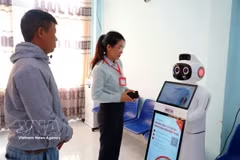
AI robots have become effective assistants in providing administrative services and reducing the workload of officials in Lam Dong province (Photo: VNA)

AI robots help streamline administrative procedures

Operating around the clock, AI robots provide information on administrative procedures, required documents, processing times, fees and relevant regulations, complementing assistance from civil servants.

High prospects for Vietnam-Italy cooperation in robotics industry

High prospects for Vietnam-Italy cooperation in robotics industry

Vietnam and Italy have highly complementary strengths in this robotics field. Italy has experience in machinery manufacturing, industrial robotics applications and an established business network, while Vietnam has a dynamic market, strong demand for production modernisation and a promising young engineering workforce.

General Secretary of the Communist Party of Vietnam (CPV) Central Committee and President To Lam and the foreign ambassadors at the meeting (Photo: VNA)

Top leader receives new foreign ambassadors

Vietnam wishes to step up cooperation with the countries in such areas as economy, trade and investment; cutting-edge science and technology applications, semiconductors, artificial intelligence, new materials, digital transformation, sustainable agriculture, the environment, energy and renewable energy, the marine economy and maritime transport.

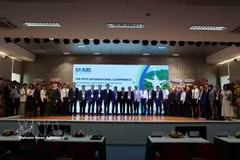
Delegates at the event (Photo: VNA)

Over 400 scientists attend international material conference

Discussions focus on six key areas, including advanced materials and their applications for sustainable development; environmentally friendly material processing technologies; product lifecycle engineering; sustainable machine design; low-carbon industries and the circular economy; and artificial intelligence and digital transformation in material and mechanical engineering.

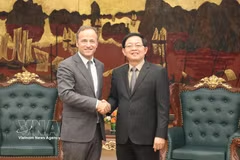
Deputy Prime Minister Ho Quoc Dung (R) and Pierre Barnabé, Chief Operating Officer of French technology group Dassault Systèmes. (Photo: VNA)

Vietnam, France step up cooperation in AI, digital twin technology

At the meeting, the Deputy PM praised the group's contributions to promoting technology cooperation between Vietnam and France, particularly its collaboration with the Ministry of Finance and the National Innovation Centre (NIC) to establish a Centre of Excellence (CoE) for digital twins and artificial intelligence (AI) in Hanoi.

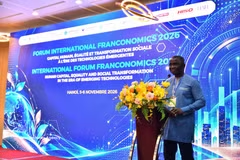
Rigobert Pinga Pinga, Acting Representative of OIF for Asia-Pacific speaks at the event. (Photo: VNA)

Franconomics 2026 explores human-centred technological transformation

Addressing the opening ceremony, Nguyen Anh Tuan, Rector of VNU-IS, said Franconomics was launched in 2019 as a multidisciplinary platform connecting scientists, policymakers, businesses and international organisations to discuss socio-economic issues relevant to Vietnam and the Francophone community.

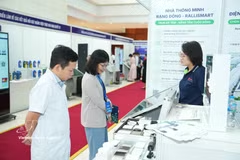
A new technology exhibition area arranged within the framework of the International Research and Innovation Funders Forum in Hanoi (Photo: VNA)

Vietnam promotes int'l cooperation in science, technology and innovation

Science is opening up new opportunities in artificial intelligence, healthcare, semiconductors and clean energy, while challenges such as climate change, energy security and epidemics require international cooperation. Science, technology, innovation and digital transformation are central to Vietnam’s new growth model.

GMA Awards are presented to honour outstanding AI courses at the Global MOOC & Online Education Conference 2026. (Photo: VNA)

Responsible AI, teaching overhaul, global ties dominate GMC 2026

Panelists said AI can support knowledge delivery, information processing and personalised learning, but cannot replace teachers in building independent thinking, critical capacity, emotional intelligence and humanistic values. Universities therefore need to overhaul teaching, testing and assessment and redefine lecturers’ role in an AI-integrated environment.

An overview of the seminar (Photo: VNA)

Coordinated development of energy, AI and infrastructure needed for industrial growth

Vietnam is emerging as a regional bright spot for data infrastructure development, driven by growing demand for AI, cloud computing, 5G commercialisation and digital transformation. However, the country needs coordinated preparations, including green power supplies, international submarine cable connectivity and operational capabilities meeting global standards.