Hanoi (VNA) – The Government has issued Decree No. 401/2026/ND-CP on administrative penalties for violations in the digital technology industry, with maximum fines of 200 million VND (7,830 USD) for organisations and 100 million VND for individuals.
The decree, signed by Deputy Prime Minister Ho Quoc Dung on behalf of the Government, stipulates violations, forms and levels of penalties, remedial measures, and the authority to impose sanctions and handle violations.
Fines ranging from 10 million VND to 60 million VND will be imposed for violations involving the provision and updating of information, and the connection and sharing of data with the digital technology industry database.
Violations of prohibitions in the digital technology industry, including unlawfully obstructing legitimate activities or supporting illegal operations, will be subject to fines of between 90 million VND and 140 million VND.
These violations include deliberately obstructing research and development, design, manufacturing, assembly, testing, packaging and other activities serving the production of hardware, software and digital content products, as well as the provision of digital technology services.
The same penalties apply to those deliberately providing, transferring, distributing, leasing or authorising the use of digital technology products and services to support organisations or individuals engaging in prohibited activities.
A fine of 140–170 million VND will be imposed on those using digital technology products or services to conduct prohibited activities, unless they are subject to penalties under other specialised laws.
Violations involving the abuse of digital technology industry activities to infringe upon national interests, national defence and security, social order and safety, public interests, human and citizen rights, or the legitimate rights and interests of organisations and individuals will face fines of 170–200 million VND.
The decree stipulates fines of 150–200 million VND for providing false information, using invalid documents or committing fraud in applications for incentives and support for large-scale key digital technology product manufacturing projects and major artificial intelligence data centre projects, provided the violations do not warrant criminal prosecution.
Meanwhile, similar fraudulent practices in applications for support policies for innovative start-ups in the digital technology industry will be subject to fines of 90–140 million VND. The above fines apply to organisations. Individuals committing the same violations will face fines equal to half those imposed on organisations.
The decree will take effect on November 22./.
See more
Vietnam needs to master robot integration technologies to develop robotics industry
Associate Professor Dr. Duong Minh Hai of the National University of Singapore said Vietnam has several advantages, including its industrial manufacturing base, network of industrial parks, foreign investment inflows and technical workforce.
Core technologies key to sustainable robotics development in Vietnam: expert
Vietnam should select suitable robotic platforms and gradually build capacity in core technologies, including sensing, environmental perception, positioning, state estimation, AI, control and system integration. This will help develop technologies applicable across multiple sectors while avoiding fragmented investment and dependence on a single product category.
AI robots help streamline administrative procedures
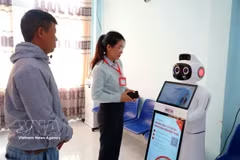
Operating around the clock, AI robots provide information on administrative procedures, required documents, processing times, fees and relevant regulations, complementing assistance from civil servants.
From QR codes to digital communities
Residents could send their QR codes to visitors and service providers, enabling them to find homes without asking for directions.
High prospects for Vietnam-Italy cooperation in robotics industry
Vietnam and Italy have highly complementary strengths in this robotics field. Italy has experience in machinery manufacturing, industrial robotics applications and an established business network, while Vietnam has a dynamic market, strong demand for production modernisation and a promising young engineering workforce.
Top leader receives new foreign ambassadors
Vietnam wishes to step up cooperation with the countries in such areas as economy, trade and investment; cutting-edge science and technology applications, semiconductors, artificial intelligence, new materials, digital transformation, sustainable agriculture, the environment, energy and renewable energy, the marine economy and maritime transport.
Over 400 scientists attend international material conference
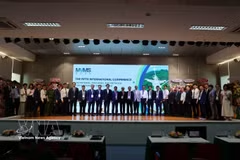
Discussions focus on six key areas, including advanced materials and their applications for sustainable development; environmentally friendly material processing technologies; product lifecycle engineering; sustainable machine design; low-carbon industries and the circular economy; and artificial intelligence and digital transformation in material and mechanical engineering.
Applied AI Centre of Excellence to be built in Ho Chi Minh City
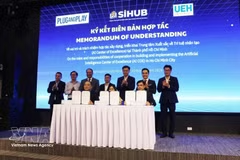
The initiative follows a memorandum of understanding signed in Ho Chi Minh City on September 30 by the three parties, aimed at establishing a regular channel linking the city’s innovation and startup ecosystem with Silicon Valley.
Digital technology opens new avenues for heritage education
Heritage education goes beyond providing knowledge to help learners understand the origins of cultural values, develop a critical mindset and foster a sense of responsibility towards the community.
Franconomics 2026 explores human-centred technological transformation
Addressing the opening ceremony, Nguyen Anh Tuan, Rector of VNU-IS, said Franconomics was launched in 2019 as a multidisciplinary platform connecting scientists, policymakers, businesses and international organisations to discuss socio-economic issues relevant to Vietnam and the Francophone community.
Vietnam promotes int'l cooperation in science, technology and innovation
Science is opening up new opportunities in artificial intelligence, healthcare, semiconductors and clean energy, while challenges such as climate change, energy security and epidemics require international cooperation. Science, technology, innovation and digital transformation are central to Vietnam’s new growth model.
Vietnam eyes deeper participation in ASEAN robotics ecosystem
Vietnam, with its strengths in export-oriented manufacturing and foreign investment attraction, is well positioned to participate more deeply in the region's robotics value chains.
Responsible AI, teaching overhaul, global ties dominate GMC 2026
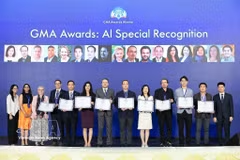
Panelists said AI can support knowledge delivery, information processing and personalised learning, but cannot replace teachers in building independent thinking, critical capacity, emotional intelligence and humanistic values. Universities therefore need to overhaul teaching, testing and assessment and redefine lecturers’ role in an AI-integrated environment.
Coordinated development of energy, AI and infrastructure needed for industrial growth
Vietnam is emerging as a regional bright spot for data infrastructure development, driven by growing demand for AI, cloud computing, 5G commercialisation and digital transformation. However, the country needs coordinated preparations, including green power supplies, international submarine cable connectivity and operational capabilities meeting global standards.
Vietnam unleashes data flows to drive digital transformation
Uniform management and regulated exploitation of information can cut repeated declarations by citizens and businesses and give state agencies a stronger basis for better administrative procedures.
Vietnam works to bridge gap between chip research and commercialisation
According to the Ministry of Science and Technology, Vietnam’s semiconductor industry has made notable progress. In 2025, it generated more than 21 billion USD in revenue and attracted over 14 billion USD in foreign investment through more than 240 projects. The country is now home to around 60 chip design companies and over 7,000 semiconductor design engineers.
Vietnam, China see potential for cooperation in humanoid robotics: Expert
Vietnam and China have significant potential to cooperate in humanoid robotics, spanning research, supply chains, practical applications, and human resources training, according to Assoc. Prof. Wang Xinsong from Beijing Normal University.
AI-powered translation platform wins Golden Startup Star award
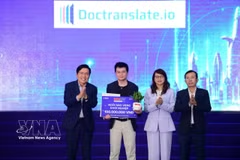
Doctranslate.io offers contextual translation, audio recording, transcription and content summarisation services for communication, meetings and international events. Supporting 80 languages, the platform aims to add more less widely spoken languages.
Vietnam, RoK promote AI cooperation
Vietnam attaches importance to international cooperation while building its own technological capabilities, gaining greater mastery of key technologies and strengthening its participation in global AI value chains, and the RoK is its important partner in this process.
Vietnam promotes cross-border digital trust in AI era
As AI becomes increasingly involved in digital transactions, digital content's origin and integrity must be verified proactively, rather than merely detecting false information after it emerges, an official has said.