Top leader receives new foreign ambassadors

Vietnam wishes to step up cooperation with the countries in such areas as economy, trade and investment; cutting-edge science and technology applications, semiconductors, artificial intelligence, new materials, digital transformation, sustainable agriculture, the environment, energy and renewable energy, the marine economy and maritime transport.

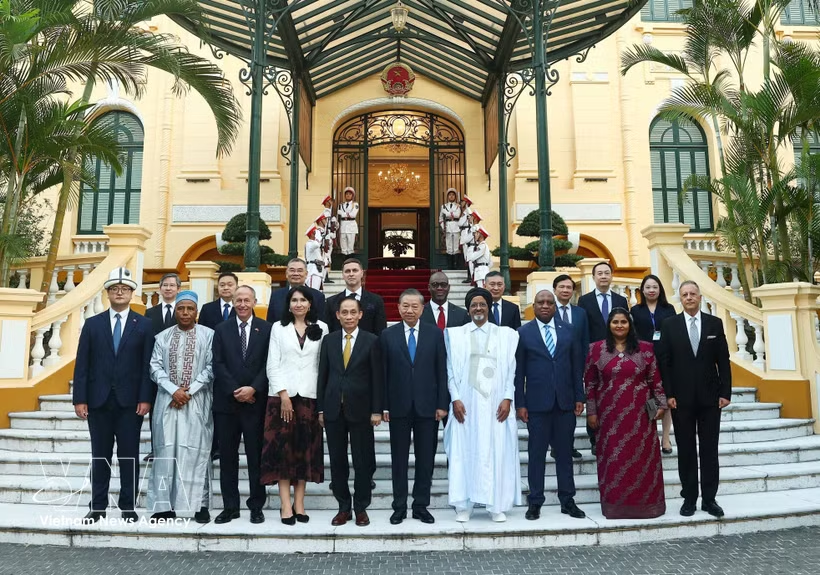
General Secretary of the Communist Party of Vietnam (CPV) Central Committee and President To Lam and the foreign ambassadors at the meeting (Photo: VNA)

Hanoi (VNA) – General Secretary of the Communist Party of Vietnam (CPV) Central Committee and President To Lam on the afternoon of November 6 received ambassadors of Luxembourg, Benin, Mauritania, Guinea, Lithuania, Botswana, the Maldives, Kyrgyzstan, Jordan and Estonia, who presented their credentials to officially assume their posts in Vietnam.

Warmly welcoming the ambassadors, the top leader said the year 2026 marks historic milestones: the 96th anniversary of the founding of the CPV, the 81st anniversary of the country’s establishment and 40 years of Doi Moi (Renewal).

From a country that endured decades of war and faced immense difficulties and challenges, Vietnam has emerged as a peaceful, unified, independent and self-reliant nation, with a dynamic economy, deep international integration and an increasingly prominent position in global production and supply chains.

General Secretary and President Lam expressed his gratitude, saying that the Vietnamese people always remember and cherished the solidarity, support and invaluable assistance extended by international friends during the country's struggle for national independence and reunification, as well as its subsequent efforts in national construction and development.

He stressed that 2026 marks Vietnam's entry into a new era of development, with two centenary goals. By 2030, the centenary of the Party's founding, Vietnam aims to become a developing country with modern industry. By 2045, the centenary of the country's establishment, it aims to become a developed, high-income nation. During 2026-2030, Vietnam will strive to maintain annual economic growth in double digits, laying a solid foundation for the next phase of accelerated development.

Vietnam has established a development model that is self-reliant, resilient, innovative, humane, sustainable and internationally integrated. It places people at the centre, ensuring they genuinely benefit from the fruits of development; regards knowledge and education as top national priorities; and identifies cutting-edge science and technology, innovation, digital and green transformations, and the development and connectivity of strategic infrastructure as key drivers of economic restructuring and development in the new era.

The leader affirmed that, throughout its past development journey and in the years ahead, Vietnam had always attached particular importance to friendly, cooperative, effective, practical and mutually beneficial relations with countries and international partners, based on shared development. The country remains steadfast in pursuing a foreign policy of independence, peace, self-reliance and resilience, and diversification and multilateralisation of external relations, while striving to be a friend and reliable partner of all countries.
vnanet_potal-tong-bi-thu-chu-tich-nuoc-to-lam-tiep-cac-dai-su-nuoc-ngoai-trinh-quoc-thu-9137429-1.jpg
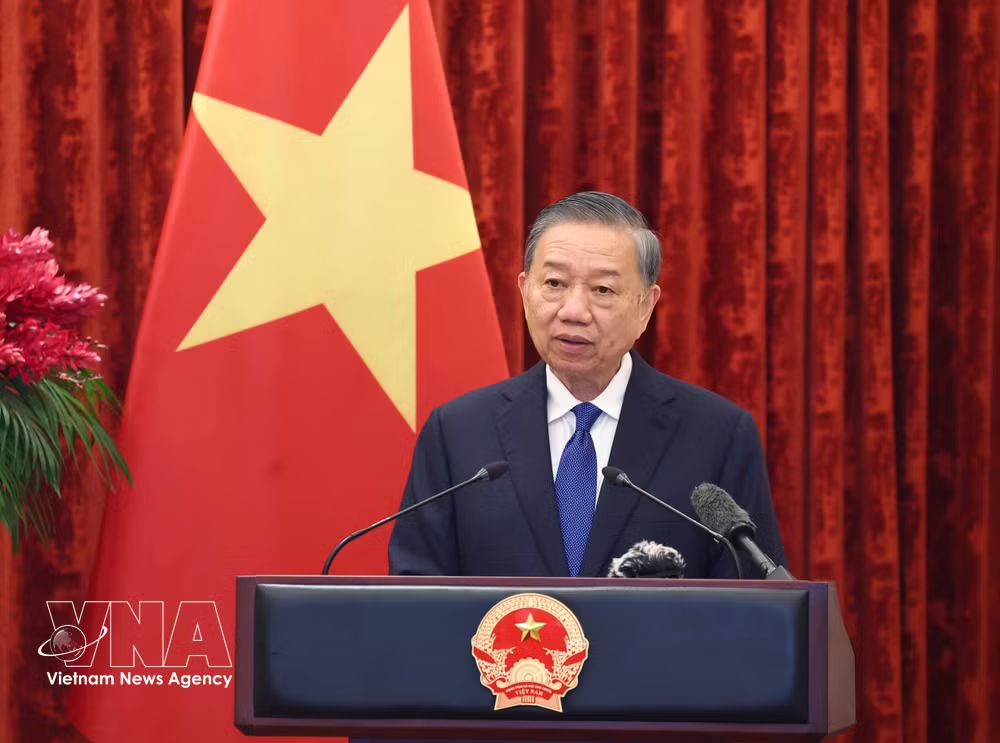
General Secretary of the Communist Party of Vietnam Central Committee and President To Lam addresses the meeting (Photo: VNA)

Expressing his pleasure at the achievements made by the countries in recent years, he said Vietnam wishes to work with them to further strengthen traditional friendship, historically close ties and multifaceted cooperation, both bilaterally and multilaterally, on the basis of equality, mutual benefit, shared responsibility and common development.

To deepen relations between Vietnam and the respective countries and make cooperation more substantive and effective in the coming period, General Secretary and President Lam called on the ambassadors to promote several areas of cooperation.

These include consolidating a firm political foundation and strengthening political trust on the basis of shared values, converging interests and a long-term vision for development, thereby ensuring stable and sustainable cooperation. This could be achieved through increased exchanges of delegations at all levels and across Party, State, Government, National Assembly, people-to-people, local and business channels.

He called for continued exchanges to renew and elevate the substance of cooperation in a flexible manner that responds to changing circumstances, creating practical value and benefits for both sides and helping one another participate more deeply in regional and global production and supply chains.

Vietnam wishes to step up cooperation with the countries in such areas as economy, trade and investment; cutting-edge science and technology applications, semiconductors, artificial intelligence, new materials, digital transformation, sustainable agriculture, the environment, energy and renewable energy, the marine economy and maritime transport, strategic infrastructure and logistics, education and training, human resources development, and people-to-people and cultural exchanges, he said.

The Party and State leader underscored the need to maintain close coordination in promoting multilateral cooperation for a more interconnected world. All countries should join hands to address common challenges at both global and regional levels, contributing to the preservation of peace and stability and the promotion of sustainable development in all regions, he said.

He expressed his hope that the ambassadors, drawing on their extensive experience and standing, would actively contribute to realising these cooperation orientations. He affirmed that the Vietnamese Government and relevant agencies would stand alongside them, provide favourable conditions and offer all necessary support to help them successfully fulfil their missions in Vietnam./.
VNA

See more

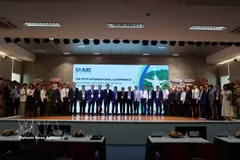
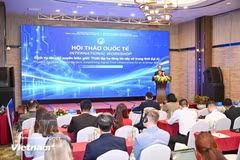
Delegates at the event (Photo: VNA)

Over 400 scientists attend international material conference

Discussions focus on six key areas, including advanced materials and their applications for sustainable development; environmentally friendly material processing technologies; product lifecycle engineering; sustainable machine design; low-carbon industries and the circular economy; and artificial intelligence and digital transformation in material and mechanical engineering.

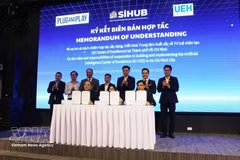
Deputy Prime Minister Ho Quoc Dung (R) and Pierre Barnabé, Chief Operating Officer of French technology group Dassault Systèmes. (Photo: VNA)

Vietnam, France step up cooperation in AI, digital twin technology

At the meeting, the Deputy PM praised the group's contributions to promoting technology cooperation between Vietnam and France, particularly its collaboration with the Ministry of Finance and the National Innovation Centre (NIC) to establish a Centre of Excellence (CoE) for digital twins and artificial intelligence (AI) in Hanoi.

Rigobert Pinga Pinga, Acting Representative of OIF for Asia-Pacific speaks at the event. (Photo: VNA)

Franconomics 2026 explores human-centred technological transformation

Addressing the opening ceremony, Nguyen Anh Tuan, Rector of VNU-IS, said Franconomics was launched in 2019 as a multidisciplinary platform connecting scientists, policymakers, businesses and international organisations to discuss socio-economic issues relevant to Vietnam and the Francophone community.

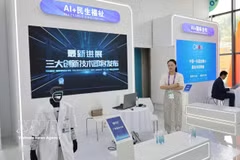
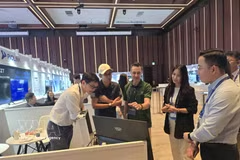
A new technology exhibition area arranged within the framework of the International Research and Innovation Funders Forum in Hanoi (Photo: VNA)

Vietnam promotes int'l cooperation in science, technology and innovation

Science is opening up new opportunities in artificial intelligence, healthcare, semiconductors and clean energy, while challenges such as climate change, energy security and epidemics require international cooperation. Science, technology, innovation and digital transformation are central to Vietnam’s new growth model.

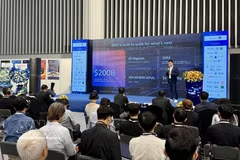
GMA Awards are presented to honour outstanding AI courses at the Global MOOC & Online Education Conference 2026. (Photo: VNA)

Responsible AI, teaching overhaul, global ties dominate GMC 2026

Panelists said AI can support knowledge delivery, information processing and personalised learning, but cannot replace teachers in building independent thinking, critical capacity, emotional intelligence and humanistic values. Universities therefore need to overhaul teaching, testing and assessment and redefine lecturers’ role in an AI-integrated environment.

An overview of the seminar (Photo: VNA)

Coordinated development of energy, AI and infrastructure needed for industrial growth

Vietnam is emerging as a regional bright spot for data infrastructure development, driven by growing demand for AI, cloud computing, 5G commercialisation and digital transformation. However, the country needs coordinated preparations, including green power supplies, international submarine cable connectivity and operational capabilities meeting global standards.

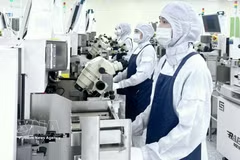
Production line at Hana Micron Vina Co., Ltd in Bac Ninh city (Photo: VNA)

Vietnam works to bridge gap between chip research and commercialisation

According to the Ministry of Science and Technology, Vietnam’s semiconductor industry has made notable progress. In 2025, it generated more than 21 billion USD in revenue and attracted over 14 billion USD in foreign investment through more than 240 projects. The country is now home to around 60 chip design companies and over 7,000 semiconductor design engineers.

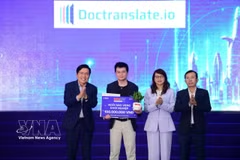
The Golden Startup Star award, worth 100 million VND, is presented to the Doctranslate.io project (Photo: VNA)

AI-powered translation platform wins Golden Startup Star award

Doctranslate.io offers contextual translation, audio recording, transcription and content summarisation services for communication, meetings and international events. Supporting 80 languages, the platform aims to add more less widely spoken languages.

Participants at the Vietnam–RoK AI and Digital Technology Forum 2026. (Photo: VNA)

Vietnam, RoK promote AI cooperation

Vietnam attaches importance to international cooperation while building its own technological capabilities, gaining greater mastery of key technologies and strengthening its participation in global AI value chains, and the RoK is its important partner in this process.

Deputy Minister of Science and Technology Pham Duc Long speaks at the international seminar entitled “Trusted Services Beyond Borders: Establishing Digital Trust Infrastructure for an AI-Driven World” on October 29, 2026. (Photo: VNA)

Vietnam promotes cross-border digital trust in AI era

As AI becomes increasingly involved in digital transactions, digital content's origin and integrity must be verified proactively, rather than merely detecting false information after it emerges, an official has said.

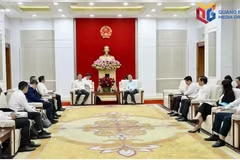
An overview of the reception (Photo: Quang Ninh Newspaper)

Quang Ninh, China’s Guangxi seek stronger cooperation in digital economy, AI

The city leader expressed his hope that the delegation would engage in professional exchanges with Quang Ninh’s departments and agencies to translate into concrete initiatives the cooperation areas in science and technology, artificial intelligence (AI) and the digital economy agreed upon by senior leaders of the two sides.

He Zhenwei, Chairman of the China Overseas Development Association in an interview with the Vietnam News Agency (Photo: VNA)

Vietnam, China explore greater scope for high-tech cooperation

Vietnam is attracting growing interest from Chinese businesses, not only in trade and traditional manufacturing but also in high-tech sectors such as artificial intelligence (AI), the digital economy, the low-altitude economy and smart agriculture, Chinese businesses and associations told Vietnam News Agency correspondents in China.

Minister of Science and Technology Vu Hai Quan (R) receives the Artemis Accords from US Ambassador to Vietnam Jennifer Wicks (Photo: Ministry of Science and Technology)

Vietnam joins Artemis Accords on space exploration

Vietnam views space science and technology as a strategic sector that can lift national science-technology capacity and support sustainable growth. The country wants to work with member nations on peaceful, safe, equitable, transparent and sustainable space exploration under international law, with tangible benefits for people and the planet.