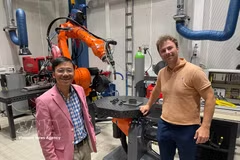
Hanoi (VNA) – As artificial intelligence (AI), automation and robotics are profoundly transforming global manufacturing, ASEAN is presented with an opportunity to develop an internationally competitive robotics industry ecosystem. Vietnam, with its strengths in export-oriented manufacturing and foreign investment attraction, is well positioned to participate more deeply in the region's robotics value chains.
Rapid advances in AI, sensor technology, intelligent control systems and computing capabilities are expanding the applications of robots beyond industrial production lines into logistics, healthcare, agriculture, construction, energy and services. In particular, physical AI and embodied AI are enabling robots to perceive their surroundings, process information, make decisions and interact with the physical world, ushering in a new phase of development for the industry.
According to the International Federation of Robotics (IFR)'s World Robotics 2026 report, approximately 5 million industrial robots were operating worldwide in 2025, up 9% year on year and double the figure recorded seven years earlier. More than 600,000 new industrial robots were installed during the year, representing an increase of 11%. The professional service robot market also continued to expand, particularly in transportation and logistics.
Against this backdrop, a key strategic direction for ASEAN is to shift from a model in which each member state develops its own robotics industry independently towards building a regional ecosystem based on connectivity and complementarity. Under this approach, countries could work together to develop technical standards, testing and certification mechanisms, human resources, shared research infrastructure and broader markets for robot applications.
Countries across the region are pursuing different development pathways. Singapore is focusing on research, testing and commercialisation of intelligent robots, while Malaysia and Thailand are promoting manufacturing automation and smart factory development. Indonesia is implementing its Making Indonesia 4.0 initiative. Vietnam, meanwhile, has strengths in export-oriented manufacturing and attracting foreign investment.
Differences in national capabilities could provide a foundation for a complementary ASEAN robotics value chain, rather than requiring each country to build an entire ecosystem independently. Under this approach, countries with strong research capabilities could focus on developing core technologies and standards, while economies with substantial manufacturing bases could take on integration, production and deployment. This approach offers Vietnam an opportunity to leverage its manufacturing strengths within the region's robotics industrial network.
The report proposes the ASEAN Robotics and Physical AI Initiative 2030 to promote harmonised standards, mutual recognition of testing results among member states, cross-border testing facilities, workforce training and supply chain development. A multi-country testing network could enable businesses to evaluate robotic solutions across different markets, reduce market entry costs and enhance their commercialisation capabilities./.
See more
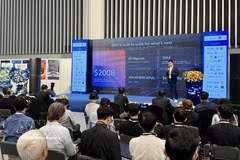
Responsible AI, teaching overhaul, global ties dominate GMC 2026
Panelists said AI can support knowledge delivery, information processing and personalised learning, but cannot replace teachers in building independent thinking, critical capacity, emotional intelligence and humanistic values. Universities therefore need to overhaul teaching, testing and assessment and redefine lecturers’ role in an AI-integrated environment.
Coordinated development of energy, AI and infrastructure needed for industrial growth
Vietnam is emerging as a regional bright spot for data infrastructure development, driven by growing demand for AI, cloud computing, 5G commercialisation and digital transformation. However, the country needs coordinated preparations, including green power supplies, international submarine cable connectivity and operational capabilities meeting global standards.
Vietnam unleashes data flows to drive digital transformation
Uniform management and regulated exploitation of information can cut repeated declarations by citizens and businesses and give state agencies a stronger basis for better administrative procedures.
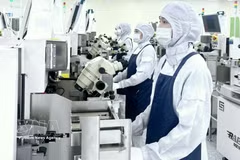
Vietnam works to bridge gap between chip research and commercialisation
According to the Ministry of Science and Technology, Vietnam’s semiconductor industry has made notable progress. In 2025, it generated more than 21 billion USD in revenue and attracted over 14 billion USD in foreign investment through more than 240 projects. The country is now home to around 60 chip design companies and over 7,000 semiconductor design engineers.
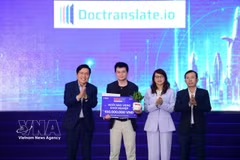
AI-powered translation platform wins Golden Startup Star award
Doctranslate.io offers contextual translation, audio recording, transcription and content summarisation services for communication, meetings and international events. Supporting 80 languages, the platform aims to add more less widely spoken languages.
Vietnam, RoK promote AI cooperation
Vietnam attaches importance to international cooperation while building its own technological capabilities, gaining greater mastery of key technologies and strengthening its participation in global AI value chains, and the RoK is its important partner in this process.
Vietnam promotes cross-border digital trust in AI era
As AI becomes increasingly involved in digital transactions, digital content's origin and integrity must be verified proactively, rather than merely detecting false information after it emerges, an official has said.
Quang Ninh, China’s Guangxi seek stronger cooperation in digital economy, AI
The city leader expressed his hope that the delegation would engage in professional exchanges with Quang Ninh’s departments and agencies to translate into concrete initiatives the cooperation areas in science and technology, artificial intelligence (AI) and the digital economy agreed upon by senior leaders of the two sides.
Vietnam, China explore greater scope for high-tech cooperation
Vietnam is attracting growing interest from Chinese businesses, not only in trade and traditional manufacturing but also in high-tech sectors such as artificial intelligence (AI), the digital economy, the low-altitude economy and smart agriculture, Chinese businesses and associations told Vietnam News Agency correspondents in China.
Vietnam joins Artemis Accords on space exploration
Vietnam views space science and technology as a strategic sector that can lift national science-technology capacity and support sustainable growth. The country wants to work with member nations on peaceful, safe, equitable, transparent and sustainable space exploration under international law, with tangible benefits for people and the planet.
Vietnam sets strategic course for comprehensive national transformation through AI: minister
Vietnam remains committed to developing AI for everyone and is ready to cooperate with partners based on equality, trust, practicality and mutual benefit, to build a safe, reliable, inclusive and sustainable AI ecosystem.
Vietnam to develop unmanned systems industry through training and infrastructure partnership
Saigon Telecommunication & Technologies Corporation (SAIGONTEL) and the US’s Pickaxe Technologies have signed a memorandum of understanding (MoU) to cooperate in manufacturing, testing, evaluation and training for unmanned and autonomous systems for civilian and commercial applications in Vietnam.
Experts discuss promotion of cybersecurity readiness in quantum era
Cuong said data safety and security in the quantum era is vital to the sustainable development of cities in the digital age. Ho Chi Minh City’s proactive approach aligns with the government’s strategic direction, which identifies quantum technology as a core technology requiring priority investment to enhance national technological self-reliance, he emphasised.
Vietnam seeks deeper role in global semiconductor value chain
As global semiconductor supply chains are restructured, experts said Vietnam’s opportunity lies not only in attracting projects but also in accumulating knowledge, technology and management expertise to move into higher-value activities.
Deputy PM requests fundamental reform of science, technology R&D
During 2021-2025, Vietnamese businesses led 181 of the 1,451 national-level science and technology tasks, accounting for 12.5% of the total number and 25.7% of the overall funding.
Solutions proposed to harness overseas Vietnamese expertise
Assoc. Prof. Vu Viet Hung, President of the Canadian Vietnamese Scientists and Experts Association (CVSEA), said the effectiveness of OV intellectuals’ contributions depends on programme design, resource allocation and stakeholder coordination.
Vietnam Digital Week to drive international cooperation in AI, strategic technologies
Under the theme “Intelligent Connectivity: AI Governance, Shaping AI Transformation,” the event, slated for October 28-30 in Quang Ninh city, aims to deepen policy dialogue, forge international partnerships and accelerate technology research, development, transfer and commercialisation, particularly in strategic and emerging technologies.
Vietnam moves to standardise digital economy measurement
The digital economy is a strategic priority for Vietnam, which aims to raise its share of GDP to at least 30% by 2030, in line with the Politburo’s Resolution No. 57-NQ/TW on breakthroughs in science and technology, innovation and national digital transformation.
Vietnam seeks to develop dedicated 5G network for high-speed rail safety
The Ministry of Construction approved two research and development projects in September, proposed by Viettel Group and Vietnam Posts and Telecommunications Group (VNPT).
Deputy PM calls for urgent action on strategic technology development
Deputy Prime Minister Ho Quoc Dung chaired a meeting at the Government headquarters on the morning of October 20 to review progress in implementing tasks for strategic technology development.