Vietnam, China explore greater scope for high-tech cooperation

Vietnam is attracting growing interest from Chinese businesses, not only in trade and traditional manufacturing but also in high-tech sectors such as artificial intelligence (AI), the digital economy, the low-altitude economy and smart agriculture, Chinese businesses and associations told Vietnam News Agency correspondents in China.

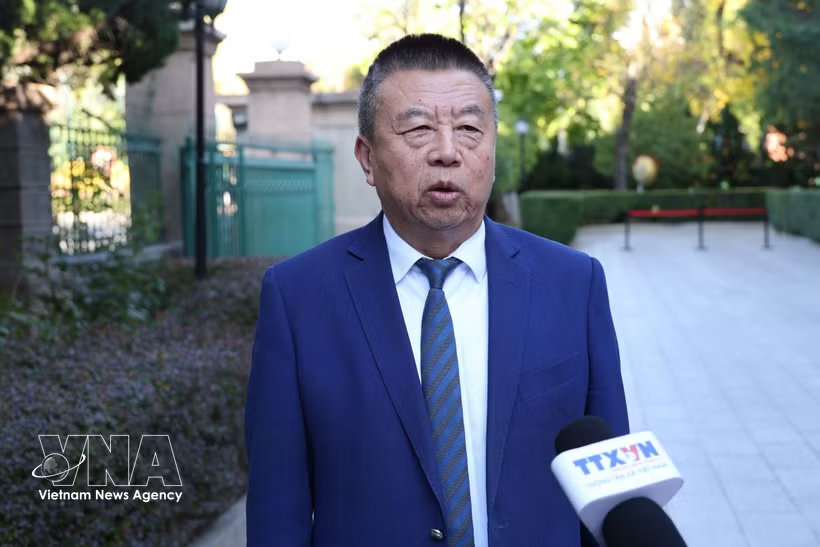
He Zhenwei, Chairman of the China Overseas Development Association in an interview with the Vietnam News Agency (Photo: VNA)

Beijing (VNA) – Vietnam is attracting growing interest from Chinese businesses, not only in trade and traditional manufacturing but also in high-tech sectors such as artificial intelligence (AI), the digital economy, the low-altitude economy and smart agriculture, Chinese businesses and associations told Vietnam News Agency correspondents in China.

He Zhenwei, Chairman of the China Overseas Development Association (CODA), said Chinese businesses are particularly interested in Vietnam, both as an investment destination and as a market for economic and trade activities. This, he said, demonstrated Vietnam’s appeal to foreign businesses, including Chinese companies seeking opportunities to expand their operations.

Assessing bilateral economic and trade ties, He said the growth in Vietnam-China trade is noteworthy amid continued global economic uncertainty, intensifying trade competition and the impact of tariffs on international commerce. He attributed the results to efforts to promote high-level cooperation based on the common perceptions reached by the two countries’ leaders, while also reflecting Vietnam’s growing appeal to Chinese businesses.

He expressed optimism about the prospects for bilateral economic, trade and investment cooperation, noting that the relationship has considerable room for development, not only in scale but also in quality, particularly in high-tech industries and the digital economy.

Looking ahead, the CODA chairman said the two countries should build on their existing cooperation while shifting towards higher-quality development. Alongside traditional sectors such as manufacturing, agriculture and mineral resources, they should give greater priority to advanced manufacturing, AI, the digital economy and the low-altitude economy, all of which offer considerable potential.

He stressed that the aim should be not merely to expand the scale of trade and investment, but also to improve their quality, efficiency and technological content. Combining established areas of cooperation with emerging technology sectors could provide fresh momentum for Vietnam-China economic ties in the years ahead.

On smart agriculture, He said there is significant potential for cooperation, particularly in applying unmanned aerial vehicles (UAVs), automation and digital solutions to agricultural production. China has made rapid advances in smart agriculture, while demand for technologies to improve production efficiency offers businesses in both countries opportunities to exchange experience and develop practical cooperation.

He noted that geographical proximity and the longstanding friendship between the two countries provide favourable conditions for such cooperation. The China Overseas Development Association plans to continue working with Vietnamese partners to organise business networking activities in smart agriculture, helping Chinese technology companies find partners and expand cooperation in Vietnam. From the perspective of a technology company, Ma Chao, Vice Chairman of Shenzhen Hejin Huagu Information Technology Co., Ltd., said Vietnam is one of Southeast Asia’s fastest-growing digital economies, with a large young population and increasingly widespread internet access and mobile application use. These characteristics align well with his company’s technology service development strategy.

To expand its operations in Vietnam, the company hopes to gain a deeper understanding of policies on digital economy and AI development, regulations on data security and personal information protection, and domestic businesses’ practical needs in customer service, marketing and digital transformation.

Ma said the company’s priority is to establish technology cooperation and build a partner ecosystem with Vietnamese system integrators, solution providers and technology partners.

Looking ahead, cooperation between Vietnam and China in AI, the digital economy, high-tech agriculture and the low-altitude economy is expected to have considerable room for growth. Their existing economic and trade ties, coupled with demand in both countries for digital transformation and the application of technology in production, provide favourable conditions for businesses to strengthen connections, share experience and implement substantive cooperation projects./.

VNA

See more

Minister of Science and Technology Vu Hai Quan (R) receives the Artemis Accords from US Ambassador to Vietnam Jennifer Wicks (Photo: Ministry of Science and Technology)

Vietnam joins Artemis Accords on space exploration

Vietnam views space science and technology as a strategic sector that can lift national science-technology capacity and support sustainable growth. The country wants to work with member nations on peaceful, safe, equitable, transparent and sustainable space exploration under international law, with tangible benefits for people and the planet.

Speakers at the discussion (Photo: VNA)

Experts discuss promotion of cybersecurity readiness in quantum era

Cuong said data safety and security in the quantum era is vital to the sustainable development of cities in the digital age. Ho Chi Minh City’s proactive approach aligns with the government’s strategic direction, which identifies quantum technology as a core technology requiring priority investment to enhance national technological self-reliance, he emphasised.

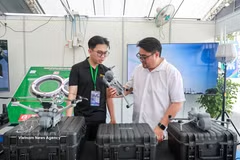
A roundtable on developing a localised platform for robot trading and operation in Vietnam held at the initiative launch on October 26. (Photo: VNA)

Strategic cooperation initiative aims develop robotics ecosystem

The initiative seeks to realise a plan to develop a localised platform for robot trading and operation in Vietnam. The partners will establish an industrial cooperation framework to promote robot sales, services and deployment tailored to the domestic market.

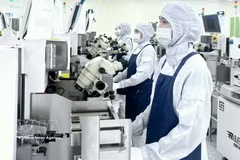
A modern production line of Hana Micron Vina Co., Ltd in Bac Ninh city (Photo: VNA)

Vietnam seeks deeper role in global semiconductor value chain

As global semiconductor supply chains are restructured, experts said Vietnam’s opportunity lies not only in attracting projects but also in accumulating knowledge, technology and management expertise to move into higher-value activities.

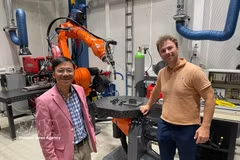
Associate Professor Vu Viet Hung (left) visits a 3D-printed space built by robots (Photo: VNA)

Solutions proposed to harness overseas Vietnamese expertise

Assoc. Prof. Vu Viet Hung, President of the Canadian Vietnamese Scientists and Experts Association (CVSEA), said the effectiveness of OV intellectuals’ contributions depends on programme design, resource allocation and stakeholder coordination.

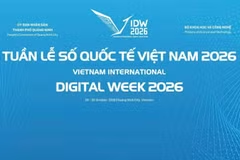
Vietnam International Digital Week 2026 (VIDW 2026) will take place in Quang Ninh from October 28 to 30.

Vietnam Digital Week to drive international cooperation in AI, strategic technologies

Under the theme “Intelligent Connectivity: AI Governance, Shaping AI Transformation,” the event, slated for October 28-30 in Quang Ninh city, aims to deepen policy dialogue, forge international partnerships and accelerate technology research, development, transfer and commercialisation, particularly in strategic and emerging technologies.

Deputy Prime Minister Ho Quoc Dung speaks at the meeting the Ministry of Science and Technology (MOST) and the Ministry of Finance (MOF) on October 21. (Photo: VNA)

Vietnam moves to standardise digital economy measurement

The digital economy is a strategic priority for Vietnam, which aims to raise its share of GDP to at least 30% by 2030, in line with the Politburo’s Resolution No. 57-NQ/TW on breakthroughs in science and technology, innovation and national digital transformation.

With well-developed infrastructure, the Saigon Hi-Tech Park in Ho Chi Minh City has attracted investment from numerous technology corporations. (Photo: VNA)

Concentrated digital technology parks to drive growth

As the nucleus of the southeastern region, Ho Chi Minh City is well positioned to lead the transition towards a growth model driven by science, technology and innovation. The city has approved a plan to develop 17 new concentrated digital technology parks covering a total area of 750-1,000 hectares.

Vietnam is stepping up the development of the semiconductor industry. (Illustrative photo: VNA)

Vietnam should look to EU experience to develop national quantum technology capacity

Quang said Vietnam should first develop high-quality human resources through interdisciplinary training programmes in quantum technology, photonics, microchips and artificial intelligence at leading universities. Scholarships, internships at European quantum labs, and strategies to bring Vietnamese experts from abroad could help speed up progress.

Ten Make in Vietnam and Australia digital technology products on display at the Vietnam–Australia forum on investment and development cooperation in digital technology and AI. (Photo: VNA)

Creating value through technological cooperation, digital transformation

From expanding international cooperation to develop core technologies and helping Vietnamese businesses to participate in global value chains to improving public services through digital solutions, these efforts are gradually turning technological advances into a driver of development and a source of tangible social benefits.

A business representative engages with the platform via a "tap-to-connect" feature at the event. (Photo: VNA)

AI platform launched to help businesses build brands

Addressing the event, experts and business representatives stressed that harnessing digital technologies requires businesses to adopt a new mindset, use data in decision-making, and maintain brand identity and consumer trust.

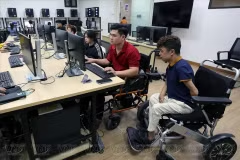
AI opens up opportunities for people with disabilities

AI opens up opportunities for people with disabilities

Amid the rapid development of the Fourth Industrial Revolution, artificial intelligence (AI) is changing the way people learn, work and communicate. For persons with disabilities (PwDs), AI is opening up new opportunities to overcome barriers once considered insurmountable, narrow the digital divide, and promote an inclusive society where no one is left behind.