Forum calls for stronger digital connectivity among Global South countries

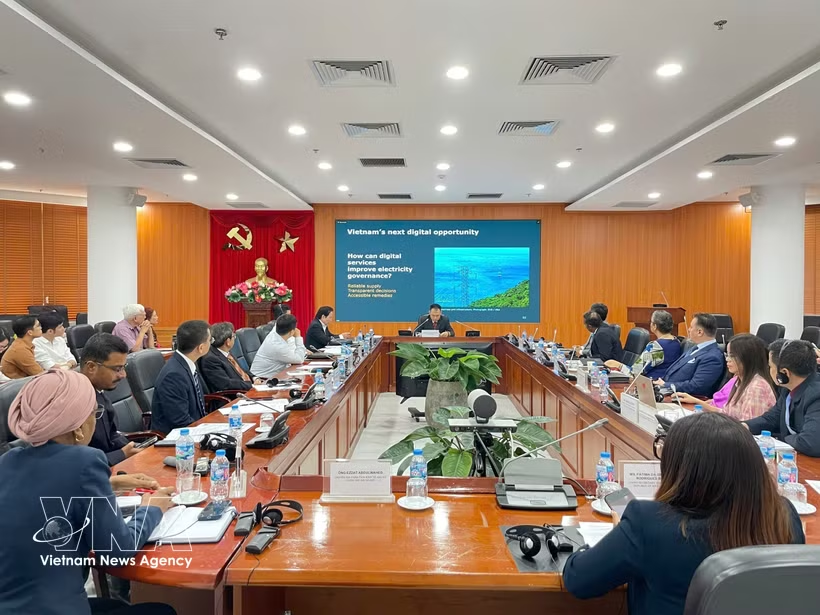
The Asia-Africa International Forum 2026, themed “Promoting Digital Connectivity among Global South Countries,” was held in Hanoi to discuss opportunities to strengthen digital cooperation among developing countries.

An overview of Asia-Africa International Forum 2026, themed “Promoting Digital Connectivity among Global South Countries” (Photo: VNA)

​Hanoi (VNA) – The Asia-Africa International Forum 2026, themed “Promoting Digital Connectivity among Global South Countries,” was held in Hanoi to discuss opportunities to strengthen digital cooperation among developing countries.

The October 15 event was organised by the Institute for South Asian, West Asian and African Studies under the Vietnam Academy of Social Sciences (VASS).

Addressing the forum, Prof. Dr. Le Van Loi, President of VASS, said digital connectivity offers the Global South new opportunities to exchange knowledge, data, technology and services, promote trade, coordinate scientific research and share resources to address common development challenges.

He stressed the need to strengthen cooperation in infrastructure development, policymaking, cross-border payments, data protection and cybersecurity, enabling countries to participate more deeply in economic, scientific and technological activities.

​Sharing Morocco’s experience, Moroccan Ambassador to Vietnam Jamale Chouaibi highlighted the growing role of digital technology in socio-economic development. Morocco’s national digital transformation strategy focuses on expanding online public services, developing the digital economy and fostering innovation.

He emphasised that expanding connectivity must go hand in hand with ensuring equitable access to digital technology and its benefits, particularly for people in developing countries.

Assoc. Prof. Dr. Nguyen Xuan Trung, Director of the Institute for South Asian, West Asian and African Studies, noted that despite significant progress in Internet connectivity, substantial digital divides remained between countries and population groups.

Figures presented at the forum showed that around six billion people worldwide used the Internet in 2025, accounting for 74% of the global population, while approximately 2.2 billion remained unconnected. In Africa, Internet penetration was only about 36%.

​Disparities between urban and rural areas and between men and women reflect barriers involving not only infrastructure but also costs, access to devices and digital skills.

Trung stressed the need to move beyond expanding network coverage to ensure people can effectively access and use digital services. Alongside infrastructure investment, countries should support low-income groups, improve digital skills and prevent vulnerable populations from being left behind.

For Vietnam, digital connectivity is a key development priority. Politburo Resolution No. 57-NQ/TW, dated December 22, 2024, identifies science and technology development, innovation and national digital transformation as leading strategic breakthroughs, providing a foundation for international cooperation and stronger technological capacity.

Participants agreed that digital connectivity among Global South countries should go beyond expanding infrastructure and Internet access to ensure people can use technology effectively and benefit from it. They called for closer cooperation, experience-sharing, stronger digital skills and personal data protection to promote an inclusive and sustainable digital economy./.​

VNA

See more

A business representative engages with the platform via a "tap-to-connect" feature at the event. (Photo: VNA)

AI platform launched to help businesses build brands

Addressing the event, experts and business representatives stressed that harnessing digital technologies requires businesses to adopt a new mindset, use data in decision-making, and maintain brand identity and consumer trust.

AI opens up opportunities for people with disabilities

AI opens up opportunities for people with disabilities

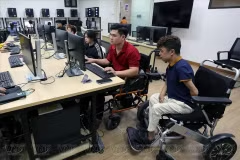
Amid the rapid development of the Fourth Industrial Revolution, artificial intelligence (AI) is changing the way people learn, work and communicate. For persons with disabilities (PwDs), AI is opening up new opportunities to overcome barriers once considered insurmountable, narrow the digital divide, and promote an inclusive society where no one is left behind.

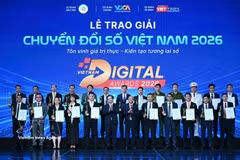
Representatives of organisations and individuals receive the 2026 Vietnam Digital Awards (Photo: VNA)

Vietnam Digital Awards 2026 honours 56 organisations, products and solutions

The 2026 awards place greater emphasis on practical effectiveness, applicability and the ability of digital transformation models to generate wider impact. They recognise not only technological innovations but also the benefits these technologies bring to people and society. Beyond acknowledging achievements, the awards also encourage initiatives capable of shaping the future.

The transformation of museums from “static repositories” into “dynamic experiential spaces” is driving the development of cultural industries. (Photo: VNA)

Digital heritage opens new avenues for cultural preservation, public access

The Southern Women’s Museum has so far digitised 1,113 artefacts, but only 113 are currently accessible to the public. According to deputy director of the museum Pham Thi Dieu, thousands of other artefacts are awaiting an exhibition system under an expansion project. The museum hopes to complete the system in 2027, enabling online visitors to explore the digitised collections.

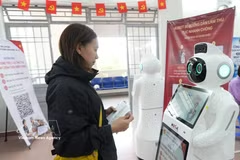
A citizen interacts with an AI-powered robot for guidance on administrative procedures at the Public Administration Service Centre of Xuan Huong–Da Lat ward, Lam Dong province. (Photo: VNA)

Vietnam taps Vietnamese talent in Canada to advance AI cooperation

As Vietnam-Canada relations enter a new phase under their strategic partnership, mobilising this resource is consistent with the orientation of Politburo Resolution No. 23-NQ/TW on overseas Vietnamese affairs, particularly the goal of harnessing knowledge, science and technology for national development.

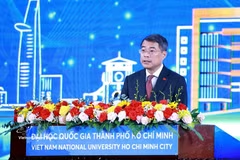
Prime Minister Le Minh Hung speaks at the ceremony (Photo: VNA)

VNU-HCM must become hub for national top talent: PM

VNU-HCM should become a leading national hub for education - training, scientific research, science -technology, innovation and digital transformation, striving to rank among Asia’s top 100 higher education establishments by 2030 and one of the region’s leading research university systems by 2045, with at least four disciplines in the global top 50.

A consumer scans a QR code to pay for OCOP products from Viet Ket Herbal Medicine Company Limited in Nhan Thang ward. Photo: Bac Ninh Newspaper.

Bac Ninh promotes cashless transactions in digital environment

With the digital economy accounting for a leading share of gross regional domestic product (GRDP) nationwide, the northern city of Bac Ninh is accelerating cashless payments in public services, online shopping and the marketing of products on digital platforms.

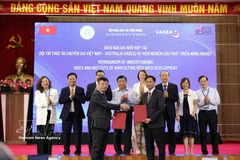
The signing of an MoU between the Department of Digital Technology and Artificial Intelligence and the Institute for Agricultural Research and Development at the forum. (Photo: VNA)

Vietnam, Australia step up digital technology, AI cooperation

An Australian diplomat said Australian businesses are keen to engage in Vietnam’s digital development, particularly in semiconductors, AI and cybersecurity. They also hope to share expertise and support Vietnamese companies in technology and investment.

A customer uses the LiveBank 24/7 service of Tien Phong Commercial Joint Stock Bank (TPBank). (Photo: TPBank)

AI adoption in banking requires strict supervision

Banks are increasingly applying AI in data analysis, personalised services, fraud detection and risk management. In August, the Joint Stock Commercial Bank for Foreign Trade of Vietnam (Vietcombank) launched its One Data Platform (ODP) project to support advanced analytics and lay the groundwork for AI and machine learning applications.

Delegates launch the commune-level digital transformation application on October 9 (Photo: VNA)

Commune-level digital transformation app launched

The app is designed to help grassroots officials, businesses, household businesses and citizens find suitable solutions, acquire relevant skills and access consultancy during their digital transformation journey.