Hanoi (VNA) – As investment in artificial intelligence (AI) infrastructure accelerates worldwide, Vietnam has an opportunity to become a specialised and well-connected technology hub.
Vietnam steps up investment in AI infrastructure
Although AI operates in the digital realm, its foundations are entirely tangible. Advanced processing chips, memory, servers, storage equipment and networking infrastructure underpin every AI model and service, driving a new wave of investment across Asia.
While economies such as China, the Republic of Korea, Singapore and Taiwan (China) continue to leverage their existing advantages, the trend towards supply chain diversification is opening up opportunities for countries with specialised capabilities and reliable links to global markets.
By combining its established electronics manufacturing base with growing capabilities in semiconductor design, AI research, cloud computing and data centres, Vietnam can become a strategic link in the regional AI ecosystem.
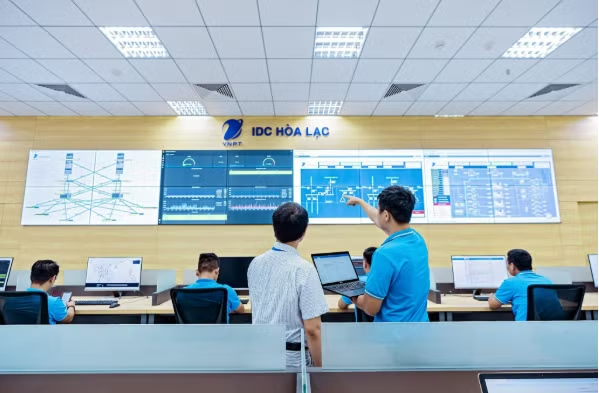
According to the Ministry of Science and Technology, Vietnam has 41 operational Internet Data Centres (IDCs), alongside a number of hyperscale projects designed to support AI workloads that are under development.
Domestic companies are driving a strong wave of investment in data centres. FPT Corporation has launched a 200 million USD AI factory.
CMC Corporation is investing more than 250 million USD in a hyperscale IDC, while Viettel has broken ground on a data centre with a capacity of 140 MW and 10,000 racks.
Meanwhile, international technology groups are continuing to expand their research and development (R&D) operations in Vietnam. NVIDIA has announced its first AI R&D centre in the country, while Marvell has expanded its workforce of engineers to more than 500, making Vietnam its third-largest R&D hub worldwide. The team contributes to chip design for AI data centre infrastructure.
Although a fully integrated ecosystem has yet to emerge, these advances demonstrate Vietnam’s expanding role, from electronics manufacturing to computing infrastructure, semiconductor engineering, research and technology design.
This direction is further reinforced by the Government’s 2026 National AI Strategy, which identifies computing infrastructure, cloud computing, edge AI and AI data centres as important foundations for national development. The strategy also aims to place Vietnam among Southeast Asia’s three leading countries in AI research and development by 2030.
Logistics supply chains connect Vietnam’s specialised capabilities
Vietnam’s opportunity does not depend on participating in every stage of the value chain. By combining its electronics manufacturing base and semiconductor design capabilities with cross-border logistics networks, the country can become an important link in Asia’s AI ecosystem.
Ee-Hui Tan, Managing Director of FedEx Express Vietnam and Cambodia, said the success of the AI economy depended not only on where technologies were developed but also on the ability to transport them efficiently and reliably. Building an AI data centre requires a combination of large-scale infrastructure and advanced technologies. As the components move through complex global supply chains, reliable cross-border logistics services are essential throughout the data centre lifecycle, from construction and commissioning to maintenance and equipment returns.
Reliable transport networks, efficient customs clearance and end-to-end shipment tracking can help technology companies manage their supply chains more effectively while strengthening connections with regional and global markets.
According to experts, to advance further and establish a distinctive position in Asia’s AI economy, Vietnam needs to develop well-integrated capabilities spanning human resources, energy infrastructure, supplier capacity and regulatory frameworks. Rising demand for computing power will create further growth opportunities in semiconductor manufacturing, engineering, electronics production, testing and data infrastructure.
Countries that succeed in the next phase of AI and semiconductor growth will not necessarily be those that seek to participate in every stage of the value chain. Rather, they will be those that identify where they can create the greatest value, build capabilities to deliver consistently efficient performance and connect those strengths to the wider ecosystem./.
See more
Bac Ninh promotes cashless transactions in digital environment
With the digital economy accounting for a leading share of gross regional domestic product (GRDP) nationwide, the northern city of Bac Ninh is accelerating cashless payments in public services, online shopping and the marketing of products on digital platforms.
Vietnam, Australia step up digital technology, AI cooperation
An Australian diplomat said Australian businesses are keen to engage in Vietnam’s digital development, particularly in semiconductors, AI and cybersecurity. They also hope to share expertise and support Vietnamese companies in technology and investment.
AI adoption in banking requires strict supervision
Banks are increasingly applying AI in data analysis, personalised services, fraud detection and risk management. In August, the Joint Stock Commercial Bank for Foreign Trade of Vietnam (Vietcombank) launched its One Data Platform (ODP) project to support advanced analytics and lay the groundwork for AI and machine learning applications.
Connecting global Vietnamese expertise to seek solutions for green agriculture
The contributions of overseas Vietnamese intellectuals should be assessed not only by the number of research publications they produce but also by their ability to develop solutions that meet the country's development needs, said a Vietnamese scientist in Canada.
Saigontel licensed to distribute satellite Internet, bolster connectivity for production
Under the licence, Saigontel can resell telecommunications services on public networks, including leased-line services for mobile base stations, Internet access via fixed satellite public telecommunications networks nationwide, and Internet access via mobile satellite public telecommunications networks for maritime connectivity.
Efforts stepped up to harness overseas Vietnamese expertise for national development
The main challenge is how to match overseas Vietnamese experts with domestic needs and utilise their expertise to generate practical results in support of the nation.
CMC showcases homegrown AI solutions for public services, business management
CMC presented its “Make in Vietnam, Made by CMC” AI ecosystem, developed on the basis of digital infrastructure, core technologies and specialised AI platforms under the company’s AI-X strategy.
Project to build big data database on law approved
The project is expected to help reform lawmaking and law enforcement, advance smart legal governance, promote a culture of legal compliance and make the law a national competitive advantage in the new era.
Vietnam targets modern pharmaceutical chemical industry by 2045
By 2030, Vietnam aims to master, acquire and transfer advanced technologies and produce selected essential and strategic pharmaceutical ingredients, prioritising active pharmaceutical ingredients (APIs), starting materials, chemical intermediates and excipients.
Vietnamese intellectuals in China pin high hopes on NA President’s visit
Vietnam could learn from China’s experience in developing research universities, attracting talent, ensuring long-term research funding and connecting universities and research institutes with businesses.
DNA testing capacity expanded to identify over 207,000 martyrs’ remains
By September 2026, Steering Committee 515 had collected samples from the remains of 207,656 martyrs, achieving 98.15% of the goal. Nearly 120,000 samples have been received and preserved. Additionally, authorities gathered 265,761 DNA samples from martyrs’ relatives, with about 100,000 analysed and around 80,000 results entered into the database.
Hanoi’s power grid modernised through science, technology and data
As the national political and administrative centre and a major hub for economic, scientific, technological and innovation activities, Hanoi is seeing growing demand for energy infrastructure. Rapid urbanisation and the development of industry, services, modern transport, data centres and the digital economy require the capital’s power system to ensure not only daily consumption but also reliable electricity for production and business activities, operations of central agencies, and major political and diplomatic events.
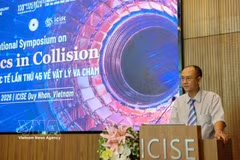
Over 50 international scientists attend 45th symposium on physics in collision
Participants are discussing the latest experimental and theoretical findings in particle physics, covering Higgs and electroweak physics, quantum chromodynamics (QCD), physics beyond the Standard Model, neutrinos and heavy ions, as well as dark matter, gravitational waves and cosmology.
Digital technology gives Vietnamese businesses an edge in market access
When data is standardised, transparent and updated, digital platforms can help businesses more effectively reach buyers, investors and international partners. Data thus becomes not merely a promotional tool but part of a business’s competitive capacity.
Vietnam turns AI ambitions into tangible business results
AI has become a high or top priority for 69% of surveyed Vietnamese businesses, while 84% expect their use of AI to increase over the next year. Although 61% of adopters remain at the experimentation stage, 71% said their AI investments have already broken even or generated returns.
Vietnam, Canada look to turn strategic partnership into tech projects
Canada's research strength paired with Vietnam's manpower, market size and speed of adoption could address national-level challenges and help small- and medium-sized enterprises modernise production and tap into the international innovation ecosystem, said Assoc. Prof. Vu Viet Hung.
Public security ministry eyes AI, cyber training ties with Canada's Concordia University
Concordia is ready to step up exchanges with the Vietnamese Ministry of Public Security's training and research facilities to identify areas that fit both sides' strengths and needs and gradually turn training and research opportunities into concrete initiatives, said Prof. Graham Carr, Concordia University's President and Vice-Chancellor.
Vietnam’s approach to innovation inspires countries worldwide: WIPO
Vietnam's approach to adopting the GII and coordinating with government agencies at both central and local levels is an invaluable lesson many other countries are studying and trying to replicate.
Overseas Vietnamese intellectuals drive innovation
Overseas Vietnamese scientists do not have to return to Vietnam for long-term work to make an impact. They can contribute by joining collaborative research teams, sharing analytical techniques, facilitating access to modern equipment, and linking Vietnam with international labs and universities.
Better Choice Awards 2026 honours innovative Vietnamese businesses, tech products
The fourth edition of the awards featured a complete restructuring into four award tracks: Innovative Choice Awards, Smart Choice Awards, Car Choice Awards and the newly introduced Nation Builders Awards. The latter honours businesses contributing to national development by building infrastructure, energy systems and technological capacity for the national economy.