Bac Ninh promotes cashless transactions in digital environment

With the digital economy accounting for a leading share of gross regional domestic product (GRDP) nationwide, the northern city of Bac Ninh is accelerating cashless payments in public services, online shopping and the marketing of products on digital platforms.

A consumer scans a QR code to pay for OCOP products from Viet Ket Herbal Medicine Company Limited in Nhan Thang ward. Photo: Bac Ninh Newspaper.

Bac Ninh (VNA) – With the digital economy accounting for a leading share of gross regional domestic product (GRDP) nationwide, the northern city of Bac Ninh is accelerating cashless payments in public services, online shopping and the marketing of products on digital platforms.

These efforts are helping translate the theme of the National Digital Transformation Day 2026, “From architecture, platforms, and data to tangible results and enhanced national governance efficiency,” into practical outcomes.

Encouraging electronic transactions


Digital transformation is gradually reshaping how people conduct transactions and access services across the city. The “Market 4.0 – Cashless Payments” model has been rolled out at most wholesale and retail markets.

In September, cashless payments accounted for 81% of total transaction value. More than 384,200 public digital signatures have also been issued, with users receiving guidance on how to use them. Meanwhile, online payments for public services involving fees and charges have reached 88.43%.

To support this transition, local authorities, departments and businesses have introduced practical measures to promote electronic transactions.

According to Nguyen Van Trieu, Deputy Director of VNPT Bac Ninh, the telecommunications provider has installed 1,295 4G base stations and operates 229 active 5G stations. Its fiber-optic network extends approximately 21,460 kilometres, providing connectivity across urban areas, industrial parks and rural communities.

As a result, 4G coverage reaches about 99% of residential areas across the city, while 5G coverage stands at around 92.12%. This infrastructure provides a critical foundation for expanding digital services and developing the digital economy, he said.

To strengthen residents’ digital skills, Bac Ninh organised 49 digital literacy and digital learning classes during the first nine months of 2026. The city also coordinated 53 digital skills training courses for commune-level officials, civil servants and public employees, as well as local residents. At administrative service centres, guidance on online payments is integrated into the processing of applications requiring fees and charges.

Nguyen The Thi, Deputy Director of the Department of Industry and Trade, said Bac Ninh benefits from well-developed banking infrastructure and intermediary payment gateways, a young workforce quick to adopt technology, and businesses increasingly aware that account-based cash flow management can improve operational efficiency.

However, small-scale traders and older people remain hesitant to embrace new technologies, partly because of concerns about information security. Persistent guidance and hands-on support are therefore essential to building public confidence, he noted.

Launching Digital Consumption Month

In response to Vietnam’s National Digital Transformation Day 2026on October 10, Bac Ninh launched its Digital Consumption Month 2026, directing communes and wards to implement a series of practical initiatives.

These include encouraging public employees and residents to shop online, helping producers and businesses list their products on reputable e-commerce platforms, and working with businesses and credit institutions to offer promotions, reward points and service-fee discounts for new customers.

bac-ninh-thuc-day-giao-dich-khong-dung-tien-mat-tren-moi-truong-so-phuong-kinh-bac.jpg
Traders at Nhon market in Kinh Bac ward display QR codes to enable customers to make cashless payments. Photo: Bac Ninh Newspaper.

The Department of Industry and Trade will work with local authorities and banks to encourage traditional market vendors and convenience stores to adopt QR-code and e-wallet payments. It will also provide guidance on secure transactions and introduce practical promotional offers and digital experiences at points of sale.

In parallel, the department will cooperate with e-commerce platforms and technology companies to help cooperatives establish online storefronts, conduct livestream sales, process payments, package goods and arrange deliveries.

Efforts will also focus on standardising product information, labels, traceability codes and packaging, while promoting cross-border e-commerce to help Bac Ninh’s traditional craft products and key local goods reach international markets. Authorities will strengthen inspections and crack down on counterfeit goods and online commercial fraud to protect consumers.

After the month, the “Market 4.0” and “Cashless Street” models will be maintained and expanded. The industry and trade sector will work with the State Bank of Vietnam’s Regional Branch 12 and commercial banks to ensure reliable payment infrastructure, provide digital skills training and improve traders’ ability to recognise sophisticated technology-enabled fraud.

These sustained efforts aim to establish cashless transactions as a lasting habit and create a solid foundation for the digital economy’s continued growth./.

See more

Viettel's Hoa Lac 2 Data Centre (Source: Viettel)

AI - infrastructure for next-generation digital economy

By combining its established electronics manufacturing base with growing capabilities in semiconductor design, AI research, cloud computing and data centres, Vietnam can become a strategic link in the regional AI ecosystem.

The signing of an MoU between the Department of Digital Technology and Artificial Intelligence and the Institute for Agricultural Research and Development at the forum. (Photo: VNA)

Vietnam, Australia step up digital technology, AI cooperation

An Australian diplomat said Australian businesses are keen to engage in Vietnam’s digital development, particularly in semiconductors, AI and cybersecurity. They also hope to share expertise and support Vietnamese companies in technology and investment.

A customer uses the LiveBank 24/7 service of Tien Phong Commercial Joint Stock Bank (TPBank). (Photo: TPBank)

AI adoption in banking requires strict supervision

Banks are increasingly applying AI in data analysis, personalised services, fraud detection and risk management. In August, the Joint Stock Commercial Bank for Foreign Trade of Vietnam (Vietcombank) launched its One Data Platform (ODP) project to support advanced analytics and lay the groundwork for AI and machine learning applications.

Delegates launch the commune-level digital transformation application on October 9 (Photo: VNA)

Commune-level digital transformation app launched

The app is designed to help grassroots officials, businesses, household businesses and citizens find suitable solutions, acquire relevant skills and access consultancy during their digital transformation journey.

Project to build big data database on law approved

Project to build big data database on law approved

The project is expected to help reform lawmaking and law enforcement, advance smart legal governance, promote a culture of legal compliance and make the law a national competitive advantage in the new era.

Vietnam targets modern pharmaceutical chemical industry by 2045. (Illustrative photo: baochinhphu.vn)

Vietnam targets modern pharmaceutical chemical industry by 2045

By 2030, Vietnam aims to master, acquire and transfer advanced technologies and produce selected essential and strategic pharmaceutical ingredients, prioritising active pharmaceutical ingredients (APIs), starting materials, chemical intermediates and excipients.

Martyr remains samples from the northern province of Cao Bang are handed over to the Military Institute of Forensic Medicine for DNA analysis. (Photo: VNA)

DNA testing capacity expanded to identify over 207,000 martyrs’ remains

By September 2026, Steering Committee 515 had collected samples from the remains of 207,656 martyrs, achieving 98.15% of the goal. Nearly 120,000 samples have been received and preserved. Additionally, authorities gathered 265,761 DNA samples from martyrs’ relatives, with about 100,000 analysed and around 80,000 results entered into the database.

Unmanned aerial vehicle used to inspect power lines. (Photo: VNA)

Hanoi’s power grid modernised through science, technology and data

As the national political and administrative centre and a major hub for economic, scientific, technological and innovation activities, Hanoi is seeing growing demand for energy infrastructure. Rapid urbanisation and the development of industry, services, modern transport, data centres and the digital economy require the capital’s power system to ensure not only daily consumption but also reliable electricity for production and business activities, operations of central agencies, and major political and diplomatic events.​

Electronic component production at Star Engineers Vietnam Co., Ltd. in Binh Xuyen Industrial Park, Phu Tho province. (Photo: VNA)

Vietnam turns AI ambitions into tangible business results

AI has become a high or top priority for 69% of surveyed Vietnamese businesses, while 84% expect their use of AI to increase over the next year. Although 61% of adopters remain at the experimentation stage, 71% said their AI investments have already broken even or generated returns.

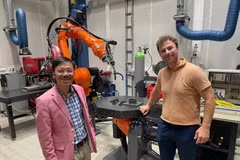
Assoc. Prof. Vu Viet Hung (left) visits a robotic 3D printing facility. (Photo published by VNA)

Vietnam, Canada look to turn strategic partnership into tech projects

Canada's research strength paired with Vietnam's manpower, market size and speed of adoption could address national-level challenges and help small- and medium-sized enterprises modernise production and tap into the international innovation ecosystem, said Assoc. Prof. Vu Viet Hung.

Associate Professor Dang Duc Huy (left) poses for a photo with Canadian Governor General Louise Arbour. (Photo: VNA)

Overseas Vietnamese intellectuals drive innovation

Overseas Vietnamese scientists do not have to return to Vietnam for long-term work to make an impact. They can contribute by joining collaborative research teams, sharing analytical techniques, facilitating access to modern equipment, and linking Vietnam with international labs and universities.