Vietnam Digital Awards 2026 honours 56 organisations, products and solutions

The 2026 awards place greater emphasis on practical effectiveness, applicability and the ability of digital transformation models to generate wider impact. They recognise not only technological innovations but also the benefits these technologies bring to people and society. Beyond acknowledging achievements, the awards also encourage initiatives capable of shaping the future.

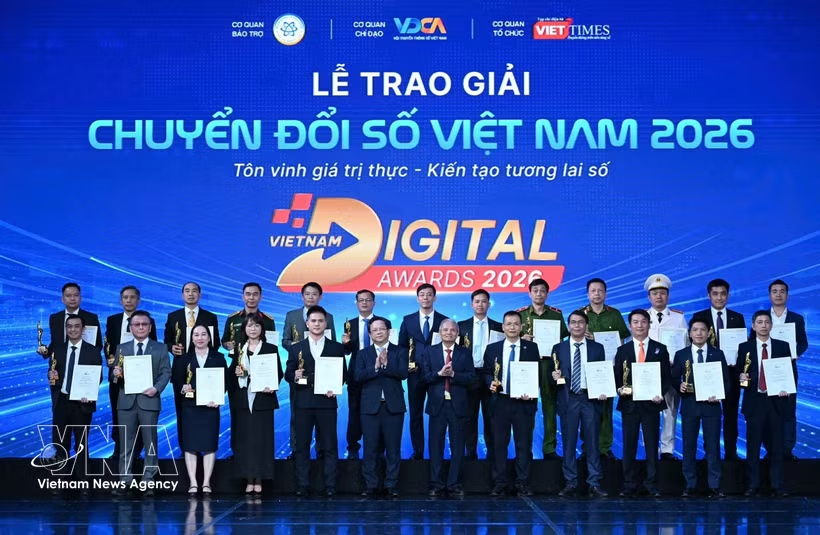
Representatives of organisations and individuals receive the 2026 Vietnam Digital Awards (Photo: VNA)

Hanoi (VNA) – A total of 56 organisations, products and solutions, along with three outstanding individuals, were honoured at the ninth Vietnam Digital Awards (VDA) 2026 ceremony held in Hanoi on October 14.

​Speaking at the ceremony, Dr. Nguyen Minh Hong, Chairman of the Vietnam Digital Communications Association (VDCA) and head of the awards' steering committee, highlighted the message of honouring real values and spreading the digital future.

The 2026 awards place greater emphasis on practical effectiveness, applicability and the ability of digital transformation models to generate wider impact. They recognise not only technological innovations but also the benefits these technologies bring to people and society. Beyond acknowledging achievements, the awards also encourage initiatives capable of shaping the future.

First held in 2018, the Vietnam Digital Awards have, over nine editions, reached more than 46,000 agencies, organisations and businesses, received over 3,000 entries and honoured arround 450 organisations, products, solutions and individuals.

The ninth edition attracted 467 entries across five categories, namely outstanding digital transformation in state agencies; outstanding digital transformation in businesses and public service units; outstanding digital technology products, services and solutions; digital transformation products and solutions for the community; and outstanding individuals.

Following preliminary and final judging rounds, the organising committee selected 56 state agencies, public service units and businesses for their outstanding digital transformation efforts, alongside digital technology products, services and solutions, community-oriented digital transformation initiatives, and three particularly outstanding individuals.

At VDA 2026, the iHanoi and HanoiWork ecosystem developed by the Hanoi People's Committee won an award in the category for outstanding digital transformation in state agencies.

The iHanoi app enables residents and businesses to interact online with local authorities and access urban services via their mobile phones. Meanwhile, HanoiWork, an integrated digital workplace platform, has been deployed across 180 units, with 84,000 user accounts.

According to information released at the event, the platform has helped cut waiting times for certain administrative procedures from one to two hours to just 15 minutes.

In the field of digital competency development, DigiX Academy was honoured in the category for outstanding digital technology products, services and solutions for its DAI Academy comprehensive digital competency assessment and development platform. The award recognises the academy's efforts to develop technological solutions for training, assessing and enhancing digital competencies, helping bring digital transformation closer to people's practical skills and capabilities./.

​

VNA

See more

The transformation of museums from “static repositories” into “dynamic experiential spaces” is driving the development of cultural industries. (Photo: VNA)

Digital heritage opens new avenues for cultural preservation, public access

The Southern Women’s Museum has so far digitised 1,113 artefacts, but only 113 are currently accessible to the public. According to deputy director of the museum Pham Thi Dieu, thousands of other artefacts are awaiting an exhibition system under an expansion project. The museum hopes to complete the system in 2027, enabling online visitors to explore the digitised collections.

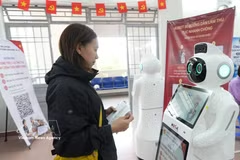
A citizen interacts with an AI-powered robot for guidance on administrative procedures at the Public Administration Service Centre of Xuan Huong–Da Lat ward, Lam Dong province. (Photo: VNA)

Vietnam taps Vietnamese talent in Canada to advance AI cooperation

As Vietnam-Canada relations enter a new phase under their strategic partnership, mobilising this resource is consistent with the orientation of Politburo Resolution No. 23-NQ/TW on overseas Vietnamese affairs, particularly the goal of harnessing knowledge, science and technology for national development.

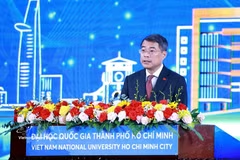
Prime Minister Le Minh Hung speaks at the ceremony (Photo: VNA)

VNU-HCM must become hub for national top talent: PM

VNU-HCM should become a leading national hub for education - training, scientific research, science -technology, innovation and digital transformation, striving to rank among Asia’s top 100 higher education establishments by 2030 and one of the region’s leading research university systems by 2045, with at least four disciplines in the global top 50.

A consumer scans a QR code to pay for OCOP products from Viet Ket Herbal Medicine Company Limited in Nhan Thang ward. Photo: Bac Ninh Newspaper.

Bac Ninh promotes cashless transactions in digital environment

With the digital economy accounting for a leading share of gross regional domestic product (GRDP) nationwide, the northern city of Bac Ninh is accelerating cashless payments in public services, online shopping and the marketing of products on digital platforms.

Viettel's Hoa Lac 2 Data Centre (Source: Viettel)

AI - infrastructure for next-generation digital economy

By combining its established electronics manufacturing base with growing capabilities in semiconductor design, AI research, cloud computing and data centres, Vietnam can become a strategic link in the regional AI ecosystem.

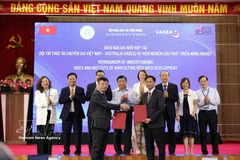
The signing of an MoU between the Department of Digital Technology and Artificial Intelligence and the Institute for Agricultural Research and Development at the forum. (Photo: VNA)

Vietnam, Australia step up digital technology, AI cooperation

An Australian diplomat said Australian businesses are keen to engage in Vietnam’s digital development, particularly in semiconductors, AI and cybersecurity. They also hope to share expertise and support Vietnamese companies in technology and investment.

A customer uses the LiveBank 24/7 service of Tien Phong Commercial Joint Stock Bank (TPBank). (Photo: TPBank)

AI adoption in banking requires strict supervision

Banks are increasingly applying AI in data analysis, personalised services, fraud detection and risk management. In August, the Joint Stock Commercial Bank for Foreign Trade of Vietnam (Vietcombank) launched its One Data Platform (ODP) project to support advanced analytics and lay the groundwork for AI and machine learning applications.

Delegates launch the commune-level digital transformation application on October 9 (Photo: VNA)

Commune-level digital transformation app launched

The app is designed to help grassroots officials, businesses, household businesses and citizens find suitable solutions, acquire relevant skills and access consultancy during their digital transformation journey.

Project to build big data database on law approved

Project to build big data database on law approved

The project is expected to help reform lawmaking and law enforcement, advance smart legal governance, promote a culture of legal compliance and make the law a national competitive advantage in the new era.

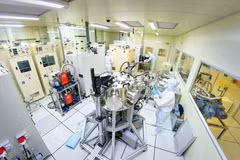
Vietnam targets modern pharmaceutical chemical industry by 2045. (Illustrative photo: baochinhphu.vn)

Vietnam targets modern pharmaceutical chemical industry by 2045

By 2030, Vietnam aims to master, acquire and transfer advanced technologies and produce selected essential and strategic pharmaceutical ingredients, prioritising active pharmaceutical ingredients (APIs), starting materials, chemical intermediates and excipients.

Martyr remains samples from the northern province of Cao Bang are handed over to the Military Institute of Forensic Medicine for DNA analysis. (Photo: VNA)

DNA testing capacity expanded to identify over 207,000 martyrs’ remains

By September 2026, Steering Committee 515 had collected samples from the remains of 207,656 martyrs, achieving 98.15% of the goal. Nearly 120,000 samples have been received and preserved. Additionally, authorities gathered 265,761 DNA samples from martyrs’ relatives, with about 100,000 analysed and around 80,000 results entered into the database.