Vietnam sets strategic course for comprehensive national transformation through AI: minister

Vietnam remains committed to developing AI for everyone and is ready to cooperate with partners based on equality, trust, practicality and mutual benefit, to build a safe, reliable, inclusive and sustainable AI ecosystem.

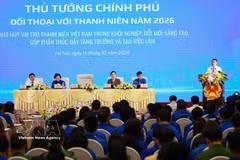
Participants in the ministerial-level roundtable on digital and AI cooperation, themed “Building Smart Connectivity, Governing AI, Enabling AI Transformation”, held in Quang Ninh city on October 28, 2026. (Photo: VNA)

Quang Ninh (VNA) – Vietnam is pursuing a strategic vision for comprehensive national transformation through artificial intelligence (AI), considered a core capability to drive growth model innovation, improve productivity and enhance national competitiveness, Minister of Science and Technology Vu Hai Quan said on October 28.

Speaking at a ministerial-level roundtable on digital and AI cooperation, themed “Building Smart Connectivity, Governing AI, Enabling AI Transformation”, held in Quang Ninh city as part of Vietnam International Digital Week 2026, Quan highlighted the strategic importance of AI development, international cooperation, connectivity infrastructure, AI governance and human-centred transformation.

AI is no longer a technology of the future but a major force shaping today’s economy and society, he said, warning that without collective action, yesterday’s digital divide could become tomorrow’s development gap.

Three pillars of AI development

He stressed that smart connectivity underpins AI, requiring next-generation networks, data centres and computing capacity. Given limited resources, countries need to balance universal connectivity with investment in high-performance infrastructure, mobilise private-sector resources and develop green, energy-efficient systems.

Alongside infrastructure, effective AI governance is essential to building trust and balancing flexibility with legal certainty, and innovation with public protection. As AI and data increasingly cross national borders, compatible governance frameworks and trusted data flows are becoming more important.

AI transformation should redesign public services, business operations and industries, enabling rapid adoption while building long-term autonomy. Ultimately, he said, its success must be measured by the value created and the benefits delivered to people.

Vietnam has identified AI as a strategic technology and a key driver of development, prioritising three pillars: institutions and legislation, human resources and talent, and the AI ecosystem.

Regarding the legal framework, Quan said legislation should provide a foundation for development rather than act as a barrier. Vietnam has enacted the Law on Artificial Intelligence, the Law on Data and the Law on Digital Transformation. It is also pursuing risk-based AI management, regulatory sandboxes and the establishment of a national AI development fund.

On human resources and talent, Vietnam is focusing on domestic training, attracting leading experts, overseas Vietnamese intellectuals and international talent, and strengthening links among the State, businesses, research institutes and universities.

For the AI ecosystem, the country is investing in computing capacity, open data and Vietnamese-language AI models while supporting startups. Efforts also include expanding nationwide 5G coverage and bringing digital skills to villages and hamlets. These initiatives were recognised through the GSMA Government Leadership Award 2026 from the Global System for Mobile Communications Association (GSMA). “AI for people, AI for everyone, AI mastered by Vietnam and developed together with the world” is the country’s guiding vision, the minister said.

Turning cooperation into practical results

Summarising discussions at the roundtable, Quan outlined three key messages: smart connectivity must come first, good governance builds trust and enables innovation, and AI transformation must be driven by and serve people.

Investment in networks, data and computing capacity must be widespread enough to ensure no one is left behind, yet sufficiently robust to foster innovation. Public-private partnerships are crucial to mobilising resources, he noted.

Practical governance tools, including regulatory sandboxes, standards, testing and internationally compatible frameworks, can help ensure AI is deployed safely in everyday life. Human resources remain decisive in determining the effectiveness of AI transformation.

To translate discussions into tangible outcomes, the official proposed regular policy exchanges among regulators, stronger links between governments, businesses, academia and international organisations, and greater cooperation in talent development and joint research. Priority should be given to projects that address practical needs and can be implemented and scaled up.

Vietnam remains committed to developing AI for everyone and is ready to cooperate with partners based on equality, trust, practicality and mutual benefit, to build a safe, reliable, inclusive and sustainable AI ecosystem, he added./.

VNA

See more

Speakers at the discussion (Photo: VNA)

Experts discuss promotion of cybersecurity readiness in quantum era

Cuong said data safety and security in the quantum era is vital to the sustainable development of cities in the digital age. Ho Chi Minh City’s proactive approach aligns with the government’s strategic direction, which identifies quantum technology as a core technology requiring priority investment to enhance national technological self-reliance, he emphasised.

A roundtable on developing a localised platform for robot trading and operation in Vietnam held at the initiative launch on October 26. (Photo: VNA)

Strategic cooperation initiative aims develop robotics ecosystem

The initiative seeks to realise a plan to develop a localised platform for robot trading and operation in Vietnam. The partners will establish an industrial cooperation framework to promote robot sales, services and deployment tailored to the domestic market.

A modern production line of Hana Micron Vina Co., Ltd in Bac Ninh city (Photo: VNA)

Vietnam seeks deeper role in global semiconductor value chain

As global semiconductor supply chains are restructured, experts said Vietnam’s opportunity lies not only in attracting projects but also in accumulating knowledge, technology and management expertise to move into higher-value activities.

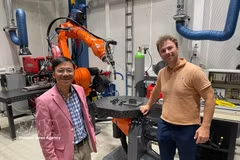
Associate Professor Vu Viet Hung (left) visits a 3D-printed space built by robots (Photo: VNA)

Solutions proposed to harness overseas Vietnamese expertise

Assoc. Prof. Vu Viet Hung, President of the Canadian Vietnamese Scientists and Experts Association (CVSEA), said the effectiveness of OV intellectuals’ contributions depends on programme design, resource allocation and stakeholder coordination.

Vietnam International Digital Week 2026 (VIDW 2026) will take place in Quang Ninh from October 28 to 30.

Vietnam Digital Week to drive international cooperation in AI, strategic technologies

Under the theme “Intelligent Connectivity: AI Governance, Shaping AI Transformation,” the event, slated for October 28-30 in Quang Ninh city, aims to deepen policy dialogue, forge international partnerships and accelerate technology research, development, transfer and commercialisation, particularly in strategic and emerging technologies.

Deputy Prime Minister Ho Quoc Dung speaks at the meeting the Ministry of Science and Technology (MOST) and the Ministry of Finance (MOF) on October 21. (Photo: VNA)

Vietnam moves to standardise digital economy measurement

The digital economy is a strategic priority for Vietnam, which aims to raise its share of GDP to at least 30% by 2030, in line with the Politburo’s Resolution No. 57-NQ/TW on breakthroughs in science and technology, innovation and national digital transformation.

With well-developed infrastructure, the Saigon Hi-Tech Park in Ho Chi Minh City has attracted investment from numerous technology corporations. (Photo: VNA)

Concentrated digital technology parks to drive growth

As the nucleus of the southeastern region, Ho Chi Minh City is well positioned to lead the transition towards a growth model driven by science, technology and innovation. The city has approved a plan to develop 17 new concentrated digital technology parks covering a total area of 750-1,000 hectares.

Vietnam is stepping up the development of the semiconductor industry. (Illustrative photo: VNA)

Vietnam should look to EU experience to develop national quantum technology capacity

Quang said Vietnam should first develop high-quality human resources through interdisciplinary training programmes in quantum technology, photonics, microchips and artificial intelligence at leading universities. Scholarships, internships at European quantum labs, and strategies to bring Vietnamese experts from abroad could help speed up progress.

Ten Make in Vietnam and Australia digital technology products on display at the Vietnam–Australia forum on investment and development cooperation in digital technology and AI. (Photo: VNA)

Creating value through technological cooperation, digital transformation

From expanding international cooperation to develop core technologies and helping Vietnamese businesses to participate in global value chains to improving public services through digital solutions, these efforts are gradually turning technological advances into a driver of development and a source of tangible social benefits.

A business representative engages with the platform via a "tap-to-connect" feature at the event. (Photo: VNA)

AI platform launched to help businesses build brands

Addressing the event, experts and business representatives stressed that harnessing digital technologies requires businesses to adopt a new mindset, use data in decision-making, and maintain brand identity and consumer trust.

AI opens up opportunities for people with disabilities

AI opens up opportunities for people with disabilities

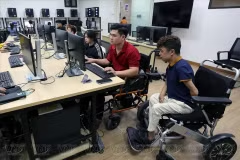
Amid the rapid development of the Fourth Industrial Revolution, artificial intelligence (AI) is changing the way people learn, work and communicate. For persons with disabilities (PwDs), AI is opening up new opportunities to overcome barriers once considered insurmountable, narrow the digital divide, and promote an inclusive society where no one is left behind.

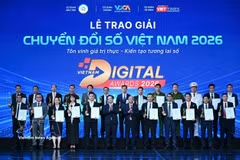
Representatives of organisations and individuals receive the 2026 Vietnam Digital Awards (Photo: VNA)

Vietnam Digital Awards 2026 honours 56 organisations, products and solutions

The 2026 awards place greater emphasis on practical effectiveness, applicability and the ability of digital transformation models to generate wider impact. They recognise not only technological innovations but also the benefits these technologies bring to people and society. Beyond acknowledging achievements, the awards also encourage initiatives capable of shaping the future.