Rome (VNA) – Vietnam and Italy have considerable potential to strengthen cooperation in the robotics industry, drawing on their complementary strengths in technology, mechanical engineering, manufacturing and research, as well as their shared need to modernise production.
Speaking to Vietnam News Agency (VNA) correspondents in Rome, Nguyen Nhu Toan, a PhD student at the Department of Industrial Engineering, University of Bologna, Italy, said the development of humanoid robots, collaborative robots (cobots) and mobile manipulation robots is opening up new applications in manufacturing and everyday life.
This also presents an opportunity for Vietnam to step up research, development and application of robotics technology in cooperation with Italy, a country with long-standing strengths in precision engineering, machinery manufacturing and industrial automation.
According to Toan, the most significant change in the robotics industry today is the shift from systems that perform only pre-programmed tasks to those capable of perceiving their surroundings, learning skills and adapting to new tasks. Combining AI and machine learning with models integrating vision, language and action is making robots increasingly versatile, enabling them to interact with people and operate in more complex environments. Notably, humanoid robots, cobots and mobile manipulation robots can improve productivity and product quality while reducing repetitive, strenuous or hazardous work.
He said experience in Europe, including Italy, shows that this trend is gradually being adopted in production. Italy is well positioned to develop robotics, thanks to its traditional strengths in mechanical engineering and machinery manufacturing, as well as its network of small and medium-sized enterprises (SMEs). Companies such as Comau in industrial robotics and qbrobotics in soft robotic hand technology, together with research projects at the Italian Institute of Technology (IIT), demonstrate the country's capabilities in robotics development. Notably, shipbuilder Fincantieri's cooperation with Generative Bionics to develop humanoid robots to assist with welding in shipbuilding, with real-world trials expected by the end of 2026, represents a promising application.
Toan noted that high initial investment costs, a shortage of highly skilled technical personnel and limited access to technology among SMEs remain barriers to robotics development in Italy. It is therefore important to link research with industrial needs and support businesses in testing and commercialising new technologies.
For Vietnam, he said priority should be given to robotics applications that meet practical needs and can be deployed in the short term. These include industrial robots for production lines, autonomous robots for warehouses and factories, and unmanned aerial vehicles (UAVs) for agriculture and logistics. In the longer term, the country should continue investing in AI, environmental perception technologies, advanced control systems and humanoid robotics.
One important direction is to prioritise mastery of software, algorithms and system integration, before gradually developing high-value hardware technologies and components. At the same time, cooperation among businesses, universities and the State should be promoted to bring research results to market and prevent products from remaining at the demonstration-model stage.
Toan said Vietnam and Italy have highly complementary strengths in this field. Italy has experience in machinery manufacturing, industrial robotics applications and an established business network, while Vietnam has a dynamic market, strong demand for production modernisation and a promising young engineering workforce. These provide a solid basis for the two countries to expand cooperation in robotics research, development and application.
Areas with immediate cooperation potential include industrial robots, cobots and mobile manipulation robots for manufacturing, assembly and logistics. In the longer term, the two sides could expand cooperation to UAVs, autonomous robotic systems for precision agriculture, infrastructure inspection and goods transportation, as well as research into intelligent robotics and human-robot interaction.
The University of Bologna doctoral candidate stressed that Vietnam-Italy cooperation should go beyond the transfer of equipment and technology to encompass joint research, development, testing and product commercialisation.
Stepping up exchanges of students, doctoral candidates and experts, while strengthening links between universities, research institutes and businesses, will help both countries make effective use of their respective strengths and lay the foundation for long-term cooperation in robotics and automation, he stated./.
See more
Top leader receives new foreign ambassadors
Vietnam wishes to step up cooperation with the countries in such areas as economy, trade and investment; cutting-edge science and technology applications, semiconductors, artificial intelligence, new materials, digital transformation, sustainable agriculture, the environment, energy and renewable energy, the marine economy and maritime transport.
Over 400 scientists attend international material conference
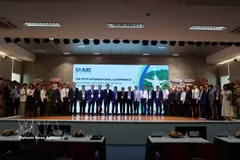
Discussions focus on six key areas, including advanced materials and their applications for sustainable development; environmentally friendly material processing technologies; product lifecycle engineering; sustainable machine design; low-carbon industries and the circular economy; and artificial intelligence and digital transformation in material and mechanical engineering.
Applied AI Centre of Excellence to be built in Ho Chi Minh City
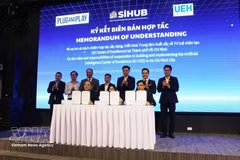
The initiative follows a memorandum of understanding signed in Ho Chi Minh City on September 30 by the three parties, aimed at establishing a regular channel linking the city’s innovation and startup ecosystem with Silicon Valley.
Digital technology opens new avenues for heritage education
Heritage education goes beyond providing knowledge to help learners understand the origins of cultural values, develop a critical mindset and foster a sense of responsibility towards the community.
Vietnam, France step up cooperation in AI, digital twin technology
At the meeting, the Deputy PM praised the group's contributions to promoting technology cooperation between Vietnam and France, particularly its collaboration with the Ministry of Finance and the National Innovation Centre (NIC) to establish a Centre of Excellence (CoE) for digital twins and artificial intelligence (AI) in Hanoi.
Franconomics 2026 explores human-centred technological transformation
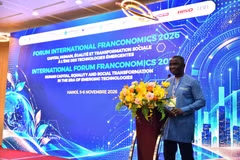
Addressing the opening ceremony, Nguyen Anh Tuan, Rector of VNU-IS, said Franconomics was launched in 2019 as a multidisciplinary platform connecting scientists, policymakers, businesses and international organisations to discuss socio-economic issues relevant to Vietnam and the Francophone community.
Vietnam promotes int'l cooperation in science, technology and innovation
Science is opening up new opportunities in artificial intelligence, healthcare, semiconductors and clean energy, while challenges such as climate change, energy security and epidemics require international cooperation. Science, technology, innovation and digital transformation are central to Vietnam’s new growth model.
Vietnam eyes deeper participation in ASEAN robotics ecosystem
Vietnam, with its strengths in export-oriented manufacturing and foreign investment attraction, is well positioned to participate more deeply in the region's robotics value chains.
Responsible AI, teaching overhaul, global ties dominate GMC 2026
Panelists said AI can support knowledge delivery, information processing and personalised learning, but cannot replace teachers in building independent thinking, critical capacity, emotional intelligence and humanistic values. Universities therefore need to overhaul teaching, testing and assessment and redefine lecturers’ role in an AI-integrated environment.
Coordinated development of energy, AI and infrastructure needed for industrial growth
Vietnam is emerging as a regional bright spot for data infrastructure development, driven by growing demand for AI, cloud computing, 5G commercialisation and digital transformation. However, the country needs coordinated preparations, including green power supplies, international submarine cable connectivity and operational capabilities meeting global standards.
Vietnam unleashes data flows to drive digital transformation
Uniform management and regulated exploitation of information can cut repeated declarations by citizens and businesses and give state agencies a stronger basis for better administrative procedures.
Vietnam works to bridge gap between chip research and commercialisation
According to the Ministry of Science and Technology, Vietnam’s semiconductor industry has made notable progress. In 2025, it generated more than 21 billion USD in revenue and attracted over 14 billion USD in foreign investment through more than 240 projects. The country is now home to around 60 chip design companies and over 7,000 semiconductor design engineers.
Vietnam, China see potential for cooperation in humanoid robotics: Expert
Vietnam and China have significant potential to cooperate in humanoid robotics, spanning research, supply chains, practical applications, and human resources training, according to Assoc. Prof. Wang Xinsong from Beijing Normal University.
AI-powered translation platform wins Golden Startup Star award
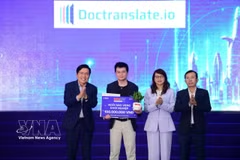
Doctranslate.io offers contextual translation, audio recording, transcription and content summarisation services for communication, meetings and international events. Supporting 80 languages, the platform aims to add more less widely spoken languages.
Vietnam, RoK promote AI cooperation
Vietnam attaches importance to international cooperation while building its own technological capabilities, gaining greater mastery of key technologies and strengthening its participation in global AI value chains, and the RoK is its important partner in this process.
Vietnam promotes cross-border digital trust in AI era
As AI becomes increasingly involved in digital transactions, digital content's origin and integrity must be verified proactively, rather than merely detecting false information after it emerges, an official has said.
Quang Ninh, China’s Guangxi seek stronger cooperation in digital economy, AI
The city leader expressed his hope that the delegation would engage in professional exchanges with Quang Ninh’s departments and agencies to translate into concrete initiatives the cooperation areas in science and technology, artificial intelligence (AI) and the digital economy agreed upon by senior leaders of the two sides.
Vietnam, China explore greater scope for high-tech cooperation
Vietnam is attracting growing interest from Chinese businesses, not only in trade and traditional manufacturing but also in high-tech sectors such as artificial intelligence (AI), the digital economy, the low-altitude economy and smart agriculture, Chinese businesses and associations told Vietnam News Agency correspondents in China.
Vietnam joins Artemis Accords on space exploration
Vietnam views space science and technology as a strategic sector that can lift national science-technology capacity and support sustainable growth. The country wants to work with member nations on peaceful, safe, equitable, transparent and sustainable space exploration under international law, with tangible benefits for people and the planet.
Vietnam sets strategic course for comprehensive national transformation through AI: minister
Vietnam remains committed to developing AI for everyone and is ready to cooperate with partners based on equality, trust, practicality and mutual benefit, to build a safe, reliable, inclusive and sustainable AI ecosystem.