Ericsson establishes R&D capability in Vietnam

This initiative builds on Ericsson’s growing software engineering and testing capabilities in the country, and will further strengthen Vietnam’s contribution to Ericsson’s global technology development.

Hanoi (VNS/VNA) – Ericsson on November 10 announced the establishment of its research and development (R&D) capability in Vietnam, reinforcing the country’s growing role in Ericsson’s global innovation ecosystem and underscoring the company's long-term commitment to Vietnam as a strategic market and technology innovation hub.

Ericsson’s R&D activities in Vietnam bring together around 500 highly skilled engineering professionals working across Radio Access Network, Core Network and cloud-native technologies. This initiative builds on Ericsson’s growing software engineering and testing capabilities in the country, and will further strengthen Vietnam’s contribution to Ericsson’s global technology development.

"Vietnam has emerged as an important hub for technology innovation and engineering excellence," said Andres Vicente, head of Ericsson Southeast Asia, Oceania and India. "The establishment of our R&D presence in Vietnam strengthens Ericsson's global innovation capabilities while creating new opportunities to invest in local talent, skills development and the broader digital ecosystem. It reflects our long-term commitment to Vietnam and our belief in the country's growing role in shaping the future of connectivity."

Ericsson's R&D activities in Vietnam support a broad range of software development and testing capabilities across its technology portfolio. These include the development of advanced radio software in Massive MIMO and remote radio solutions, cloud infrastructure platforms, test frameworks and automation. These capabilities contribute to Ericsson’s global product development and support the evolution of 5G and future technologies.

Ericsson’s collaboration with R&D partners in Vietnam enables it to leverage local, scalable engineering expertise with Ericsson’s global technology and development capabilities. This model provides access to specialised competencies across multiple technology domains and supports the continued scaling of Ericsson’s R&D activities in Vietnam.

Head of Ericsson Vietnam Rita Mokbel said: "This is an important milestone in Ericsson’s journey in Vietnam. Vietnam is not only adopting some of the world’s most advanced connectivity technologies — Vietnamese engineering talent is also increasingly contributing to their development.

"Through our R&D presence here, we want to create more opportunities for local talent to work on technologies with global relevance while contributing to Vietnam’s ambition to become a leading centre for digital innovation and engineering excellence."

Beyond strengthening Ericsson’s global innovation capabilities, the company's R&D presence is expected to contribute to Vietnam's technology ecosystem by creating opportunities for local engineers to work on advanced telecommunications software and globally relevant technology platforms.

With more than a century of experience in connectivity and innovation, Ericsson continues to invest in technologies that empower communications service providers, enterprises and societies to benefit from a connected, intelligent and sustainable future./.

VNA
See more

An AI-powered robot at the 2026 Seoul AI Conference. (Photo: VNA)

RoK’s AI robotics drive opens cooperation opportunities with Vietnam

Dao Tuan Hung, President of the Business Association of Vietnamese in Korea (BAVIK), said Vietnam should adopt a practical approach by prioritising specialised robots, including autonomous mobile robots (AMR/AGV), collaborative robots and machine vision systems, in sectors such as agro-fishery processing, textiles and garments, electronics and logistics.

Russian survey vessel Akademik M.A. Lavrentyev (Photo: VNA)

Russian survey vessel docks in Hai Phong

This is the third joint marine scientific survey in Vietnamese waters, running from November 4 - December 12, and one of the opening field activities under the Vietnam–Russia roadmap for marine scientific research cooperation for 2026-2035.

Smart products, chips and semiconductor materials are displayed at the launch ceremony of the national semiconductor chip prototyping support centre in Hanoi on June 26, 2026. (Photo: VNA)

Vietnam-Japan semiconductor cooperation paves the way for high-tech investment

The two countries are implementing five semiconductor research projects involving leading universities, with funding agreements signed in July. The projects cover three-dimensional integrated circuits, advanced semiconductor materials, secure artificial intelligence (AI) chips and power electronic components.

An exhibition space at the “Da Nang Semiconductors and High-Tech 2026” conference, organised by the Da Nang People’s Committee. (Illustrative photo: VNA)

Mobilising international resources to drive Vietnam’s technology development

Vietnam previously focused mainly on attracting overseas experts and intellectuals to work in the country over the long term, but this approach encountered certain difficulties. Cooperation methods are now shifting towards greater flexibility, allowing experts to take part in conferences and scientific seminars, contribute to addressing major national challenges, or participate in short-term training and research programmes.

Assoc. Prof. Dr. Dinh Ngoc Thach, lecturer and researcher in automatic control theory and robotics at the French National Conservatory of Arts and Crafts (Cnam) (Photo: VNA)

Core technologies key to sustainable robotics development in Vietnam: expert

Vietnam should select suitable robotic platforms and gradually build capacity in core technologies, including sensing, environmental perception, positioning, state estimation, AI, control and system integration. This will help develop technologies applicable across multiple sectors while avoiding fragmented investment and dependence on a single product category.

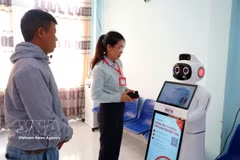
AI robots have become effective assistants in providing administrative services and reducing the workload of officials in Lam Dong province (Photo: VNA)

AI robots help streamline administrative procedures

Operating around the clock, AI robots provide information on administrative procedures, required documents, processing times, fees and relevant regulations, complementing assistance from civil servants.

High prospects for Vietnam-Italy cooperation in robotics industry

High prospects for Vietnam-Italy cooperation in robotics industry

Vietnam and Italy have highly complementary strengths in this robotics field. Italy has experience in machinery manufacturing, industrial robotics applications and an established business network, while Vietnam has a dynamic market, strong demand for production modernisation and a promising young engineering workforce.

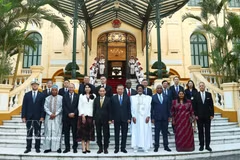
General Secretary of the Communist Party of Vietnam (CPV) Central Committee and President To Lam and the foreign ambassadors at the meeting (Photo: VNA)

Top leader receives new foreign ambassadors

Vietnam wishes to step up cooperation with the countries in such areas as economy, trade and investment; cutting-edge science and technology applications, semiconductors, artificial intelligence, new materials, digital transformation, sustainable agriculture, the environment, energy and renewable energy, the marine economy and maritime transport.

Delegates at the event (Photo: VNA)

Over 400 scientists attend international material conference

Discussions focus on six key areas, including advanced materials and their applications for sustainable development; environmentally friendly material processing technologies; product lifecycle engineering; sustainable machine design; low-carbon industries and the circular economy; and artificial intelligence and digital transformation in material and mechanical engineering.

Deputy Prime Minister Ho Quoc Dung (R) and Pierre Barnabé, Chief Operating Officer of French technology group Dassault Systèmes. (Photo: VNA)

Vietnam, France step up cooperation in AI, digital twin technology

At the meeting, the Deputy PM praised the group's contributions to promoting technology cooperation between Vietnam and France, particularly its collaboration with the Ministry of Finance and the National Innovation Centre (NIC) to establish a Centre of Excellence (CoE) for digital twins and artificial intelligence (AI) in Hanoi.

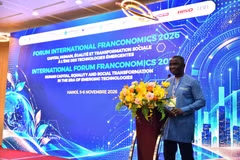
Rigobert Pinga Pinga, Acting Representative of OIF for Asia-Pacific speaks at the event. (Photo: VNA)

Franconomics 2026 explores human-centred technological transformation

Addressing the opening ceremony, Nguyen Anh Tuan, Rector of VNU-IS, said Franconomics was launched in 2019 as a multidisciplinary platform connecting scientists, policymakers, businesses and international organisations to discuss socio-economic issues relevant to Vietnam and the Francophone community.

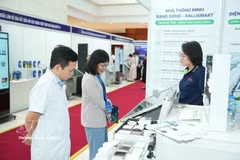
A new technology exhibition area arranged within the framework of the International Research and Innovation Funders Forum in Hanoi (Photo: VNA)

Vietnam promotes int'l cooperation in science, technology and innovation

Science is opening up new opportunities in artificial intelligence, healthcare, semiconductors and clean energy, while challenges such as climate change, energy security and epidemics require international cooperation. Science, technology, innovation and digital transformation are central to Vietnam’s new growth model.

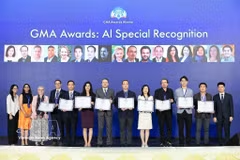
GMA Awards are presented to honour outstanding AI courses at the Global MOOC & Online Education Conference 2026. (Photo: VNA)

Responsible AI, teaching overhaul, global ties dominate GMC 2026

Panelists said AI can support knowledge delivery, information processing and personalised learning, but cannot replace teachers in building independent thinking, critical capacity, emotional intelligence and humanistic values. Universities therefore need to overhaul teaching, testing and assessment and redefine lecturers’ role in an AI-integrated environment.