Strategic technologies key to improving Vietnam’s Global Innovation Index

The 2025 and 2026 GII reports show that Vietnam continued to rank first globally in the share of high-tech exports and creative goods in total trade.

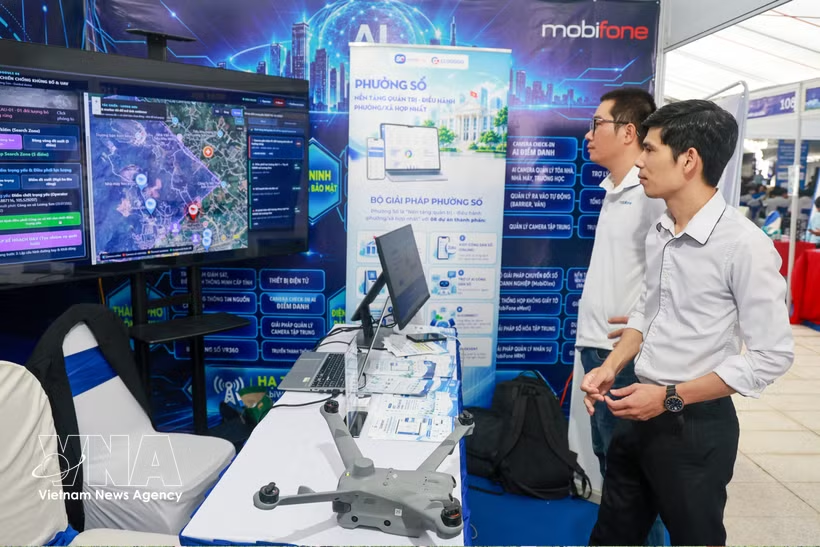
The use of UAVs provides authorities with an additional tool for monitoring construction activities, infrastructure and urban order. (Photo: VNA)

Hanoi (VNA) - Vietnam’s strong performance in high-tech exports contrasts with its limited capacity to create and capture value from technology, according to the Global Innovation Index (GII).

Promoting the development of strategic technologies and products is expected to strengthen national innovation capacity and lay the groundwork for improving the country’s GII ranking in the coming years.

Identifying weaknesses

The 2025 and 2026 GII reports show that Vietnam continued to rank first globally in the share of high-tech exports and creative goods in total trade.

According to the Ministry of Science and Technology, a considerable number of Vietnamese businesses are involved in strategic technologies and products, generating combined revenues worth tens of billions of US dollars. However, most of this revenue comes from foreign-invested enterprises. Domestic businesses account for around one-quarter of the total number but contribute only a small share of revenue. This indicates that while Vietnam has become a major high-tech manufacturing hub, Vietnamese enterprises remain in relatively low positions in global value chains.

Meanwhile, business investment in research and development (R&D) has been increasing. In 2023, enterprises spent approximately 33.3 trillion VND (1.3 billion USD) on R&D, significantly more than other sectors. Experts consider the country's expanding high-tech manufacturing base and rising business investment in research favourable conditions for developing strategic technologies.

Nevertheless, several indicators in the 2026 GII report highlight persistent weaknesses. Vietnam ranked 110th in intellectual property receipts, 100th in high-skilled employment, which accounts for only around 11% of total employment, and 79th in the human capital and research pillar. These figures reveal a gap between Vietnam's deep integration into global technology supply chains and its capacity to generate and capture value from technology and intellectual assets.

Closing this gap requires a shift from processing and assembly towards designing, mastering, owning and commercialising technologies. Vietnam's R&D expenditure currently stands at around 0.4% of GDP. Raising this figure to 2% of GDP, as targeted by Politburo Resolution No. 57-NQ/TW on breakthroughs in science and technology development, innovation and national digital transformation, will be a major challenge requiring contributions from society as a whole, particularly the business sector.

Measures to improve innovation performance

Chu Thuc Dat, Deputy Director of the State Agency of Technology and Innovation under the Ministry of Science and Technology, said enterprises are permitted to establish, manage and use science and technology development funds to conduct or commission research, invest in research infrastructure, acquire technologies and intellectual property, purchase equipment and software, train personnel, cooperate in research and invest in innovative start-ups. Lawful grants and direct expenditures by enterprises on science, technology and innovation activities are also deductible when calculating taxable income.

Experts stressed that achieving the 2%-of-GDP R&D target cannot rely solely on State budget allocations. Instead, mechanisms are needed to encourage greater business investment while sharing risks.

The ministry said the strategic technology programme directly addresses several of Vietnam's weakest GII indicators. Mastering core technologies, registering and commercialising patents will increase intellectual property revenues; developing strong research teams and engineering design capabilities will strengthen human capital and research capacity; greater State and business investment will improve R&D indicators; and closer cooperation among research institutes, universities and enterprises will enhance innovation linkages.

As of October 19, the ministry had completed the appraisal of all 29 proposals for strategic technology and strategic technology product development tasks in the first phase. Of these, 17 had been approved by ministries and sectors, with proposed funding totalling 2.31 trillion VND, including 34.5% from non-State and socialised sources. The ministry had also received and processed 53 new proposals from organisations, research institutes, universities and businesses, while reviewing major technological challenges submitted by provinces and cities.

Short-term tasks are expected to take 18–24 months, while long-term ones will span 36–60 months. If implementation begins in late 2026 and proceeds on schedule, the first strategic technologies and products could emerge in 2028.

Ultimately, the programme's success will be measured not simply by the number of projects completed, but by the ability to master technologies, establish new industries and value chains, and generate breakthroughs in socio-economic development, national defence and security./.

VNA

See more

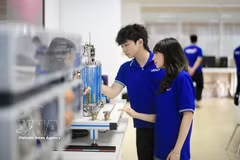
USTH students access modern equipment (Photo: VNA)

Vietnam’s AI ambition runs into talent wall

AI is becoming a foundational technology, cutting across industrial production, healthcare, education, finance, governance and public service delivery. But turning technological potential into practical value requires a workforce able to study, master and apply AI to Vietnam’s real-world problems.

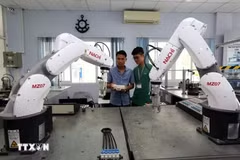
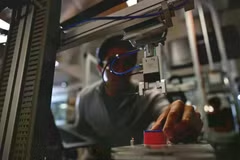
Trainees practise programming and operating robots at the Ho Chi Minh City High-Tech Park Training Centre. (Photo: VNA)

Vietnam, Malaysia hold potential for cooperation in robotics industry

Businesses from both countries should lead joint research and field-testing projects in areas such as electronic component inspection, warehouse transport, agricultural monitoring and medical logistics, said Samirul Ariff Othman, a policy, economic and business analyst at Global Asia Consulting and visiting lecturer at Universiti Teknologi PETRONAS.

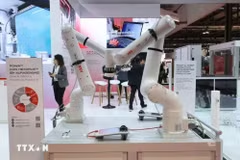
Illustrative image (Photo: SGGP)

Ericsson establishes R&D capability in Vietnam

This initiative builds on Ericsson’s growing software engineering and testing capabilities in the country, and will further strengthen Vietnam’s contribution to Ericsson’s global technology development.

An AI-powered robot at the 2026 Seoul AI Conference. (Photo: VNA)

RoK’s AI robotics drive opens cooperation opportunities with Vietnam

Dao Tuan Hung, President of the Business Association of Vietnamese in Korea (BAVIK), said Vietnam should adopt a practical approach by prioritising specialised robots, including autonomous mobile robots (AMR/AGV), collaborative robots and machine vision systems, in sectors such as agro-fishery processing, textiles and garments, electronics and logistics.

Russian survey vessel Akademik M.A. Lavrentyev (Photo: VNA)

Russian survey vessel docks in Hai Phong

This is the third joint marine scientific survey in Vietnamese waters, running from November 4 - December 12, and one of the opening field activities under the Vietnam–Russia roadmap for marine scientific research cooperation for 2026-2035.

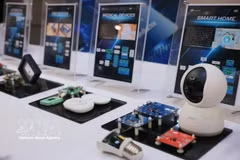
Smart products, chips and semiconductor materials are displayed at the launch ceremony of the national semiconductor chip prototyping support centre in Hanoi on June 26, 2026. (Photo: VNA)

Vietnam-Japan semiconductor cooperation paves the way for high-tech investment

The two countries are implementing five semiconductor research projects involving leading universities, with funding agreements signed in July. The projects cover three-dimensional integrated circuits, advanced semiconductor materials, secure artificial intelligence (AI) chips and power electronic components.

An exhibition space at the “Da Nang Semiconductors and High-Tech 2026” conference, organised by the Da Nang People’s Committee. (Illustrative photo: VNA)

Mobilising international resources to drive Vietnam’s technology development

Vietnam previously focused mainly on attracting overseas experts and intellectuals to work in the country over the long term, but this approach encountered certain difficulties. Cooperation methods are now shifting towards greater flexibility, allowing experts to take part in conferences and scientific seminars, contribute to addressing major national challenges, or participate in short-term training and research programmes.

Assoc. Prof. Dr. Dinh Ngoc Thach, lecturer and researcher in automatic control theory and robotics at the French National Conservatory of Arts and Crafts (Cnam) (Photo: VNA)

Core technologies key to sustainable robotics development in Vietnam: expert

Vietnam should select suitable robotic platforms and gradually build capacity in core technologies, including sensing, environmental perception, positioning, state estimation, AI, control and system integration. This will help develop technologies applicable across multiple sectors while avoiding fragmented investment and dependence on a single product category.

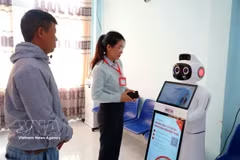
AI robots have become effective assistants in providing administrative services and reducing the workload of officials in Lam Dong province (Photo: VNA)

AI robots help streamline administrative procedures

Operating around the clock, AI robots provide information on administrative procedures, required documents, processing times, fees and relevant regulations, complementing assistance from civil servants.

High prospects for Vietnam-Italy cooperation in robotics industry

High prospects for Vietnam-Italy cooperation in robotics industry

Vietnam and Italy have highly complementary strengths in this robotics field. Italy has experience in machinery manufacturing, industrial robotics applications and an established business network, while Vietnam has a dynamic market, strong demand for production modernisation and a promising young engineering workforce.

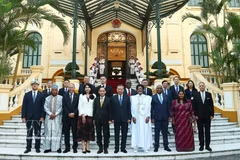
General Secretary of the Communist Party of Vietnam (CPV) Central Committee and President To Lam and the foreign ambassadors at the meeting (Photo: VNA)

Top leader receives new foreign ambassadors

Vietnam wishes to step up cooperation with the countries in such areas as economy, trade and investment; cutting-edge science and technology applications, semiconductors, artificial intelligence, new materials, digital transformation, sustainable agriculture, the environment, energy and renewable energy, the marine economy and maritime transport.

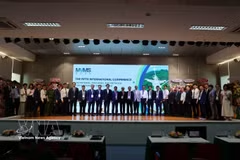
Delegates at the event (Photo: VNA)

Over 400 scientists attend international material conference

Discussions focus on six key areas, including advanced materials and their applications for sustainable development; environmentally friendly material processing technologies; product lifecycle engineering; sustainable machine design; low-carbon industries and the circular economy; and artificial intelligence and digital transformation in material and mechanical engineering.

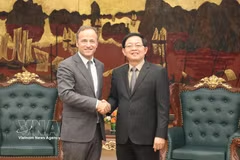
Deputy Prime Minister Ho Quoc Dung (R) and Pierre Barnabé, Chief Operating Officer of French technology group Dassault Systèmes. (Photo: VNA)

Vietnam, France step up cooperation in AI, digital twin technology

At the meeting, the Deputy PM praised the group's contributions to promoting technology cooperation between Vietnam and France, particularly its collaboration with the Ministry of Finance and the National Innovation Centre (NIC) to establish a Centre of Excellence (CoE) for digital twins and artificial intelligence (AI) in Hanoi.

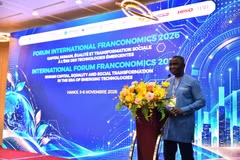
Rigobert Pinga Pinga, Acting Representative of OIF for Asia-Pacific speaks at the event. (Photo: VNA)

Franconomics 2026 explores human-centred technological transformation

Addressing the opening ceremony, Nguyen Anh Tuan, Rector of VNU-IS, said Franconomics was launched in 2019 as a multidisciplinary platform connecting scientists, policymakers, businesses and international organisations to discuss socio-economic issues relevant to Vietnam and the Francophone community.