Vietnam builds initial semiconductor foundation

Experts said the first step is not another broad strategy but a hard-headed audit of what Vietnam can actually do and a clear-eyed map of its advantages, technology gaps and opportunities in the global value chain.

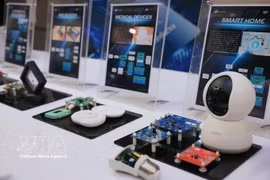
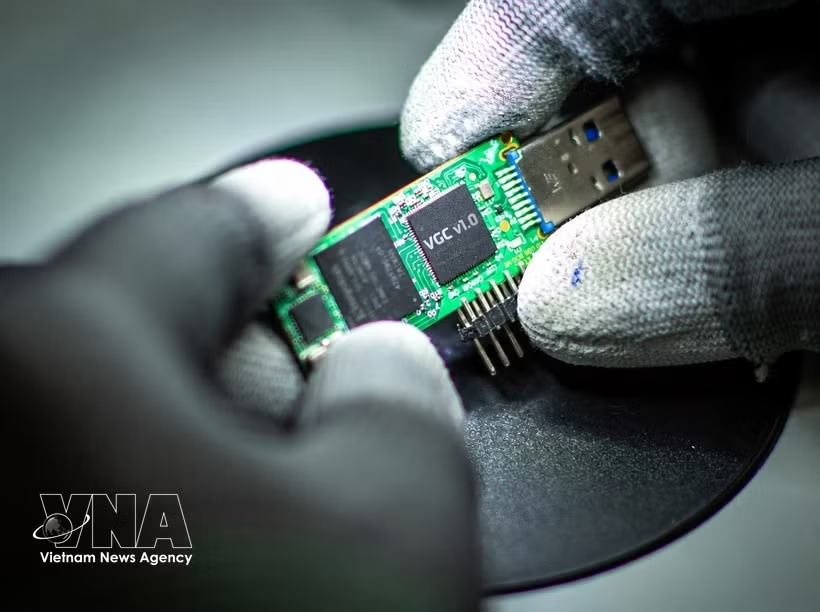
The VGC v1.0 security chip, designed and developed by Vietnam (Photo: VNA)

Hanoi (VNA) – Vietnam has laid only the first foundation of a semiconductor industry, including a circuit-design engineering corps, research and training establishments, a handful of companies and several flagship investment projects.

The country, however, still lacks R&D depth, product development capability, domestic corporate scale and meaningful presence in the high-value stages where semiconductor profits are concentrated.

Experts said the first step is not another broad strategy but a hard-headed audit of what Vietnam can actually do and a clear-eyed map of its advantages, technology gaps and opportunities in the global value chain.

Mastering manufacturing process

Deputy Minister of Science and Technology Le Xuan Dinh calls semiconductors the “physical core” underpinning national strategic technologies such as AI, cloud computing, the Internet of Things (IoT), quantum technology, optical chips and cybersecurity. Without a domestic semiconductor industry, Vietnam risks full dependence on imported hardware as it builds strategic infrastructure.

Vietnamese engineers have designed some chips, but manufacturing still goes overseas because Vietnam has no domestic fab. That is a control risk. National technology security is not real until Vietnam masters the full chain from design to domestic production.

Assoc. Prof. Dr Nguyen Tran Thuat, Director of the Institute of Semiconductors and Advanced Materials at Vietnam National University, Hanoi, said policy levers, including the Politburo's Resolution No. 57-NQ/TW and the Prime Minister's Decision No. 1018/QD-TTg and Decision No. 1017/QD-TTg, are producing tangible gains.

Domestic digital tech firms are moving into circuit design. Viettel, working with the Government Cipher Committee, developed the VGC security chip Version 01 on a 28nm CMOS process with 300 million transistors, which encrypts and decrypts about 15 times faster than a pure software solution for the same task, Thuat noted.
vnanet-vietnams-semiconductor-industry-2876.jpg
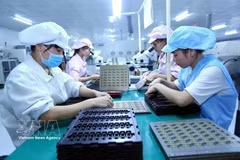
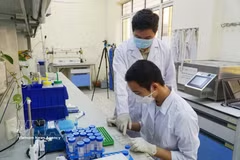
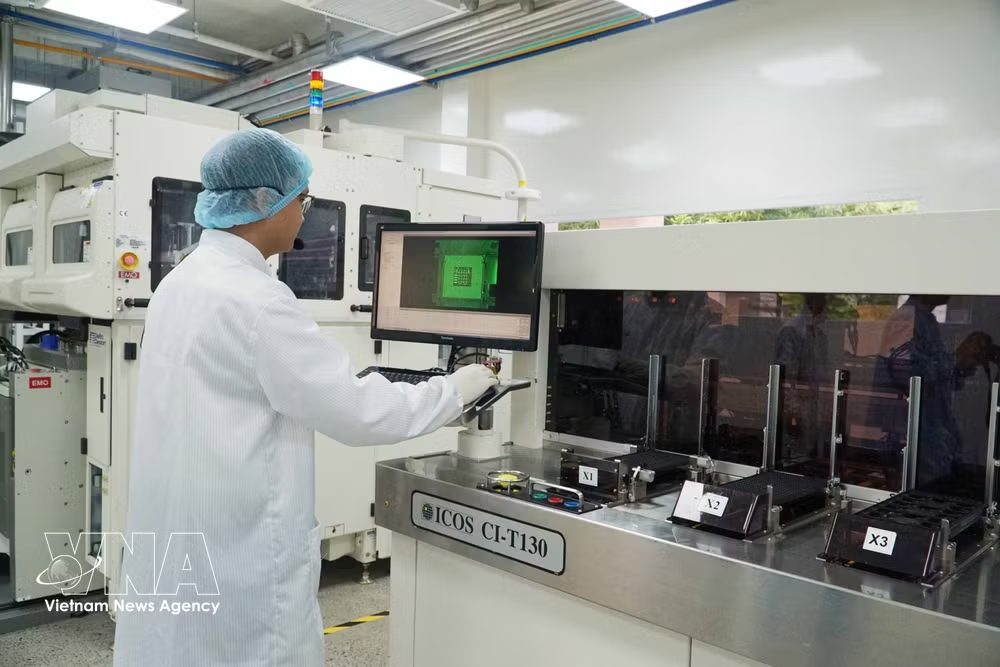
An integrated circuit assembly and test lab at the Saigon Hi-Tech Park in Ho Chi Minh City (Photo: VNA)

However, R&D still has three hard bottlenecks. Clean rooms, test-and-measurement equipment and pilot manufacturing are too expensive for any single institute, university or startup, so the State must act as financial “midwife” to push ideas past academic simulation. Vietnam also lacks chief architects and engineers with real experience at international corporations to lead complex designs. And financial management, specialised equipment procurement and project acceptance rules need a “controlled risk-acceptance space” because chip commercialisation has a very high test-failure rate.

Leveraging existing advantages

Dinh said the Ministry of Science and Technology has set three priorities. Vietnam will not fight head-on in general-purpose chips, where capital requirements run into tens of billions of USD. It will concentrate on specialised lines, including Edge AI, IoT and 5G/6G devices, where it can use strengths in optimisation algorithms, intelligent design architecture and customisation for domestic needs.

The policy shift is from grants to commissioning science tasks around real corporate problems, with commercialisation as the test. The State will push co-funding from science and venture capital funds, apply lump-sum contracting through to the final product and accept risk. Besides, training will be tied to real-process practice, and Vietnam will create a mechanism to attract chief architects and overseas Vietnamese experts to lead domestic R&D teams.

Dr Richard L. Thurston, Chairman and CEO of Great Lakes Semiconductor, who has decades of experience in leading ecosystems, supply chains and semiconductor intellectual property management at large corporations, said Vietnam needs one unified national semiconductor strategy. It should connect ministries, research institutes, universities, domestic companies, foreign investors and supply chain partners through a disciplined industrial policy with common priorities and measurable milestones, instead of isolated labs, disconnected incentives or scattered, overlapping projects.

Vietnam should not build a large-scale chip fab now as it will too easily become a burden. The better play is to use existing strengths in electronics assembly, packaging and testing, talented engineers, industrial clusters and trade networks as a launchpad into higher-value work such as design, materials, specialised components and commercialisation.

According to Thurston, Vietnam should also build complementary partnerships with semiconductor powers like the US, Japan, Germany, Ireland and others in equipment and design to access production capacity, materials testing, training, investment and customers. The partnership should be mutually beneficial, not a substitute for Vietnam’s own capabilities./.


VNA

See more

The inauguration ceremony of the ASEAN-China Health Exchange and Cooperation Centre in Chongqing. (Photo: VNA)

Vietnam proposes stronger ASEAN-China cooperation in AI

For Vietnam, AI-driven transformation is both a strategic opportunity and an inevitable requirement for development. Science, technology and innovation are becoming key drivers of growth, productivity and competitiveness, said Deputy Minister of Foreign Affairs Nguyen Manh Cuong.

Assembling electronic components on the production line of Bao Sen Co., Ltd in Bac Ninh City. (Photo: VNA)

Vietnam builds technological capacity in digital era

As science, technology and digital transformation become increasingly integrated into production, governance and daily life, they can help create new drivers of growth and advance the development goals set out in the resolution.

The beauty of Dong Van Karst Plateau (Photo: VNA)

Vietnam tourism’s competitive future runs on digitalisation

The Vietnam National Authority of Tourism (VNAT) reported that Vietnam drew about 19.5 million foreign arrivals in the first 10 months of 2026, up 13.8% from a year earlier. That growth, along with changing consumer behavior, is forcing travel companies to rethink sales, service quality and how they mine customer data.

Visitors at the exhibtion held within the framework of the 16th Business of IP Asia Forum. (Photo: VNA)

Vietnam promotes innovation links at Hong Kong Entrepreneur Day 2026

Van expressed her hope that the NIC would serve as a bridge to encourage businesses and major corporations from the GBA to invest in Vietnam and transfer innovative technologies, particularly in artificial intelligence (AI), green transition and financial technology (FinTech).

Karnataka Chief Minister D.K. Shivakumar speaks positively about cooperation prospects and expresses hope that more Vietnamese businesses will invest in the Indian state. (Photo: VNA)

Vietnam, India's Karnataka boost science, technology cooperation

The ambassador highlighted the complementary strengths of Vietnam and the Indian state, home to the country's Silicon Valley, and significant potential for cooperation in artificial intelligence (AI), semiconductors, digital technology, and research and development.

Delegates pose for a group photo at the Bengaluru Tech Summit 2026 in Karnataka, India (Photo: VNA)

Vietnam attends annual int’l tech summit in India

Vietnam's growing focus on science and technology, digital transformation and innovation as new drivers of development made India a natural partner in achieving its development and digital transformation goals. Cooperation potential between the two countries remains substantial, spanning both hardware and software.

Representatives of Cambodia’s Ministry of Education, Youth and Sport (MoEYS), the Agence Universitaire de la Francophonie (AUF) and Viettel Cambodia (Metfone) sign a tripartite agreement to strengthen cooperation and accelerate digital transformation in Cambodia’s higher education sector. (Photo: khmertimeskh.com)

Vietnamese company joins Cambodia’s digital transformation efforts

The agreement establishes a cooperation framework to modernise higher education through digital governance, digital learning, artificial intelligence (AI) applications, and capacity building through training and knowledge sharing. It also aims to expand internship, employment and scholarship opportunities for students.

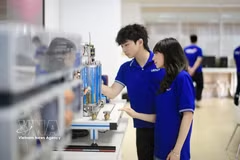
USTH students access modern equipment (Photo: VNA)

Vietnam’s AI ambition runs into talent wall

AI is becoming a foundational technology, cutting across industrial production, healthcare, education, finance, governance and public service delivery. But turning technological potential into practical value requires a workforce able to study, master and apply AI to Vietnam’s real-world problems.

Trainees practise programming and operating robots at the Ho Chi Minh City High-Tech Park Training Centre. (Photo: VNA)

Vietnam, Malaysia hold potential for cooperation in robotics industry

Businesses from both countries should lead joint research and field-testing projects in areas such as electronic component inspection, warehouse transport, agricultural monitoring and medical logistics, said Samirul Ariff Othman, a policy, economic and business analyst at Global Asia Consulting and visiting lecturer at Universiti Teknologi PETRONAS.

Illustrative image (Photo: SGGP)

Ericsson establishes R&D capability in Vietnam

This initiative builds on Ericsson’s growing software engineering and testing capabilities in the country, and will further strengthen Vietnam’s contribution to Ericsson’s global technology development.

An AI-powered robot at the 2026 Seoul AI Conference. (Photo: VNA)

RoK’s AI robotics drive opens cooperation opportunities with Vietnam

Dao Tuan Hung, President of the Business Association of Vietnamese in Korea (BAVIK), said Vietnam should adopt a practical approach by prioritising specialised robots, including autonomous mobile robots (AMR/AGV), collaborative robots and machine vision systems, in sectors such as agro-fishery processing, textiles and garments, electronics and logistics.

Russian survey vessel Akademik M.A. Lavrentyev (Photo: VNA)

Russian survey vessel docks in Hai Phong

This is the third joint marine scientific survey in Vietnamese waters, running from November 4 - December 12, and one of the opening field activities under the Vietnam–Russia roadmap for marine scientific research cooperation for 2026-2035.