Vietnam tourism’s competitive future runs on digitalisation

The Vietnam National Authority of Tourism (VNAT) reported that Vietnam drew about 19.5 million foreign arrivals in the first 10 months of 2026, up 13.8% from a year earlier. That growth, along with changing consumer behavior, is forcing travel companies to rethink sales, service quality and how they mine customer data.

The beauty of Dong Van Karst Plateau (Photo: VNA)

Hanoi (VNA) - Vietnam’s tourism recovery is turning digital transformation from a buzzword into a competitive necessity.

The Vietnam National Authority of Tourism (VNAT) reported that the country drew about 19.5 million foreign arrivals in the first 10 months of 2026, up 13.8% from a year earlier. That growth, along with changing consumer behavior, is forcing travel companies to rethink sales, service quality and how they mine customer data.

For tour operators, digitalisation has moved well beyond websites and online booking channels. AI is now being deployed in customer advice, demand analysis and service matching, with the goal of linking search, product selection, booking, payment and itinerary management into one digital flow.

vnanet-x.jpg
Travel companies are deploying digital solutions (Photo: VNA)

Vietravel Hanoi has launched a redesigned travel.com.vn platform with Tripi, an AI chatbot that runs 24/7. The interface lets customers search tours by departure point and choose itineraries themselves, cutting the time needed to find and access products, its Deputy Director Pham Van Bay said.

According to him, Tripi is meant to be more than a Q&A tool. It serves as a trip planning assistant that can take requests, suggest routes and keep advising outside normal sales hours. The AI digitises the first stage of consultation and helps filter demand, but human advisers remain critical for complex itineraries, international tours, visas and tailor-made journeys.

The platform also acts as a digital transaction point, letting customers search products, book tours, check reservations and pay online through Visa, Mastercard, JCB, VNPay, ZaloPay and MoMo.

BestPrice Travel is making a similar bet with Bipi, an AI travel chatbot that helps customers consider and plan trips. Using budget, timing, preferences and travel style, the system recommends products and shortens the consultation process.

Its Marketing Director Bui Thanh Tu said digital transformation is less about technology alone than about understanding customers and personalising experiences at scale. BestPrice is analysing search and booking behaviour, recommending itineraries that fit needs and budgets, and offering customisation from the first consultation.

The early results show AI can lift sales efficiency and service quality. But digital transformation is not just about bolting technology onto individual steps, but also requires connected data and a reorganised operating model.

VNAT Deputy Director Nguyen Thi Hoa Mai said data and technology are becoming central as competition among destinations intensifies. They matter for management, policy planning, market research and promotion. The industry needs more than arrival counts and source markets; it must understand demand, preferences, spending, length of stay and travel trends by customer segment. That data is the basis for spotting potential markets, targeting customer groups, building products, improving experiences and running more focused promotion campaigns.

uh.jpg
At the launch of the “Digital check-in and loyalty points” introduced by the Dong Van communal Tourism Association (Photo published by VNA)

The VNAT is pushing to standardise tourism resource data and guide localities in using data management software. In October, training sessions on tourism resource survey databases were held in the north and south to align collection, evaluation and updating methods. It is also trying to modernise promotion by analysing customer needs and behaviour, using data to identify potential markets, build suitable products, reach travellers more effectively and sharpen destination competitiveness.

Yet, the hurdles remain, including investment resources, technology talent, data interoperability and customer information security. For small and medium-sized enterprises, the key is to choose solutions that match their scale, costs and practical capacity, avoiding scattered spending that delivers little, she said./.


VNA

See more

Visitors at the exhibtion held within the framework of the 16th Business of IP Asia Forum. (Photo: VNA)

Vietnam promotes innovation links at Hong Kong Entrepreneur Day 2026

Van expressed her hope that the NIC would serve as a bridge to encourage businesses and major corporations from the GBA to invest in Vietnam and transfer innovative technologies, particularly in artificial intelligence (AI), green transition and financial technology (FinTech).

Karnataka Chief Minister D.K. Shivakumar speaks positively about cooperation prospects and expresses hope that more Vietnamese businesses will invest in the Indian state. (Photo: VNA)

Vietnam, India's Karnataka boost science, technology cooperation

The ambassador highlighted the complementary strengths of Vietnam and the Indian state, home to the country's Silicon Valley, and significant potential for cooperation in artificial intelligence (AI), semiconductors, digital technology, and research and development.

Delegates pose for a group photo at the Bengaluru Tech Summit 2026 in Karnataka, India (Photo: VNA)

Vietnam attends annual int’l tech summit in India

Vietnam's growing focus on science and technology, digital transformation and innovation as new drivers of development made India a natural partner in achieving its development and digital transformation goals. Cooperation potential between the two countries remains substantial, spanning both hardware and software.

Vietnamese Deputy Minister of Science and Technology Tran Trung Tinh speaks at the event. (Photo: Published by VNA)

Vietnam, RoK seek to expand cooperation in AI and semiconductor sectors

Vietnamese Deputy Minister of Science and Technology Tran Trung Tinh stressed that the Politburo's Resolution No. 57-NQ/TW identifies science and technology, innovation and digital transformation as leading breakthroughs and key drivers of rapid and sustainable development. Semiconductors and artificial intelligence (AI) are among the strategic technologies prioritised for development.

Representatives of Cambodia’s Ministry of Education, Youth and Sport (MoEYS), the Agence Universitaire de la Francophonie (AUF) and Viettel Cambodia (Metfone) sign a tripartite agreement to strengthen cooperation and accelerate digital transformation in Cambodia’s higher education sector. (Photo: khmertimeskh.com)

Vietnamese company joins Cambodia’s digital transformation efforts

The agreement establishes a cooperation framework to modernise higher education through digital governance, digital learning, artificial intelligence (AI) applications, and capacity building through training and knowledge sharing. It also aims to expand internship, employment and scholarship opportunities for students.

USTH students access modern equipment (Photo: VNA)

Vietnam’s AI ambition runs into talent wall

AI is becoming a foundational technology, cutting across industrial production, healthcare, education, finance, governance and public service delivery. But turning technological potential into practical value requires a workforce able to study, master and apply AI to Vietnam’s real-world problems.

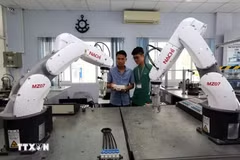
Trainees practise programming and operating robots at the Ho Chi Minh City High-Tech Park Training Centre. (Photo: VNA)

Vietnam, Malaysia hold potential for cooperation in robotics industry

Businesses from both countries should lead joint research and field-testing projects in areas such as electronic component inspection, warehouse transport, agricultural monitoring and medical logistics, said Samirul Ariff Othman, a policy, economic and business analyst at Global Asia Consulting and visiting lecturer at Universiti Teknologi PETRONAS.

Illustrative image (Photo: SGGP)

Ericsson establishes R&D capability in Vietnam

This initiative builds on Ericsson’s growing software engineering and testing capabilities in the country, and will further strengthen Vietnam’s contribution to Ericsson’s global technology development.

An AI-powered robot at the 2026 Seoul AI Conference. (Photo: VNA)

RoK’s AI robotics drive opens cooperation opportunities with Vietnam

Dao Tuan Hung, President of the Business Association of Vietnamese in Korea (BAVIK), said Vietnam should adopt a practical approach by prioritising specialised robots, including autonomous mobile robots (AMR/AGV), collaborative robots and machine vision systems, in sectors such as agro-fishery processing, textiles and garments, electronics and logistics.

Russian survey vessel Akademik M.A. Lavrentyev (Photo: VNA)

Russian survey vessel docks in Hai Phong

This is the third joint marine scientific survey in Vietnamese waters, running from November 4 - December 12, and one of the opening field activities under the Vietnam–Russia roadmap for marine scientific research cooperation for 2026-2035.

Smart products, chips and semiconductor materials are displayed at the launch ceremony of the national semiconductor chip prototyping support centre in Hanoi on June 26, 2026. (Photo: VNA)

Vietnam-Japan semiconductor cooperation paves the way for high-tech investment

The two countries are implementing five semiconductor research projects involving leading universities, with funding agreements signed in July. The projects cover three-dimensional integrated circuits, advanced semiconductor materials, secure artificial intelligence (AI) chips and power electronic components.

An exhibition space at the “Da Nang Semiconductors and High-Tech 2026” conference, organised by the Da Nang People’s Committee. (Illustrative photo: VNA)

Mobilising international resources to drive Vietnam’s technology development

Vietnam previously focused mainly on attracting overseas experts and intellectuals to work in the country over the long term, but this approach encountered certain difficulties. Cooperation methods are now shifting towards greater flexibility, allowing experts to take part in conferences and scientific seminars, contribute to addressing major national challenges, or participate in short-term training and research programmes.