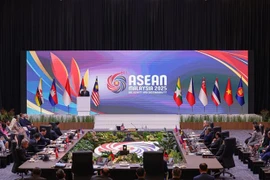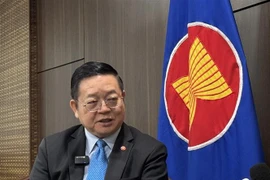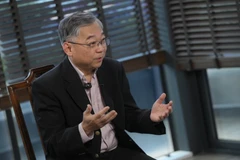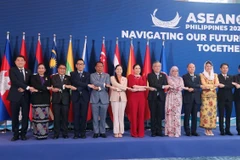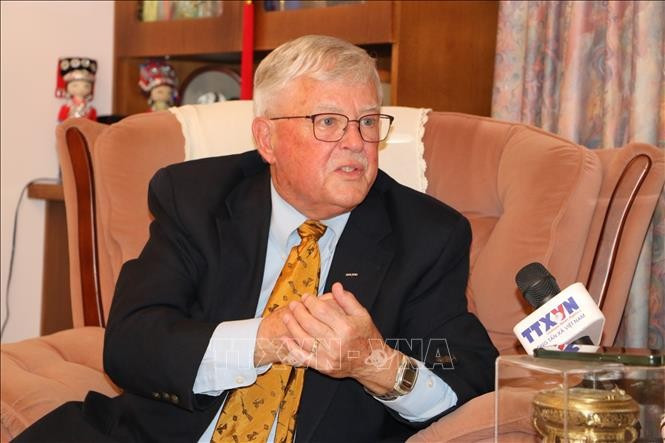
Sydney (VNA) – Malaysia’s choice of the theme “Inclusive and Sustainable” for its term as ASEAN Chair is meant to convey that the needs and interests of all 10 members will be included in policy deliberations and that ASEAN’s Community Building programme, which starts a new phase after 2025, will promote sustainable and environmentally friendly economic growth, said Carlyle A. Thayer, Emeritus Professor at Australian Defence Force Academy, the University of New South Wales.
Talking about the purpose, meanings and importance of the ASEAN Summit 2025 with the Vietnam News Agency (VNA)'s resident correspondent in Sydney, the Australian scholar said that in January this year, the Press Statement after the ASEAN Foreign Ministers’ Retreat identified the following priorities set by Malaysia as ASEAN Chair for 2025: “advancing ASEAN’s collective vision of a resilient, people-centred, forward looking ASEAN Community while advancing economic growth and regional connectivity, and enhancing regional resilience.”
The ASEAN’s programme of community-building rests on three pillars - economic, political-security and socio-cultural. Each of these pillars has a strategic plan and a blueprint that expire at the end of this year. Adopting new Strategic Plans for 2026-2030 for the ASEAN Economic Community (AEC), ASEAN Political-Security Community (APSC) and ASEAN Socio-Cultural Community (ASCC) will be priority items on the agenda and come under the adoption of an ASEAN Community Vision 2045: Resilient, Innovative, Dynamic and People-Centred ASEAN.
ASEAN will also address three pressing issues: the upheaval in the global trading system, the humanitarian crisis in Myanmar and how to achieve ASEAN’s Five-Point Consensus, and Timor-Leste’s long-standing application for membership.
Thayer said that ASEAN community building will be a continual work in progress. ASEAN’s 46th Summit will conduct an end of term review on each of its three pillars’ Blueprints for 2025 – AEC, APSC, and ASCC – and endorse new blueprints for 2026.
But progress will remain spotty and incremental. For example, ASEAN will transfer responsibility for coordinating cross-pillar issues from its Joint Consultative Meeting to the Committee of Permanent Representatives to address gaps. This will take time to implement, Thayer said.
He noted that ASEAN has a growing list of projects under its three pillars that are moving too slowly.
The ASEAN Framework Agreement on Intellectual Property Cooperation will need to be revised and upgraded. A definite timeline for advancing regional connectivity under the ASEAN Power Grid, the Roadmap on Digital Trade Standards in ASEAN, ASEAN Connectivity Strategic Plan, and the ASEAN Plan of Action in Combatting Transnational Crime need to be stepped up.
There are other matters than have slowed and need attention such as the ASEAN Extradition Treaty, model templates on ASEAN Mutual Legal Assistance in Criminal Matters, whether to establish an ASEAN Prosecutors/Attorney General Meeting/Body/Entity, draft of the Guidelines for the Exchange of Information on E-Commerce Data, draft ASEAN Sustainable Investment Guidelines, ASEAN Digital Economic Framework Agreement, ASEAN Framework Agreement on Competition, Blue Economic Implementation Plan (2026-2030), upgrading ASEAN Trade in Goods Agreement, establishment and operation of the ASEAN Centre for Public Health Emergencies and Emerging Diseases, and finalisation of the ASEAN Report on Women Political Participation and Leadership.
Approval to establish the ASEAN Centre for Climate Change and the ASEAN Coordinating Centre for Transboundary Haze Pollution Control has been delayed by several ASEAN members who have not signed in to the requisite agreements.
Regrading the contribution of the ASEAN Summit in enhancing ASEAN's role in the region and the world, and in the regional and global peace, stability and prosperity, Thayer said that ASEAN members fully support the ASEAN Outlook on the Indo-Pacific (AOIP) and continually insist on ASEAN’s centrality in the regional security architecture. ASEAN’s dialogue partners also have endorsed the AOIP’s four priority areas: maritime cooperation, connectivity economic co-operation and sustainable development.
Meanwhile, assessing the prospect of the ASEAN-Australia relationship in the future, especially after this summit, the professor said that Australia and ASEAN already have a Plan of Action (2025-2029) that covers an extensive range of cooperative activities under each of ASEAN’s three pillars. For example, Australia contributes to the ASEAN Political Security Community pillar through cooperation in maritime security, counter-terrorism, humanitarian assistance and disaster relief, mine action, cyber and transnational crime.
The recent protocol to the ASEAN Australia New Zealand Free Trade Agreement (AANZFTA) provides a framework for cooperation to mitigate the impact of US President Donald Trump’s trade policy with its focus on trade and tariffs. In addition, Australia and ASEAN can work together as members of the Regional Comprehensive Economic Partnership (RCEP) to remove trade barriers and promote resilient supply chains.
Thayer said that Australia will provide enhanced support for ASEAN-led mechanisms, especially the East Asia Forum where dialogue among heads of state and government are vital at a time of rising geopolitical tensions. In addition, Australia will strongly support the ASEAN Regional Forum moving into the second phase of its development – preventive diplomacy, he added./.