BSR, ExxonMobil expand crude oil supply cooperation

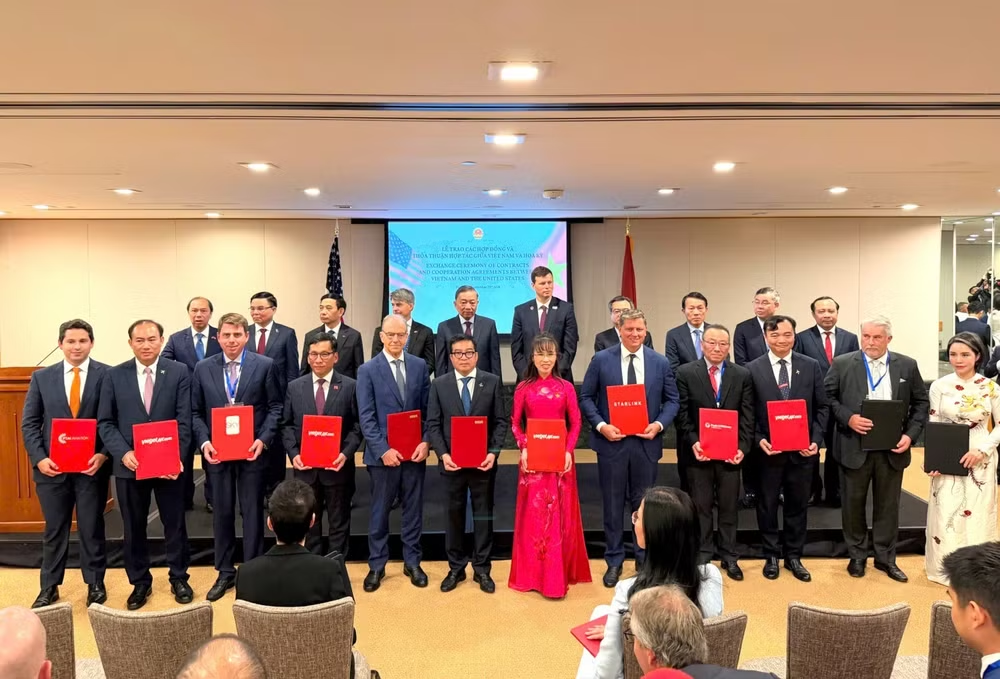
The agreement was exchanged on September 23 in New York, during a high-level roundtable between General Secretary of the Communist Party of Vietnam Central Committee and President To Lam and leaders of major US businesses.​

Hanoi (VNA) – The Petrovietnam Refining and Petrochemical Corporation (BSR), a member of the Vietnam National Industry-Energy Group (Petrovietnam), has signed a framework agreement with ExxonMobil Asia Pacific to expand crude oil supply options for the Dung Quat Refinery.

The agreement was exchanged on September 23 in New York, during a high-level roundtable between General Secretary of the Communist Party of Vietnam Central Committee and President To Lam and leaders of major US businesses.​

The ceremony took place during the Vietnamese top leader's working trip to the US from September 20-23 to attend the high-level general debate of the 81st session of the UN General Assembly and conduct bilateral activities.​

The agreement comes as BSR is diversifying its crude oil sources, increasing operational flexibility and strengthening its ability to respond to unpredictable developments in the global energy market.

Since early 2026, BSR has actively sought, assessed and expanded crude oil supplies from various regions, including the US. The company has also signed crude oil supply agreements with Chevron to help secure stable feedstock for the refinery.​

The ability to process a wide range of crude oils has become an important advantage of the Dung Quat Refinery. Since the beginning of 2026, BSR has successfully tested three new crude oil grades, bringing the total number of crude types that can be processed at the refinery to 40, including 12 domestic and 28 imported grades.​

In 2026, BSR has also mastered the processing of Nigeria's Erha crude, with a maximum blending ratio of about 45% by volume, and Sao Vang-Dai Hung condensate, with a maximum ratio of around 12%.​

120260924165733.jpg
General Secretary of the Communist Party of Vietnam Central Committee and President To Lam and senior Party, State and Government leaders witness BSR's exchange of the framework agreement on crude oil purchases with ExxonMobil Asia Pacific. BSR General Director Nguyen Viet Thang (sixth from left, front row) exchanges the agreement with a representative of ExxonMobil Asia Pacific. (Photo: petrovietnam.petrotimes.vn)​

Expanding its crude oil portfolio gives BSR greater flexibility in selecting feedstock according to market conditions while reducing reliance on traditional sources.​

In 2025, the Dung Quat Refinery imported about 8.28 million tonnes of crude oil, with imported crude accounting for around 31% of its total supply.​

In 2026, BSR has prioritised domestic crude supplies to ensure feedstock availability and cope with geopolitical uncertainties, while maintaining imports at around 15%. Imported crude is sourced from various regions, including West Africa, the Mediterranean and Southeast Asia.​

The framework agreement with ExxonMobil Asia Pacific will further expand BSR's international crude oil supply network and provide an additional source of feedstock for the Dung Quat Refinery.​

It is also in line with BSR's strategy of strengthening feedstock security, improving its ability to respond to fluctuations in the global oil market and enhancing the refinery's operational capacity./.
VNA

See more

The MoU signing ceremony between the gency for Domestic Market Surveillance and Development and Procter & Gamble (P&G). (Photo: Ministry of Industry and Trade)

Vietnam steps up fight against counterfeits, IP violations

The renewed memorandum between Vietnam's domestic market surveillance force and Procter & Gamble (P&G) is expected to build on the results achieved since 2023, strengthen IP enforcement, safeguard the legitimate rights and interests of businesses and consumers, and contribute to a more transparent and fair business environment.

A Jatropha cultivation area of Star Japan Co., Ltd in My Son commune, Khanh Hoa province (Photo of Star Japan Co., Ltd)

Vietnam – a potential regional supply hub for Jatropha seed oil

Japan’s research on non-edible oil feedstocks showed that Jatropha is highly drought-tolerant and could grow well on wasteland, eroded sandy land and infertile soil. Given this, areas in central Vietnam, including Ninh Thuan, Binh Thuan and the Central Highlands, have climatic, sunlight and soil conditions suitable for achieving high seed yields and oil content.

Officials launch the Expo Platform on September 29. It will be officially put into use on October 20, two days before the opening of HCMC Export 2026. (Photo: VNA)

Technology opens new routes for Vietnamese exports

As global markets impose increasingly stringent requirements on standards, traceability, sustainability and green transformation, digitalising product data and bringing buyers closer to production sites can help Vietnamese businesses demonstrate their capabilities and meet market-specific requirements.

Phuong Dinh Anh, Deputy Chief of the Office of the Central Coordination Office for the National Target Programme, speaks at the event.( VNA)

Turning OCOP products into rural tourism experiences

Experts stressed that rural tourism can develop sustainably only when local communities actively participate and benefit from it. Investment in transport, accommodation and attractions must go hand in hand with clean water, waste treatment, hygiene, traditional craft preservation and environmental protection.

Prime Minister Le Minh Hung and his Cambodian counterpart Hun Manet witness the exchange of cooperation agreements between businesses of the two countries (Photo: VNA)

Vietnam, Cambodia look to elevate economic links

Prime Minister Le Minh Hung said that economic, trade and investment cooperation constitutes an important pillar of bilateral ties, which has achieved positive results. However, considerable room remains for further expansion to match the strong political ties and the potential of both countries.

An overview of the meeting (Photo: chinhphu.vn)

Deputy PM calls for tighter price management of essential goods

Deputy PM Thang, who is also head of the committee, urged ministries and agencies to coordinate closely to deliver effective fiscal and macroeconomic policies. The aim is to control inflation, stabilise the macroeconomy, ensure major economic balances, create room to support growth and bolster the economy’s resilience to external shocks.

 Khanh Binh International Land Border Gate in An Giang province.( Photo: VNA)

Vietnam-Cambodia trade gathers pace towards 20 billion USD target

After setting a record of more than 11.3 billion USD in 2025, bilateral trade reached about 8.7 billion USD in the first eight months of 2026, up 8.3% year on year. Vietnam is currently Cambodia’s third-largest trading partner, its second-largest source of imports and second-largest export market.

Vietnamese Ambassador to India Trinh Minh Manh discusses potential areas and strengths for cooperation between Vietnam and India’s Gujarat state. (Photo: VNA)

Vietnam, India’s Gujarat state seek to unlock cooperation potential

Vietnam attaches importance to strengthening cooperation with Indian states boasting strong economic potential, including Gujarat, to further advance the two countries’ Enhanced Comprehensive Strategic Partnership, particularly in the economy, trade and investment, said Ambassador Trinh Minh Manh.

At Nestlé Vietnam factory in Hung Yen province (Photo: VNA)

Vietnam seeks to build stronger ecosystem for FDI

The World Bank has stressed the need to connect global companies with domestic suppliers, improve the business climate and develop supply-chain finance solutions. Those steps will let domestic firms gradually meet requirements on quality, technology, costs and delivery times, and position them to become suppliers to multinational corporations.

Construction of technical infrastructure facilities serving APEC 2027 in Phu Quoc Special Zone, An Giang province. (Illustrative photo: VNA)

Vietnam enters investment grade credit rating category for first time

Vietnam has maintained robust growth, outperforming other Southeast Asian economies. Its ongoing government reforms aimed at streamlining the state apparatus, promoting the private sector, improving the institutional framework and developing capital markets will strengthen the country’s growth potential and economic resilience.