China-ASEAN trade up over 18% in H1

Trade in intermediate goods, including parts, components and production inputs, rose 24.5% to 2.86 trillion CNY during the period, accounting for around two-thirds of total bilateral trade.

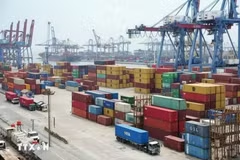
Beijing (VNA) - China-ASEAN trade reached 4.34 trillion CNY (approximately 643.2 billion USD) in the first half of 2026, up 18.2% year on year, reported the General Administration of Customs of China (GACC).

Trade in intermediate goods, including parts, components and production inputs, rose 24.5% to 2.86 trillion CNY during the period, accounting for around two-thirds of total bilateral trade.

GACC Spokesperson Lyu Daliang attributed the steady growth in intermediate goods trade to the increasingly deep integration and connectivity between Chinese and ASEAN industrial and value chains.

Meanwhile, the latest data from Nanning Customs showed that trade between China’s Guangxi Zhuang Autonomous Region and ASEAN reached 248.21 billion CNY in the first seven months of 2026, up 2.5% year on year and setting a new record for the period. Notably, trade with Vietnam rose 3.3% to 183.71 billion CNY.

According to Chinese media, freight trains linking Guangxi with Vietnam now operate daily, up from the previous three services a week, carrying electronics and machinery southward while transporting tropical fruits such as durians and mangosteens northward.

Another framework supporting regional trade is the Regional Comprehensive Economic Partnership (RCEP), a 15-member trade agreement comprising China, Japan, the Republic of Korea, Australia, New Zealand and the 10 ASEAN countries. The pact, which took effect in January 2022, has been fully implemented by all 15 signatories since June 2023. Under its rules of origin, materials originating in one member country and used in production in another member country are considered originating materials of the latter.

Xu Yingming, head of the Institute of International Market Research under China’s Ministry of Commerce, said RCEP and the China-ASEAN Free Trade Area have reduced transaction costs and facilitated closer integration of regional industrial chains.

An expanding China-ASEAN transport network has supported the smooth movement of resources and driven a boom in trade. The China-Laos Railway, which began operations in December 2021 and connects Kunming in southwest China with Laos’ capital Vientiane, recorded 17.17 billion CNY in import-export cargo value in the first half of 2026, up 33.8% year on year. During the period, imports of tropical fruits such as durians, mangosteens and longans rose 25.8% to 4.22 billion CNY.

The railway now transports more than 3,900 types of goods, with freight services reaching markets in 19 countries and territories./.

VNA
See more

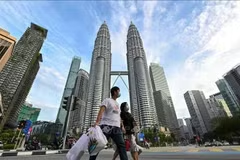
The Petronas Twin Towers in Kuala Lumpur, Malaysia. (Photo: Xinhua/VNA)

Malaysia eyes becoming ASEAN’s AI hub

Malaysia possessed the fundamentals to emerge as ASEAN's digital and AI hub, including its strategic location, strong connectivity, growing digital ecosystem and rising investor confidence, said Digital Minister Gobind Singh Deo.

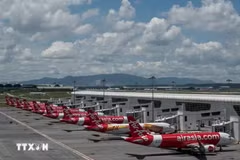
Malaysia is pursuing a vision of becoming one of the Asia-Pacific’s leading air connectivity hubs. (Illustrative photo: AFP/VNA)

Malaysia eyes regional air transport hub status

Stronger connectivity was essential for the movement of capital and goods, while helping deepen Malaysia's economic ties with major regional centres, said Transport Minister Anthony Loke.

A perspective of the passenger terminal at Long Thanh International Airport in its first phase. (Photo: ACV)

Vietnam, India emerge on Asia-Pacific aviation map

Vietnam is considered one of the most promising markets in Southeast Asia in terms of international visitor numbers and travel demand. The country plans to increase the number of airports to 30 by 2030 to meet the needs of its rapidly growing economy.

At the press conference (Photo: VNA)

Lao Digital Week 2026 slated for October in Vientiane

The event will serve as a major information technology and digital innovation platform, with sidelines events including the Lao Digital Forum; seminars on e-government, digital economy, the fourth industrial revolution and smart technologies.

A Facebook post on the official page of Pasaxon newspaper. (Photo: VNA)

Lao media spotlights late NA President’s deep bond with Vietnam

The article stressed that, regardless of the position he held, Xaysomphone Phomvihane devoted to building a prosperous country and a united society. He maintained a particularly deep concern and sincere affection for the special Laos-Vietnam relationship.

Illustrative photo (Photo: ifbaworld.com)

Indonesia ranks fourth in ASEAN in F&B exports

Speaking at the Indonesia Food and Beverage Trade Promotion Forum in Jakarta on August 11, Esti said the country's F&B exports still had significant room for growth as the Ministry of Trade encourages local businesses to expand into international markets through Indonesia's global trade network.

Indonesia plans separate visa for foreign content creators

Indonesia plans separate visa for foreign content creators

Happy Reza Dipayuda, head of the Visa Services Sub-directorate at the Directorate General of Immigration under the Ministry of Immigration and Corrections, said the proposed C5A visa would be designed for foreigners travelling to Indonesia to produce digital content, including promotional activities and collaborations with businesses and brands.

The coffin of Xaysomphone Phomvihane, Politburo member of the Lao People's Revolutionary Party Central Committee and President of the National Assembly of Laos, is carried to the venue for the memorial service. (Photo: VNA)

Laos holds State funeral for National Assembly President

Xaysomphone Phomvihane was a capable revolutionary intellectual with broad knowledge and a strategic vision. Throughout his career, he remained committed to the Party's ideals and objectives, and demonstrated responsibility, flexibility and discipline in carrying out his assigned tasks.