Cultures of the World Festival opens in Hanoi

Vietnam views culture as both the spiritual foundation of society and an important goal, driving force and resource for national development. The country is working to build an advanced culture imbued with national identity while actively absorbing the cultural quintessence of humanity and expanding international cultural exchange and cooperation.
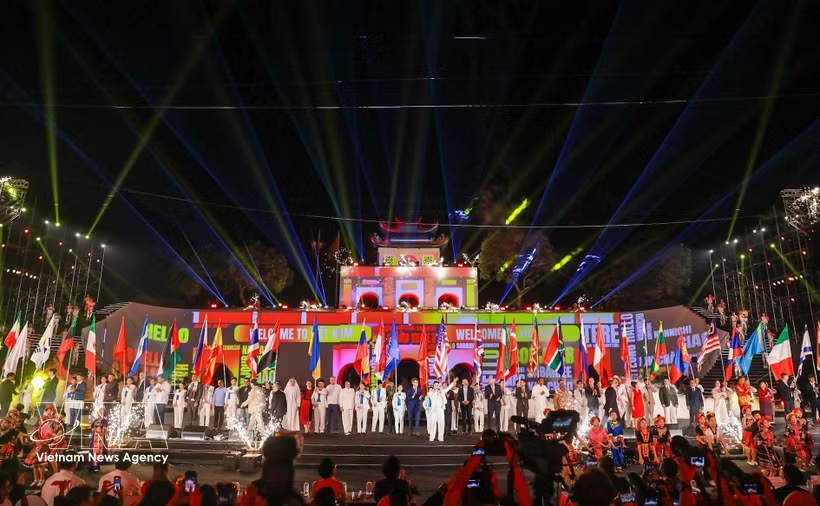
The second Cultures of the World Festival runs from October 1 to 4, featuring the participation of 50 countries and international organisations. (Photo: VNA)

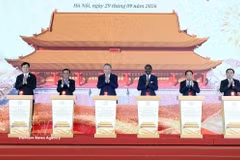
Hanoi (VNA) – The second Cultures of the World Festival in Hanoi 2026 opened on October 1 at the Thang Long Imperial Citadel under the theme “Converging Heritage – Shaping the Future.”

The four-day festival is jointly organised by the Ministry of Culture, Sports and Tourism, the Ministry of Foreign Affairs and the Hanoi People’s Committee.

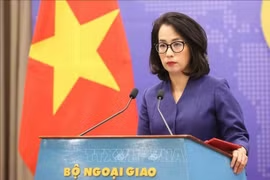
Deputy Prime Minister Pham Thi Thanh Tra attended and delivered remarks at the opening ceremony, which also brought together Minister of Culture, Sports and Tourism Lam Thi Phuong Thanh, Hanoi People’s Committee Chairman Vu Dai Thang, representatives of ministries and central agencies, ambassadors, chargés d’affaires and heads of diplomatic missions, as well as artists, artisans and cultural researchers.

Addressing the event, Tra said the festival is a gathering that connects cultures, spreads the spirit of friendship and creativity, and promotes dialogue for peace and development.

The festival takes on special significance as it is held in the year marking the 50th anniversary of Vietnam’s accession to UNESCO and at the Thang Long Imperial Citadel, a UNESCO World Heritage Site. The site is a symbol of Vietnam’s long history, cultural vitality and aspiration for peace and prosperity, she said.

According to the Deputy PM, heritage represents the memory of each nation and the result of human knowledge, labour and creativity accumulated over thousands of years. Heritage, however, does not belong only to the past. It remains present and serves as an important resource for shaping the future.

Each country and nation has its own heritage, but when brought together, these cultural values enrich the diversity of human civilisation, she noted.

Folk songs, dances, music and traditional performing arts, as well as traditional costumes, cuisine, handicrafts, monuments, landscapes, festivals and folk knowledge, all tell stories about people, cultures, homelands and the aspirations and values that generations seek to pass on to the future.

“Convergence of heritage is therefore a convergence of people, while convergence of cultures is a convergence of shared human values,” the Deputy PM said.

She noted that the world is undergoing rapid changes, with digital technology, artificial intelligence and new forms of communication transforming how people create, experience and share cultural values.

Vietnam views culture as both the spiritual foundation of society and an important goal, driving force and resource for national development, she said. The country is working to build an advanced culture imbued with national identity while actively absorbing the cultural quintessence of humanity and expanding international cultural exchange and cooperation.

vnanet_potal-khai-mac-le-hoi-van-hoa-the-gioi-tai-ha-noi-lan-thu-hai-muon-sac-mau-cung-hoi-tu-9061340.jpg
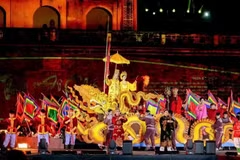
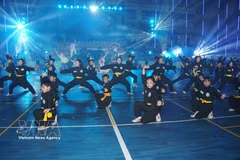
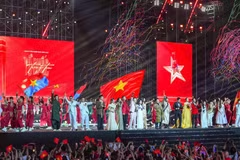
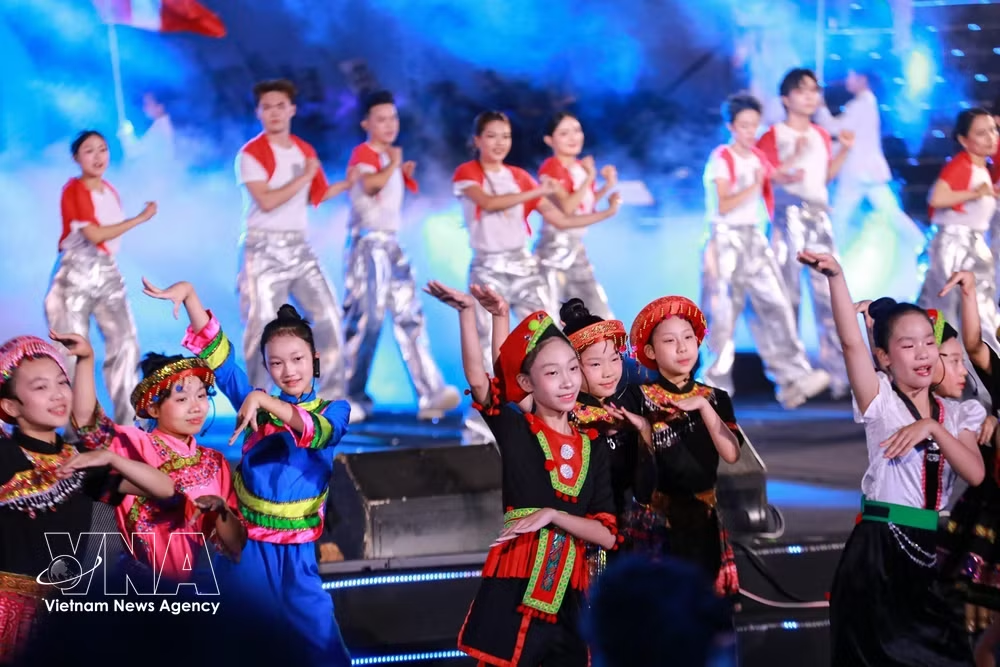
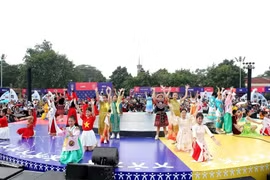
A performance at the opening ceremony of the festival. (Photo: VNA)

She stressed that heritage conservation must go hand in hand with promotion, tradition with creativity, and heritage with contemporary life. Science, technology and AI should also be further applied to digitise, preserve, restore and promote heritage, helping bring authentic cultural values closer to communities, particularly younger generations.

UNESCO World Heritage Centre Director Lazare Eloundou Assomo said there could be no more suitable venue for the festival than the Thang Long Imperial Citadel, whose archaeological layers span more than a millennium and reflect the continuity of political and cultural life.

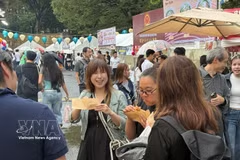
Over the four days, 45 cultural spaces, 35 food stalls, 19 international performing arts troupes, film screenings and fashion shows from around the world will bring new life to the ancient site, he said.

He described the celebration of world cultures at a place representing the enduring creative journey of a civilisation as a powerful statement on the meaning of heritage.

The festival runs from October 1-4, featuring the participation of 50 countries and international organisations. The event aims to promote friendship, mutual understanding and trust among peoples, while highlighting the power of culture to connect people across borders and differences and contribute to a peaceful, humane and sustainable world./.
VNA

See more

A performance at the Thang Long - Hanoi Festival 2025 (Photo of the organising board)

Asia-Pacific dialogue – a showcase of Vietnam-UNESCO cooperation: Official

It also gave countries a platform to hear Vietnam outline its culture and heritage policies and its approach to tying cultural development to sustainable development. Participants discussed Vietnam's contributions to global efforts, including its proposal for an International Decade of Culture for Sustainable Development for 2027-2036.

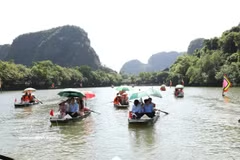
The UNESCO delegation visits the Trang An Landscape Complex by boat. (Photo: VNA)

UNESCO delegation explores Trang An heritage complex in Ninh Binh

The visit provided an opportunity for Ninh Binh to introduce and promote the outstanding landscape, natural, cultural and historical values of the Trang An Landscape Complex, a UNESCO World Cultural and Natural Heritage Site, as well as its people and outstanding universal value.

Vietnamese Ambassador to India Trinh Minh Manh (sixth, left) poses for a photo with designer Nguyen Thi Doan Trang (seventh, left) at the show. (Photo: VNA)

Vietnamese ao dai collection shines at UPITS 2026

Inspired by this enduring beauty, “Sac Viet” blends nature, people and the Vietnamese spirit. Each ao dai is a “moving painting,” featuring carefully selected and subtly arranged motifs symbolising Vietnam's land and skies.

The Phu Tho delegation visits Vietnamese Embassy in Greece. (Photo published by VNA)

Vietnamese tea, cuisine promoted in Greece

Vietnamese Ambassador to Greece Pham Thi Thu Huong highlighted opportunities for cooperation between Phu Tho and Greek localities in areas including cultural heritage preservation and promotion, education, labour, logistics and agricultural products.

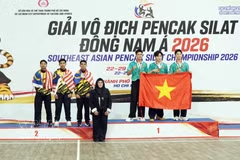
Titih Hayati, head of the Technical Committee of the International Pencak Silat Federation, presents awards to athletes competing in the men’s team performance event at the 2026 Southeast Asian Pencak Silat Championships. (Photo: VNA)

Vietnam top Southeast Asian Pencak Silat Championships

Vietnamese athletes won 20 gold, nine silver and one bronze medal to finish first overall. Malaysia placed second with six gold, 17 silver and three bronze, followed by Singapore with three gold, one silver and six bronze.

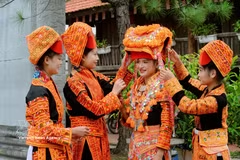
Red Dao girls in Van Son commune, Bac Ninh province, are dressed in traditional attire. (Photo: VNA)

Digital transformation key to preserving, promoting ethnic cultural values

Training local young people in filming, audio recording, digital storytelling, data preservation and responsible use of AI can help build a new generation of cultural custodians. This, in turn, can help transform cultural heritage into a resource for economic development while contributing to the country’s broader development.

Tourism breathes new life into craft villages

Tourism breathes new life into craft villages

More than 5,400 craft villages and villages with craft activities provide a rich and distinctive resource for Vietnam’s tourism sector, especially as interests are shifting from sightseeing and shopping to exploring local lifestyles.However, simply attracting visitors or adding destinations to tours is only a first step. Craft village tourism is sustainable only when local artisans and residents benefit from it, and it breathes new life into the places where the crafts originated.

Political-artistic programme “Fatherland in Our Hearts”, jointly organised by Nhan Dan Newspaper and the Ho Chi Minh City People’s Committee. (Photo: nhandan.vn)

Vietnam eyes building national brands for cultural industries

This is the first time a Party document has set specific quantitative targets for cultural brands and cultural industries. With thousands of tangible and intangible heritage assets and the rich cultural life of 54 ethnic groups, Vietnam has a strong foundation for achieving these goals. However, turning cultural resources into recognised brands requires determination and systematic approaches.