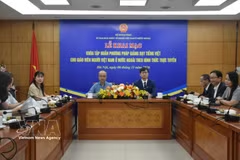
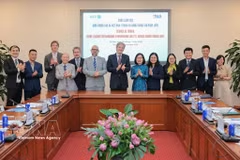
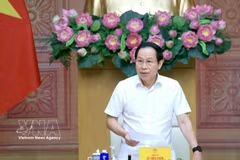
Deputy Prime Minister Vu Duc Dam held a working session on June 24 withrepresentatives of foreign donors and organisations on ensuring foodsafety and hygiene in Vietnam.
According to theMinistry of Health’s Food Safety and Hygiene Department, in recentyears, food safety issue has received special attention by theVietnamese Party, Government and National Assembly.
In early 2012, the Prime Minister approved a National Strategy onFood Safety for 2011-2020 with a vision to 2030. The strategy aims toequip 70 percent of food farmers, processors, businessmen, 80 percent ofmanagers and 79 percent of consumers with knowledge about food safetyand thus adopting corresponding actions by 2015. It also sets the targetthat all localities put in place their food safety management systemand all supermarkets and half of wet markets are monitored in terms offood safety and hygiene by the year.
However,Deputy PM Dam shared with the delegates that at present, 80 percent offood sold at small markets has yet to receive full quarantine, whilemany farmers are lacking knowledge in using fertilizers, pesticides andgrowth stimulants.
Therefore, he stressed theimportance of narrowing the gap in quality between products sold atsupermarkets and markets, controlling the smuggling of pesticides, andgrowth stimulants, and reorganising food production and distributionsystems at markets.
For the long term, Vietnamshould speed up the development of a distribution system in supermarketchains and supply chains of farmers, while for the short term, thecountry should continue installing mobile food testing machines atmarkets, he suggested.
The Deputy PM also askedMinistries of Health, Agriculture and Rural Development, and Industryand Trade to cooperate to improve the efficiency of food safety andhygiene quarantine centres and labs.
Agreeingwith his opinions, representatives of foreign donors and organisationshoped for closer coordination between ministries and sectors to ensurethe quality and implementation progress of ODA projects and programmesrelating to food safety and hygiene.-VNA