Deputy PM urges 1.5-2 percentage point lending rate cuts for businesses, priority sectors

Monetary policy should be managed proactively and flexibly, in close coordination with fiscal policy and other macroeconomic measures, while maintaining the goal of controlling inflation, safeguarding macroeconomic stability and ensuring major economic balances.

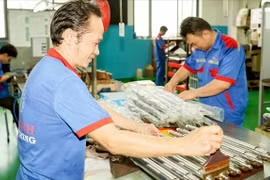
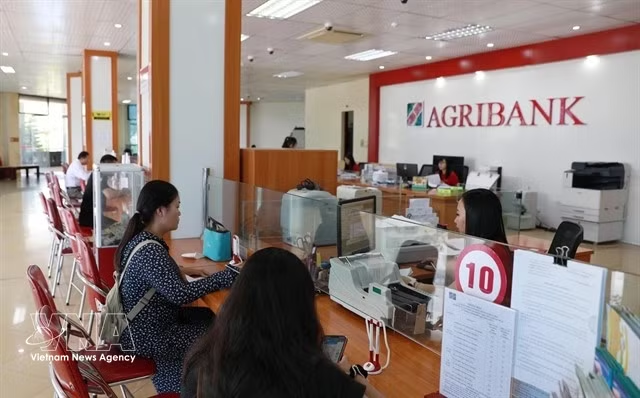
Transactions at Agribank in Lai Chau province. Deputy Prime Minister Nguyen Van Thang has asked banks to cut lending interest rates by 1.5-2 percentage points for production, business and priority sectors. (Photo: VNA)

Hanoi (VNS/VNA) – Deputy Prime Minister Nguyen Van Thang has asked banks to cut lending interest rates by 1.5-2 percentage points for production, business and priority sectors to ease borrowing costs and support economic growth.

Thang made the request at a meeting on monetary policy management for the remainder of 2026 on October 16, following directives from General Secretary of the Communist Party of Vietnam Central Committee and President To Lam and the Party Central Committee’s Conclusion No. 106 issued on October 15.

He acknowledged coordination between the State Bank of Vietnam (SBV) and the Ministry of Finance in implementing monetary and fiscal policies, which had helped control inflation, maintain macroeconomic stability, safeguard the banking system and support growth.

However, Thang said a complicated and unpredictable global environment continued to put pressure on interest rates, the exchange rate and inflation.

Lending rates remained high, increasing capital costs for businesses and households and limiting their access to credit. Bad debts and risks in banking operations also remained a concern.

The Deputy PM called on the SBV to work with relevant agencies to urgently introduce substantive measures to bring down lending rates.

Monetary policy should be managed proactively and flexibly, in close coordination with fiscal policy and other macroeconomic measures, while maintaining the goal of controlling inflation, safeguarding macroeconomic stability and ensuring major economic balances, he said.

The Government aims to promote double-digit economic growth while maintaining financial system safety, he stressed.

The SBV was asked to review and draw lessons from measures taken to stabilise interest rates and lower borrowing costs, and to implement more effective and timely solutions.

Inspections and supervision must also be enhanced to ensure lenders’ compliance with interest-rate regulations and central bank directives, he said. Credit institutions that fail to comply with instructions to stabilise rates and reduce lending costs, or engage in unhealthy interest rate competition, must be strictly dealt with.

Thang also instructed the SBV to direct lenders to expand credit safely and efficiently, prioritising production, business activities and other priority sectors.

The SBV should also provide refinancing at reasonable interest rates to banks participating in social housing lending programmes, while maintaining strict controls over bad debts and safeguarding the banking system.

On asset quality, Thang called for effective and timely measures to resolve existing bad debts, prevent new ones and tighten credit risk management, particularly in sectors with elevated risks, including real estate.

He also urged continued restructuring of credit institutions alongside bad-debt resolution to improve the banking system’s soundness, efficiency, transparency and compliance with the law.

The Government also called for decisive action against informal ownership arrangements, cross-ownership, hidden ownership and practices through which related entities or individuals manipulate or dominate credit institutions. Violations must be strictly handled to prevent risks from accumulating or spreading across the banking system.

Commercial banks should continue to cut operating costs, accelerate digital transformation and improve efficiency to create room for lending rate reductions that benefit businesses and households, he asked./.

VNA
See more

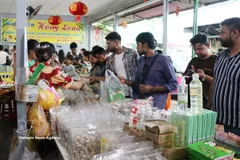
People enjoy tea at the fair. (Photo: VNA)

Northwest tourism fair opens in Lao Cai

Running from October 15 to 21, the fair is part of the expanded Northwest tourism cooperation programme for 2026 and is held in connection with the 2026 Muong Lo Culture and Tourism Festival.

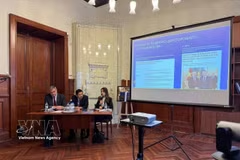
Speakers at the thematic session on economic cooperation at the St. Petersburg Chamber of Commerce and Industry on October 16. (Photo: VNA)

Vietnam-Russia trade at structural turning point: report

The report adopts a practical approach, focusing on how businesses operate rather than relying solely on diplomatic assessments. Its aim is to identify ways to translate the two countries’ political goodwill and longstanding trust into tangible economic cooperation.

An overview of the Vietnam-Cambodia International Commerce & Culture Forum 2026. (Photo: VNA)

Vietnam-Cambodia Int’l Commerce & Culture Forum promotes business ties

Alongside the positive growth in bilateral economic and trade ties, Vietnamese Ambassador to Cambodia Nguyen Minh Vu highlighted regular cultural exchange activities, including culture weeks and days, artistic performances and photo exhibitions, which have helped introduce each country’s culture to the people of the other.

Prime Minister Le Minh Hung (C) witnesses the exchange of the Strategic Alliance Agreement between Petrovietnam and PETRONAS. (Photo: VNA)

Prime Minister backs PETRONAS’ further investment expansion in Vietnam

Prime Minister Le Minh Hung praised PETRONAS and the Vietnam National Industry-Energy Group (Petrovietnam) for maintaining a strong partnership for more than 30 years, with joint efforts supporting Vietnam’s energy security, sustainable development and economic growth, as well as those of the Asian region.

The central province of Nghe An holds an investment promotion conference in Seoul on October 15. (Photo: VNA)

Nghe An seeks stronger tech, clean energy ties with RoK

A Nghe An official affirmed the province's commitment to providing a fair and favourable investment environment, preparing cleared land in the expanded Southeast Nghe An Economic Zone, streamlining administrative procedures, and ensuring clean energy infrastructure for investment projects.

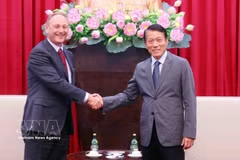
Deputy Minister of Foreign Affairs Nguyen Minh Hang (right) meets with US Deputy Assistant Secretary of Commerce for Asia and Acting Executive Director of SelectUSA Kelly Coldiron in Hanoi on October 15, 2026. (Photo: baoquocte.vn)

Vietnam, US propel economic, trade, investment ties

Vietnam considers the US one of its leading strategic partners and wants to continue advancing the Comprehensive Strategic Partnership in a stable, substantive, and effective way for the benefit of its citizens and enterprises, said Deputy Minister of Foreign Affairs Nguyen Minh Hang.

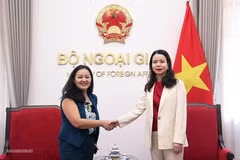
Deputy Foreign Minister Nguyen Minh Hang (R) receives Pamela Phan, former Deputy Assistant Secretary for Asia at the US Department of Commerce, in Hanoi on October 15, 2026. (Photo: baoquocte.vn)

Vietnam, US look to strengthen business, investment ties

Vietnam and the US should further promote business connections and practical cooperation in trade and investment, Deputy Foreign Minister Nguyen Minh Hang told Pamela Phan, former Deputy Assistant Secretary for Asia at the US Department of Commerce, in Hanoi on October 15.

Shoppers at Winmart (Photo: VNA)

National brand programme drives Vietnamese corporate competitiveness

Vietnam’s national brand value reached 462.28 billion USD in 2026, up 45.14% from 2020 and ranking 32nd among 193 countries, according to Brand Finance. The challenge, however, goes beyond climbing the rankings or scaling up. It is turning those gains into lasting competitiveness and getting Vietnamese firms deeper into global value chains.