National brand programme drives Vietnamese corporate competitiveness

Vietnam’s national brand value reached 462.28 billion USD in 2026, up 45.14% from 2020 and ranking 32nd among 193 countries, according to Brand Finance. The challenge, however, goes beyond climbing the rankings or scaling up. It is turning those gains into lasting competitiveness and getting Vietnamese firms deeper into global value chains.

Shoppers at Winmart (Photo: VNA)

​

Hanoi (VNA) - Since its launch in 2008, the Vietnam National Brand Programme has grown from 30 companies with 50 products to 227 with 499 products in 2026.

Companies recognised in the 2026 round generated combined revenue of more than 2.5 quadrillion VND (96.1 billion USD) in 2025, including export revenue above 262 trillion VND, and contributed over 133 trillion VND to the State budget. They provided jobs for more than 760,000 workers and invested nearly 43.6 trillion VND in research and development, up more than 6% from a year earlier.

Vietnam’s national brand value reached 462.28 billion USD in 2026, up 45.14% from 2020 and ranking 32nd among 193 countries, according to Brand Finance. The challenge, however, goes beyond climbing the rankings or scaling up. It is turning those gains into lasting competitiveness and getting Vietnamese firms deeper into global value chains.

To make the programme a more tangible growth driver, support policies need to match companies’ needs to upgrade their capabilities and enter new markets.

Vu Ba Phu, Director of the Vietnam Trade Promotion Agency under the Ministry of Industry and Trade, said the 10th selection round is underway in 2026 as the country follows new Politburo resolutions aimed at meeting its economic goals for 2030 and its vision for 2045. The programme has revised its regulations and selection criteria to fit that agenda.
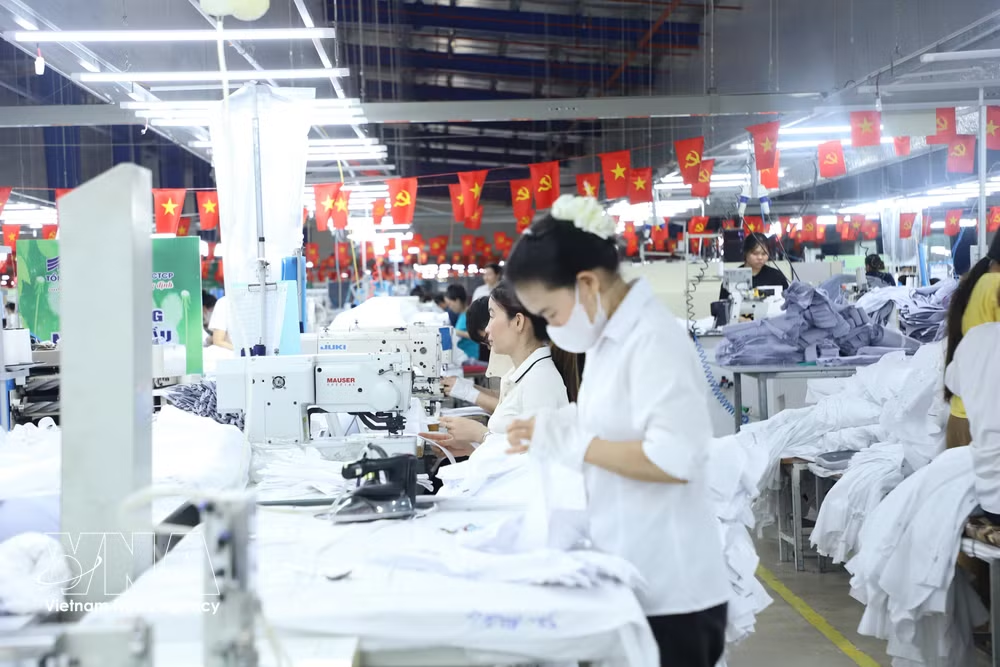
vnanet_potal-khu-kinh-te-vung-ang-truoc-nguong-cua-but-pha-moi-9047034.jpg
Workers at May 10 factory (Photo: VNA)

Innovation now carries more weight among the programme’s three core values of quality, innovation-creativity and pioneering capacity. Its score has been raised to 300 of 1,000 points from 180, underscoring the role of technology and innovation in sharpening competitiveness.

Phu said the programme has raised Vietnamese enterprises’ awareness of brand-building over successive cycles, and the rising value of the national brand has improved competitiveness, drew investment and expanded exports.

He added that linking the programme with initiatives to develop science, technology and innovation will help firms step up research, apply new technologies and commercialise products, improving quality, brand value and competitiveness at home and abroad.

Deputy Minister of Industry and Trade Luong Hoang Thai said the programme will focus on developing the National Brand Development Strategy through 2035, with a vision to 2045, strengthening companies’ brand-building and management capabilities, and helping Vietnamese brands expand overseas.

By spurring innovation, digital transformation and green transition, and by strengthening links to global value chains, the programme aims to raise product value, bolster the standing of Vietnamese firms and shift their edge from manufacturing capacity to value creation, thus burnishing the country’s competitiveness and reputation abroad./.

​

VNA

See more

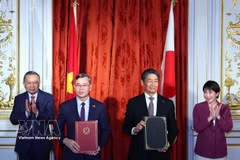
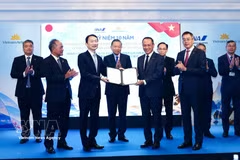
General Secretary and President To Lam and Japanese Prime Minister Takaichi Sanae witness the exchange of cooperation documents in Tokyo on November 9, 2026. (Photo: VNA)

Vietnam, Japan exchange three loan and grant aid documents

The exchange of the three documents on loans and grant aid reaffirms Japan's position as one of Vietnam's leading economic partners and reflects the strong commitment of both governments to translating high-level agreements into concrete cooperation projects, contributing to further strengthening the Vietnam-Japan Comprehensive Strategic Partnership.

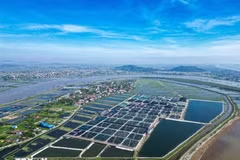
North central region targets marine hub status with 10.5% growth goal

North central region targets marine hub status with 10.5% growth goal

The region’s GRDP rose 8.37% in 2025 and contributed 6.47% to national growth. Drivers are increasingly complementary. Ha Tinh’s industry and construction sector grew 24.25% in the first half; Nghe An’s industrial production index rose 23.02% and exports hit 3.1 billion USD, up 58.4%.

The conference on Vietnam-Cambodia trade connectivity will be held in AN Giang province on November 13, 2026. (Suource: Bnews)

Vietnam, Cambodia to boost trade connectivity

The Vietnam–Cambodia trade connectivity conference is part of a scheme to boost cross-border trade and exports to Cambodia in 2026, aiming to help raise bilateral trade to 20 billion USD by 2030.

Deputy Prime Minister Ho Quoc Dung (right) receives Per Narvinger, President and CEO of Swedish telecommunications equipment maker Ericsson, in Hanoi on November 9. (Photo: VNA)

Vietnam, Sweden step up cooperation in telecom infrastructure, cybersecurity

Vietnam is accelerating institutional reforms, improving its investment and business environment, developing infrastructure and enhancing human resources quality. The Government stands ready to cooperate with leading global corporations investing in sectors of strategic importance to the country's development.

Vice President of the National Assembly Nguyen Thi Thanh speaks at the NA agenda on November 9. (Photo: VNA)

NA approves 2027 central budget allocation plan

The National Assembly (NA) on November 9 adopted a resolution on the allocation of the 2027 central budget, with all 469 deputies present voting in favour. Under the resolution, total central budget revenue in 2027 is estimated at more than 1.7 quadrillion VND (66.62 billion USD), while total expenditure is projected at over 2.3 quadrillion VND.

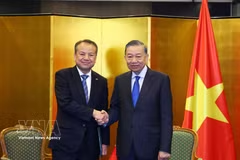
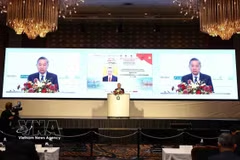
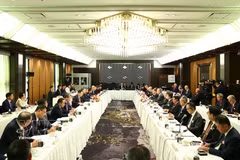
General Secretary of the Communist Party of Vietnam Central Committee and President To Lam attends the Vietnam-Japan Public-Private Forum on Economic, Science and Technology Cooperation in Tokyo on November 9, as part of his official visit to Japan. (Photo: VNA)

Vietnam-Japan relations evolve amid changing economic landscape: Nikkei Asia

Vietnam and Japan are seeking to improve the quality and added value of cooperation. During Party General Secretary and President Lam’s visit, they are expected to promote collaboration in artificial intelligence (AI), small modular reactor (SMR) technology, nuclear power and human resource training, Nikkei Asia reported.

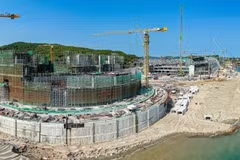
The APEC Convention Centre and related facilities are taking shape on Phu Quoc special zone, An Giang province. (Photo published by VNA)

Phu Quoc special zone envisioned as new growth engine

For 2026–2030, the Phu Quoc special economic zone will focus on high-value-added services, marine ecotourism and the digital economy. Total investment across society is expected to surpass 195 trillion VND.

Production line at Hana Micron Vina Co., Ltd in Bac Ninh city (Photo: VNA)

Processing and manufacturing continue to drive industrial growth

The sector’s industrial production index (IIP) rose 13% year on year, contributing 10.2 percentage points to overall industrial growth. Mining increased 7.1%, adding 1.1 percentage points, while electricity generation and distribution grew 10.6%, contributing one percentage point. Water supply, waste and wastewater management and treatment expanded 9.2%.

Vietnamese workers at a Japanese oyster processing factory (Photo: VNA)

Vietnam-Japan trade machine has room to run

Economic, trade and investment cooperation remains the core pillar and the main engine of comprehensive, sustainable bilateral ties. General Secretary of the Communist Party of Vietnam Central Committee and President To Lam’s official visit to Japan is therefore a key moment to reinforce political trust, deepen the Comprehensive Strategic Partnership and open new cooperation opportunities in the next growth phase.