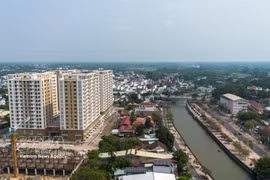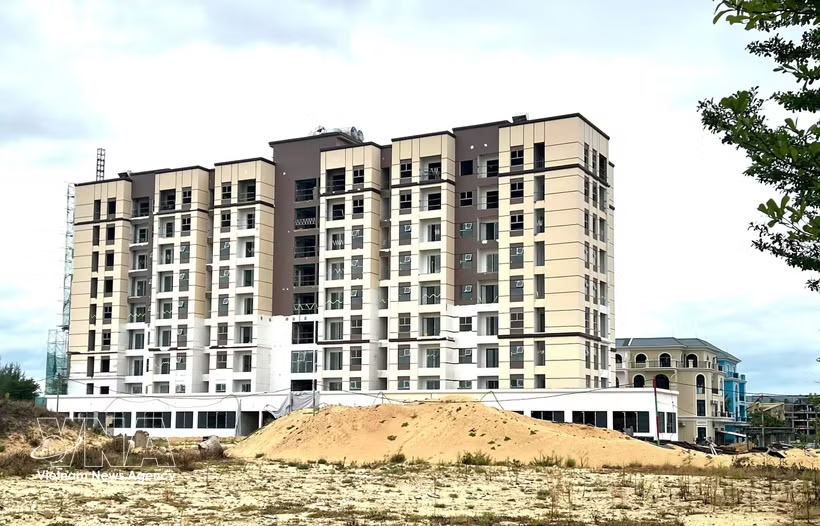
Hanoi (VNA) – Vietnam completed 170 social and rental housing projects totalling 46,497 units in the first nine months of the year, Deputy Director of the Ministry of Construction’s Department of Housing and Real Estate Market Management Ha Quang Hung told the ministry’s third-quarter press briefing in Hanoi on October 15.
The tally is 48% of the annual target and comprises 38,183 units for sale or rent-to-own and 8,314 rental units.
Construction started on 128 projects with 183,293 units over the period, including 140,492 social housing and 42,801 rental units. The ministry expects 87,601 units to be finished by the end of 2026, of which 69,552 are for sale or rent-to-own and 18,049 are rentals.
Hung said rental housing should be treated as a long-term strategic segment serving a large number of citizens, as directed by Party, State and Government leaders.
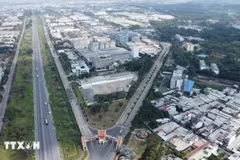
Rental apartments are being prioritised in major urban areas, industrial parks, economic zones, key economic areas and important economic corridors. Housing development should be aligned with land-use planning, transport networks, industrial parks and labour markets, especially in transit-oriented development (TOD) areas.
The policy aims to widen housing options, particularly for those who can’t afford to buy, and help stabilise the property market. The State will play an enabling and regulatory role, ensuring reasonable profits for developers while keeping rents affordable.
The ministry is studying how to write these directions into housing policy and legislation. Under the proposed framework, urban and rural plans will have to set aside land for rental housing in special-class, Grade I and Grade II urban wards, TOD areas, and sites near industrial parks, export processing zones, universities and colleges.
The provincial authorities will be responsible for pooling resources for compensation, support and resettlement, and creating clean land for projects. Proposed incentives include exemptions from land-use fees and land rent within project boundaries, tax breaks, preferential loans and support for technical infrastructure connectivity.
Developers could devote part of a project’s area to commercial housing or service and commercial facilities to supplement revenue, subject to legal conditions.
Vietnam has 947 social housing projects in the pipeline, totalling 910,933 units and an estimated 841.338 trillion VND (32.35 billion USD) in investment, according to the ministry.
Of those, 363 projects with 216,626 units are complete, 293 projects with 363,065 units have broken ground, and 291 projects with 331,242 units have received in-principle approval for investment.
Units in projects that are complete, under construction or approved in principle equal 91% of the goal of building at least 1 million social housing units.
To speed up delivery, the ministry asked localities to write social and rental housing targets into their socio-economic development plans and set specific roadmaps covering projects, timelines and resources./.