Discovering Vietnam’s five best villages listed by UN Tourism

Vietnam has quietly amassed five villages on the United Nations World Tourism Organisation (UN Tourism)’s “Best Tourism Villages” list

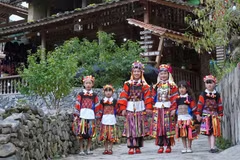
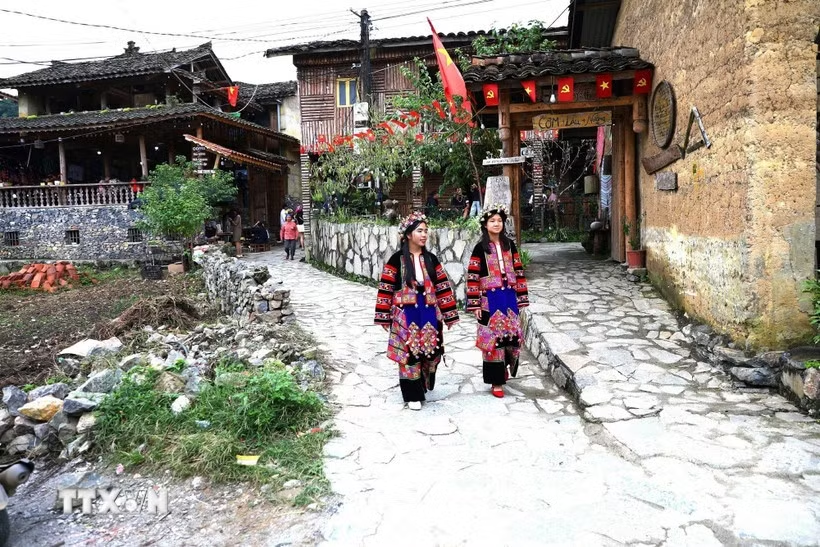
In Lo Lo Chai community-based tourism village (Photo: VNA)

Hanoi (VNA) - Vietnam has quietly amassed five villages on the United Nations World Tourism Organisation (UN Tourism)’s “Best Tourism Villages” list, including Tan Hoa in Quang Tri, Thai Hai in Thai Nguyen, Tra Que Vegetable Village in Da Nang, Lo Lo Chai in Tuyen Quang, and Quynh Son Community Tourism Village in Lang Son.

Thai Hai village (Thai Nguyen)

Back in December 2022, UN Tourism selected Thai Hai ethnic stilt-house conservation area as one of 32 global Best Tourism Villages, marking Vietnam’s first honoree that year.

Nestled among verdant hills in Thai Nguyen province, Thai Hai serves as both a cultural preservation hub for the Tay ethnic group and a tourism destination. The site maintains more than 30 traditional wooden stilt houses and provides immersive experiences in weaving, pottery and local cuisine, complemented by wellness offerings like outdoor meditation and yoga.

Tan Hoa village (Quang Tri)

UN Tourism recognised Tan Hoa in October 2023 for its sustainable tourism practices and effective use of local natural and cultural assets.

Formerly vulnerable to seasonal flooding, Tan Hoa pioneered floating houses following the devastating 2010 floods. Today, over 600 donation-funded floating residences enable year-round habitation and economic continuity during high-water periods.

The village also serves as the entry point to the Tu Lan cave system, a premier adventure-tourism asset. Community-managed initiatives safeguard the environment while showcasing local traditions through festivals and family-style dining.

Tra Que vegetable village (Da Nang)

In November 2024, Tra Que earned Vietnam’s slot on the UN Tourism’s Best Tourism Villages list.

Dating to the 16th century and situated three km from Hoi An, Tra Que specialises in organic vegetable farming, a practice designated as National Intangible Cultural Heritage in 2022.

Today, 202 households cultivate 18 ha of land, offering visitors hands-on agricultural experiences, cooking classes and cycling tours.

Historic landmarks include the Cham Stone Well, Tho Than Shrine, Ngu Hanh Shrine and Nguyen Van Dien’s Tomb, alongside rituals like Cau Bong and enduring customs, beliefs and culinary practices.

Lo Lo Chai village (Tuyen Quang)

In October 2025, UN Tourism awarded Lo Lo Chai for exemplary preservation of the Lo Lo ethnic culture.

Situated in Lung Cu commune, the village features distinctive earthen-walled houses topped with yin-yang tiles, alongside handwoven garments and communal festivals. In recent years, locals have expanded homestay offerings without altering traditional architecture.

Tourists join everyday pursuits such as cooking, weaving and folk dances. The influx has revitalised customs and boosted household earnings.

Quynh Son community tourism village (Lang Son)

Recognised alongside Lo Lo Chai in 2025, Quynh Son is embedded within the Bac Son Uprising National Special Relic Site and UNESCO’s Lang Son Global Geopark.

The village upholds core Tay ethnic elements, including stilt houses, “Then” singing rituals and indigenous instruments. Community tourism encompasses farm work, textile weaving, cooking sessions and cultural events.

This approach fosters revenue growth while conserving ancestral knowledge and scenic integrity, making Quynh Son a benchmark for viable community-based tourism./.

VNA

See more

A representative of Anex Tour Vietnam presents a conical hat to the first passengers arriving in Da Nang from Vladivostok. (Photo: VNA)

Da Nang welcomes first flight from Vladivostok

According to the plan, the programme will run from April 16 to October 23, connecting eight cities across Russia, the CIS, and Belarus with Da Nang. The total number of visitors is expected to reach approximately 25,500, with a maximum frequency of 36 flights per month, equivalent to around 4,800 passengers monthly.

Visitors explore and experience the cultural space of Lo Lo Chai village in Lung Cu commune, Tuyen Quang province. (Photo: qdnd.vn)

Administrative expansion unlocks new momentum for tourism development

Nguyen Thi Hoai, Deputy Director of the Department of Culture, Sports and Tourism of Tuyen Quang, said the expansion of administrative boundaries has opened up new development space for the province, with key tourism products including cultural-historical tourism, ethnic cultural experiences, community-based tourism linked to scenic sites, spiritual tourism, and other distinctive experiential offerings.

At Thung Nham ecological tourism site in Ninh Binh province. (Photo: VNA)

Vietnam’s tourism defies fuel price shock with record Q1 “hat-trick”

According to data released by the National Statistics Office, foreign arrivals in March reached nearly 2.1 million, up 1.3% year-on-year. In total, Vietnam welcomed an estimated 6.76 million foreign tourists in the first quarter, a more than 12% jump from the same period in 2025 and the highest Q1 figure ever recorded.

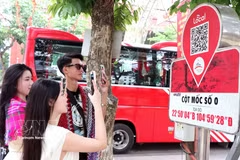
Visitors scan QR codes at Km0 Ha Giang to access tourism information. (Photo: VNA)

Technology powers tourism growth in mountainous province

Last year, Tuyen Quang welcomed over 3.9 million visitors, and is aiming to attract around 4.1 million arrivals, including around 600,000 foreigners, this year. Tourism continues to be identified as a key economic sector, with development oriented toward sustainability, green growth, and enhanced competitiveness through digitalisation.

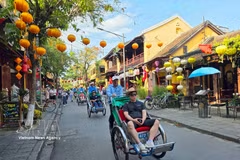
Tourists enjoy a rickshaw tour of Hoi An Ancient Town, Da Nang city. (Photo: VNA)

ITE HCMC 2026 to promote Vietnam’s tourism on global map

With its large scale, the ITE HCMC 2026 aims to promote tourism cooperation between Vietnam and priority markets such as Northeast Asia, Western Europe, North America, Southeast Asia, and Oceania while also boosting visitor arrivals from the Indian market

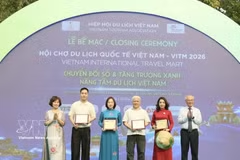
The organisers of VITM 2026 honour sponsors. ( Photo: VNA)

VITM 2026 boosts tourism demand ahead of peak season

According to the organisers, around 4,500 representatives from Vietnamese and international tourism enterprises attended the event, generating more than 25,000 business meetings and partnership exchanges. Approximately 15,000 discounted tours and travel products were offered to visitors.

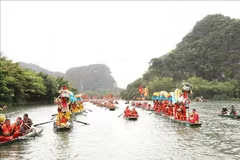
Traditional dragon procession held on the river in Ninh Binh. (Photo: VNA)

Cultural heritage drives sustainable tourism growth in Ninh Binh

In the first two months of 2026, Ninh Binh welcomed over 5.4 million visitors, up 9.9% year-on-year, generating nearly 5.84 trillion VND (221 million USD) in tourism revenue, up 15.9%. During the 2026 Lunar New Year holiday alone, the province received 2.38 million visitors, an 81.4% increase from the previous year, ranking second nationwide.

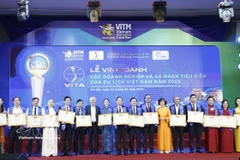
Outstanding individuals and firms honoured at VITM 2026 (Photo: VNA)

Outstanding individuals, firms honoured at Vietnam International Travel Mart 2026

In 2025, Vietnam’s tourism sector recorded its highest-ever number of visitors, welcoming more than 21.5 million international arrivals, up more than 20% from 2024, and serving over 135.5 million domestic travellers. Tourism revenue also surpassed 1 quadrillion VND (nearly 38 billion USD). The sector has become a bright spot of the economy, with Vietnam ranking among the world’s fastest-growing tourism destinations.

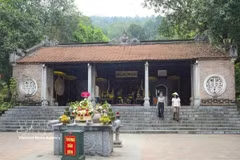
The Ba Trieu Temple in Thanh Hoa province (Photo: VNA)

Thanh Hoa taps digital transformation to boost heritage tourism

With 28 nationally-recognised intangible cultural heritage elements, Thanh Hoa province has prioritised integrating conservation with tourism development. Digital transformation, in particular, is seen as a crucial bridge connecting tradition with innovation, helping heritage sites become more accessible and engaging.

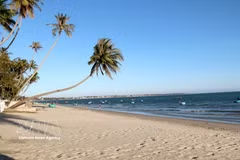
Pristine white-sand beach on Cu Lao Cham Island, Da Nang city, is a magnet for visitors. (Photo: VNA)

Vietnam – a safe destination amid global uncertainties

Despite global tourism headwinds linked to geopolitical conflicts, transport disruptions and surging travel expenses, Vietnam’s tourism sector has sustained strong growth, underscoring the destination’s resilience and rising international profile.